Live data from Hacker News

108B Pixel Scan of Johannes Vermeer's Girl with a Pearl Earring

hirox-europe.com

121–130 of 144 posts

Re: 108B Pixel Scan of Johannes Vermeer's Girl with a Pearl Earring

#121
post #54

When you zoom in on the cracks, you can see the bevel on the edge of the crack. That’s incredible. In many places on the edges of the cracks in the dark background you can see tinges of blue or pink color. Is that from the lighting, or is the color actually there, if it is there, anyone have an idea why?

Also at many places the cracks seems to be overpainted, filled in. I guess that's from the restorations...

I just looked it up and there is a picture from an analysis where they are showing its possible state before the restoration:

https://media.springernature.com/lw685/springer-static/image...
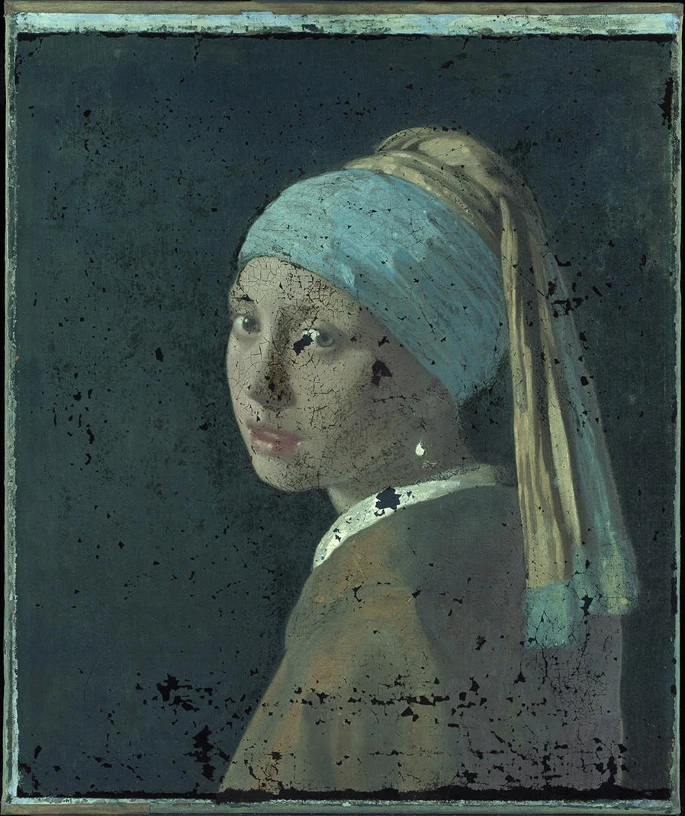
"In UV fluorescence, the natural resin varnish layer fluoresces greenish, and areas retouched in 1994 can be distinguished from the original paint as they appear darker"

The full paper: https://www.nature.com/articles/s40494-019-0307-5

Re: 108B Pixel Scan of Johannes Vermeer's Girl with a Pearl Earring

#122

Earlier quoted context omitted.

Side-rant: I just watched a clip[0] and I have to say something about the misrepresentation of the Hockney-Falco thesis[1] in it. And when I say I have to I really mean that: I'm Dutch, tried studying physics, dropped out, switched to studying art, specifically photography (even built my own camera at one point), then in the first year of art school was introduced to the Hockney-Falco thesis, then went to the Interna…

This does make me wonder what kinds of secrets can and can't be kept; on the face of it, that a critical bit of insider information would be kept for oral transmission at particular times (something like a mystery cult) leads me to think that keeping such a secret is at least possible. At the same time, people love gossip. Of course, the only secrets we know from the past were by definition not exactly well-kept.

They'd also have to paint without anyone seeing them paint. The fact that Vermeer stood out for being so secretive about his process says something here. Even a no-lens camera obscura would be pretty hard to hide given that it would require to be painting in a darkened room next to the person being painted.

But your question is an interesting one, for sure. Revealed secrets come in different flavors - fully known ones, but also "known unknown" types of secrets, like the exact "recipes" a painter might have used for their paints being a mystery. However, when it comes to "unknown unknowns" hiddeo secrets I think it's very hard to keep those when dealing with more than a handful of individuals.

Re: 108B Pixel Scan of Johannes Vermeer's Girl with a Pearl Earring

#123

Earlier quoted context omitted.

I agree that Tim definitely comes off as a bit of a jerk. However... > First, if his art is so great, then why is it not displayed all over the place? He has a few alleged experts giving praise without criticism, and in the end, it is on the wall in his bedroom. Surely, if the art were that easy to recreate, galleries would be demanding his piece? I could be wrong but I don't think there's much demand for replicas of…

I thought the point of the movie was to claim that Vermeer was nothing special, and Tim's effort to recreate the painting was supposed to prove that. I think the galleries would disagree with that point, otherwise they would not care whether Vermeer actually painted them. And yes, both of my points are speculation, fueled by an immense dislike for the movie.

If the claims are true then Vermeer is absolutely exceptional, just in a different manner than is usually considered.

All painters must grapple with the technical nature of paint itself and its manipulation. Choice of type of paint, canvas, application, &c. is paramount. Rothko’s work, for instance, is only effective because he found a novel way to apply paint that lends his paintings a remarkable, nigh eerie depth of color. Spending roughly half an hour just staring at the Seagram murals in the “Rothko Room” at the Tate Modern is one of my all-time favorite experiences.

Re: 108B Pixel Scan of Johannes Vermeer's Girl with a Pearl Earring

#124
Paintings are not photographs. Paintings are not two-dimensional images. They are 3d sculptures that change based on light causing a million little shadows. Similarly, the paint has transparency and depth. A trillion pixels wouldn't be enough to convey the experience of actually being in the same room with such a painting.

Re: 108B Pixel Scan of Johannes Vermeer's Girl with a Pearl Earring

#125

Earlier quoted context omitted.

The microscope used for this is mind blowing. Falls squarely into the list of things I want but do not need.

After watching the video I was trying to find out just how much one of those microscopes cost. Couldn’t find a price anywhere so I’m assuming it’s far out of my budget. But this kind of video is probably the greatest kind of ad there is, just genuinely showing how cool something is. Don’t have a use for it either though, but I would love to have one anyways.

Seems like a fun DIY project. Take an off the shelf digital microscope and attach motors!

Re: 108B Pixel Scan of Johannes Vermeer's Girl with a Pearl Earring

#126

Earlier quoted context omitted.

Was it the same approach? The 3D relief has artifacts akin to ones produced by heightmaps

Click the "3D" button on the bottom-center toolbar to see the 3D scan artifact.

It's has 5x exaggerated height by default, so maybe that's what makes it look wonky. Looks way better by 1x.

If you really want to capture the full visual information of a painting, you'd need full PBR-style data — reflective, refractive, subsurface properties — essentially the response of the surface from any viewing angle in the hemisphere, lit from at least a few fixed directions (like in a museum light setup). Even limited to the visible spectrum, this would massively increase the amount of data needed to represent the image accurately.

The 2019 scan apparently deliberately removed reflections, even though they're an essential part of the artist's intended expression.

Are there models that simulate the actual physical properties of paintings — under artificial lighting, viewed from arbitrary angles? Seems like a worthwhile direction for preserving artworks beyond their flat 2D captures. It could also enable virtually accurate displays of art for single observers using head-tracked screens or VR.

Might also be a promising use case for NERFs or 3D Gaussian Splatting.

Re: 108B Pixel Scan of Johannes Vermeer's Girl with a Pearl Earring

#127

Paintings are not photographs. Paintings are not two-dimensional images. They are 3d sculptures that change based on light causing a million little shadows. Similarly, the paint has transparency and depth. A trillion pixels wouldn't be enough to convey the experience of actually being in the same room with such a painting.

[deleted]

Re: 108B Pixel Scan of Johannes Vermeer's Girl with a Pearl Earring

#128

Earlier quoted context omitted.

I thought the point of the movie was to claim that Vermeer was nothing special, and Tim's effort to recreate the painting was supposed to prove that. I think the galleries would disagree with that point, otherwise they would not care whether Vermeer actually painted them. And yes, both of my points are speculation, fueled by an immense dislike for the movie.

If the claims are true then Vermeer is absolutely exceptional, just in a different manner than is usually considered. All painters must grapple with the technical nature of paint itself and its manipulation. Choice of type of paint, canvas, application, &c. is paramount. Rothko’s work, for instance, is only effective because he found a novel way to apply paint that lends his paintings a remarkable, nigh eerie depth o…

There have been posts about reproducing art and I always thinking maybe I could make a mini-Rothko room in spare room.

Re: 108B Pixel Scan of Johannes Vermeer's Girl with a Pearl Earring

#129
post #26

Earlier quoted context omitted.

If you get a chance to see some of the impressionists in person, they’re kind of mind blowing for exactly the same reason - you’re looking at a scene of a ship in a storm and seeing all kinds of nuance, and then you get closer and realize it’s all your brain filling in the blanks. From a literary angle - two books I’ve read that are absolute master classes in this are Italio Calvino’s “Invisible Cities” and “This Is…

I read a lot of sci-fi and because it's come up in recommendations I've tried two or three times to read that book, "This Is How You Lose the Time War". The popularity of that book along with stuff like N.K. Jemisin winning "Best SciFi book" of the year 3 years in a row prove more than ever that the vast majority of people simply don't have taste in the sense they can not decide if they actually like something or not…

Try to learn to be less self-centered. Something isn’t objectively bad because you don’t like it. People aren’t tricked into liking something just because you don’t like it. People’s tastes vary and different people like different writing styles. Try something like “I think the books are very poorly written and I just cannot understand how they continue to be so popular. Seriously, what is the appeal?” Not only are you presenting your viewpoint, not as some arbiter of truth, but you are inviting discussion and an opportunity to learn something you don’t currently know i.e. what people enjoy about those books that makes them popular.
Post reply on HN