Live data from Hacker News

Caltrain's new electric trains

fastcompany.com

121–130 of 140 posts

Re: Caltrain's new electric trains

#121
post #84

Being from the EU for me all trains are electric (except many in Germany only) so I do not feel any special excitement but observe a thing: the idea of all wagon individually powered is ancient, very ancient, like monorails. Both ideas never get spread simply because they are too expensive instead of cheap, in practice. Electric motors are not expensive as diesel one, they are much more compact etc etc etc but are st…

> the idea of all wagon individually powered is ancient, very ancient, like monorails. Both ideas never get spread simply because they are too expensive instead of cheap, in practice. > it sound extra added complexity for little to no return What on earth are you going on about? The vast majority of all current and new passenger trains in the EU are multiple units with no power car, because they are pretty much bette…

Maybe it's a translation issue: I simply say most trains in the world are not self-propelled wagons but one ore two with motors and the others pulled/pushed by them. And no, in the EU most trains have a single or two locomotive, only metros have SOME all powered trains.

> Passengers want to get where they are going quickly. No train accelerates at a speed which causes discomfort to passengers.

Maybe you haven't used Milan's red lines where accelerations are enough to catapult anyone standing distracted at every start or stop. Remember that sometimes trains are crowded and nowadays it normal to have toilets always open because trains collect anything instead of freely discharging in nature, since more than two decades, so it's normal to have people standing while in start/stop phases.

Re: Caltrain's new electric trains

#122
post #84

Being from the EU for me all trains are electric (except many in Germany only) so I do not feel any special excitement but observe a thing: the idea of all wagon individually powered is ancient, very ancient, like monorails. Both ideas never get spread simply because they are too expensive instead of cheap, in practice. Electric motors are not expensive as diesel one, they are much more compact etc etc etc but are st…

>the idea of all wagon individually powered is ancient, very ancient, like monorails. Both ideas never get spread simply because they are too expensive instead of cheap, in practice. >Meanwhile a larger electric locomotive it's still fast (for instance France TGV, Japan Shinkansen etc) What are you talking about? The shinkansen doesn't have any locomotives: all the cars are powered. >all other countries tend to scale…

> The shinkansen doesn't have any locomotives: all the cars are powered.

Maybe it's a translation issue: for locomotive I mean a both a dedicated wagon with no passengers and a single or two wagons with motors and passengers while all the others have no motors are just pushed/pulled by the "locomotive".

> Japan is constantly scaling up their train service.

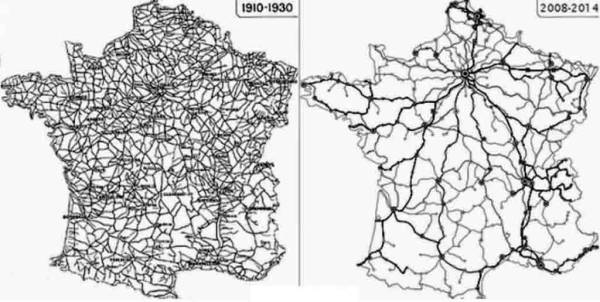
Japan is not Tokyo, Osaka alone, it's much vast than that and economically it's passengers rails get MUCH from the State to be sustained. The issues with passengers is that you need to move them everywhere at every time, and a country is not few large (and unsustainable) cities sucking the entire country resources just to stand. You might have specific paths at specific times running at full/nearly full/overfull capacity, but we have 24h/day, 365 day/year. Or a system can satisfy 99% of the people needs or it's wasted resources, that's why https://www.theguardian.com/world/2023/sep/19/european-gover... and anyway take a look at http://carfree.fr/img/2015/06/sncf.jpg as a good dimension. I bet the situation in Japan it's not much different in that historical perspective.

Consider a thing: having cars, buses, metro, trains means under-utilizing all, it's very expensive. Having a single tool that scale means efficiency. That's why in the past we have decided the "convergence toward IP" even if IP it's not the cheaper signaling protocol, not the simplest, the point is that we need it anyway, so for scaling it's better doing next-to-anything with it. For similar reasons we choose a convergence to electricity because we need it anyway so it's logic to try using it for all. Despite all the claims and the so far little tangible progress the transportation future is by air, because not needed to maintain large and fragile and hyper-expensive to evolve ground infra it's much cheaper than the energy we still need to flight especially with chopper-alike devices (like drones).

Re: Caltrain's new electric trains

#123
post #121

Earlier quoted context omitted.

> the idea of all wagon individually powered is ancient, very ancient, like monorails. Both ideas never get spread simply because they are too expensive instead of cheap, in practice. > it sound extra added complexity for little to no return What on earth are you going on about? The vast majority of all current and new passenger trains in the EU are multiple units with no power car, because they are pretty much bette…

Maybe it's a translation issue: I simply say most trains in the world are not self-propelled wagons but one ore two with motors and the others pulled/pushed by them. And no, in the EU most trains have a single or two locomotive, only metros have SOME all powered trains. > Passengers want to get where they are going quickly. No train accelerates at a speed which causes discomfort to passengers. Maybe you haven't used…

That's just not true. The most exported high speed train is the Siemens Velaro which has motors along the whole train. And multiple units are very common in regional and suburban trains, S Bahn style services.

Re: Caltrain's new electric trains

#124
post #122

Earlier quoted context omitted.

>the idea of all wagon individually powered is ancient, very ancient, like monorails. Both ideas never get spread simply because they are too expensive instead of cheap, in practice. >Meanwhile a larger electric locomotive it's still fast (for instance France TGV, Japan Shinkansen etc) What are you talking about? The shinkansen doesn't have any locomotives: all the cars are powered. >all other countries tend to scale…

> The shinkansen doesn't have any locomotives: all the cars are powered. Maybe it's a translation issue: for locomotive I mean a both a dedicated wagon with no passengers and a single or two wagons with motors and passengers while all the others have no motors are just pushed/pulled by the "locomotive". > Japan is constantly scaling up their train service. Japan is not Tokyo, Osaka alone, it's much vast than that and…

>Maybe it's a translation issue: for locomotive I mean a both a dedicated wagon with no passengers and a single or two wagons with motors and passengers while all the others have no motors are just pushed/pulled by the "locomotive".

That's exactly what a locomotive is. The shinkansen trains don't have them. All the cars have motors and propel themselves.

>The issues with passengers is that you need to move them everywhere at every time, and a country is not few large (and unsustainable) cities sucking the entire country resources just to stand.

What are you talking about? Cities are very sustainable, that's why humans have been building them and living in them for thousands of years now. Cities are the engines of any modern economy. And no, you don't need to move passengers 24x7; most people sleep at late hours so you can shut things down at those times and let the few people who need to travel use other means.

>Consider a thing: having cars, buses, metro, trains means under-utilizing all

What are you talking about? Trains and buses here in Japan are not under-utilized at all. Cars are, but that's a problem everywhere and one of many reasons people shouldn't use them so much.

>the transportation future is by air

No, it really isn't, thanks to basic physics. Maybe if someone invents a low-energy anti-gravity device.

Anyway, WTF is your point with all this? You just seem to be rambling with no point.

Re: Caltrain's new electric trains

#125
post #122

Earlier quoted context omitted.

> The shinkansen doesn't have any locomotives: all the cars are powered. Maybe it's a translation issue: for locomotive I mean a both a dedicated wagon with no passengers and a single or two wagons with motors and passengers while all the others have no motors are just pushed/pulled by the "locomotive". > Japan is constantly scaling up their train service. Japan is not Tokyo, Osaka alone, it's much vast than that and…

>Maybe it's a translation issue: for locomotive I mean a both a dedicated wagon with no passengers and a single or two wagons with motors and passengers while all the others have no motors are just pushed/pulled by the "locomotive". That's exactly what a locomotive is. The shinkansen trains don't have them. All the cars have motors and propel themselves. >The issues with passengers is that you need to move them every…

My point is simple: in a future of resource scarcity due to overpopulation, needed mass relocations and supply chains reorganizations due to climate changes there is already and there will be no room for cities and trains. What's there will remain of course for longer, becoming a bit at a time a receptacles of poor and desperate who do not see nothing outside their bar-less prisons, a thing we can already witness in vast part of the world.

Specifically:

> That's exactly what a locomotive is. The shinkansen trains don't have them. All the cars have motors and propel themselves.

Ok, shinkansen have self-propelled wagons, I do not know for sure but TGV definitively not and I'm pretty sure most trains in Japan are not self-propelled for all wagons, as in the EU.

> Cities are very sustainable, that's why humans have been building them and living in them for thousands of years now.

Things changes, are have always changed. We have had urbanization and deurbanization cycles but what's different was the tech, now we have TLCs, IT, fast logistic a thing we haven't had in the known past. Meanwhile we are more and more, too much for high-resource intensive big stuff like cities.

> Cities are the engines of any modern economy.

Yes, but less and less. With the first globalization factories pull out of rich cities to go to cheap countries, with remote works there is no need for offices and as a result there is only a kind of unsustainable economics in cities: service industry to humans that are poorer and poorer. Cities are need by modern financial capitalism because you do not want self-driving taxis, uber, just eat and so on outside the city, but such form of economical and social development is at the end, being oppressive and unsustainable, consuming way too much resources for the planet.

> And no, you don't need to move passengers 24x7; most people sleep at late hours so you can shut things down at those times and let the few people who need to travel use other means.

That's what happen today and that's one of the reason of cities inefficiencies. BTW just imaging how ABSURD and inefficient is in modern times having big buildings which demand big infra around to use them for less than 12h/day commuting between them just to consume services and being exposed to physical ads in various forms.

> Trains and buses here in Japan are not under-utilized at all. Cars are, but that's a problem everywhere and one of many reasons people shouldn't use them so much.

To be tied to someone else service, right? So enslaved by conformism and other services will and design. A notorious tract of any dictatorship notoriously ending in deep sufferance and disruption. Cars are needed because collective transportation means can't substitute them, BUT, cars can substitute collective transportation means, that's why a SANE economy choose to ditch other transportation means.

> No, it really isn't, thanks to basic physics.

That's not what WEF say and not the path we really took mostly silently preoccupied by people reaction not by technical feasibility https://www.easa.europa.eu/sites/default/files/dfu/uam-full-... and if you really think despite the name it's clear that there is nothing "urban" in density and tall buildings terms for such mobility, if you go further you'll notice there is no possible green new deal future for dense area because we must re-made them from scratch a thing possible with big issues for a single building or a small area but not more and you might know that all future city projects, like Neom, Arkadag, Innopolis, Telosa, Prospera, are failed as the original Fordlandia because their model in untenable.

For Japan: do you remember the Shinkansen blocked in a plane fully exposed to the tsunami due to it's central command model? Do you remember Tokyo emergency coordination failed due again to a central design? Japan is in deep trouble as we are, because of the city-centric development, it's about time to try a totally different model possibly before the WWIII witch we will loose anyway.
Re: Caltrain's new electric trains

#126
post #118
post #86

Earlier quoted context omitted.

> ... as bad or worse than what the Eurostar has now I was just on a Eurostar train from Antwerp to Paris last month (connecting from a local train from Boom), the week before the olympics, even, and security was nonexistent. Didn't even have to go through a metal detector, just walked through the fare gates and boarded. I guess maybe stations are inconsistent with their security level? What did you have to go throug…

I believe security checks on Eurostar only happen when crossing the Channel Tunnel (leaving from St. Pancras or Gare du Nord).

Until last year, only the London services were branded as Eurostar, whereas Paris Brussels/Amsterdam/Cologne was known as Thalys. Thalys was acquired by Eurostar a few years back and evidently they wanted to unify their brands now, though.

Re: Caltrain's new electric trains

#127
post #88

Earlier quoted context omitted.

Between Amsterdam and Paris you are within the Schengen zone. UK to Europe will have border control, passports, etc.

Border control, sure, but we're talking about security. And GGP was talking about traveling around, and seemed to go on multiple trains, presumably several that were not crossing a controlled border. But re: UK mainland I guess it shouldn't be surprising that there's more security for the Chunnel crossing. That feels like it would be a much more likely terrorist target than a random HSR route on land.

Paris Brussels/Amsterdam/Cologne used to be branded as Thalys and Eurostar used to refer only to the London Paris/Brussels/Amsterdam services.

A few years back Thalys merged with Eurostar and then last year they started rebranding the former Thalys services as Eurostar, too, which probably explains the confusion.

Only the former Eurostar services (nowadays "Eurostar Blue") have the security theatre on account of the Channel Tunnel plus UK being non-Schengen, whereas the former Thalys services ("Eurostar Red") are regular train services just like in the rest of Europe (except for Spain, which does some security theatre for its high speed trains, too, although AFAIK a bit less intense than Eurostar, which in turn is less intense than flying).

Re: Caltrain's new electric trains

#128
post #58

Earlier quoted context omitted.

> we'd probably subject it to TSA security as bad or worse than what the Eurostar has now I take the Eurostar a few times a year for work between Amsterdam and Paris and there's literally no security whatsoever. If there's security to board the Eurostar in routes to/from the UK maybe it's because of Brexit?

Can't edit my original comment, but I guess maybe I was wrong. I went through a long security line with x-ray and metal detector, but I was going between Paris and UK. It also had passport controls for leaving France and entering UK, all done at Gare du Nord (nice because at St Pancras we were able to just walk right out without any more hassle). I had read some reviews saying Eurostar security was airport like on al…

> I wonder how much the UK paid for the LNER lines, e.g. from King's Cross up to Waverley Station in Edinburgh.

It's hard to come up with a definite single figure, because you'd have to go all the way back to the original railways in the 19th century and trace your way through all the upgrades that happened bit by bit since then, plus figure out how to handle inflation/purchasing power etc. across such a long time span.

Re: Caltrain's new electric trains

#129
post #103
post #50

Earlier quoted context omitted.

How about the horns? I heard that they are much worse in the new trains.

The one electric Caltrain I rode recently played an ear shattering tone inside the trains when the doors were about to open and close. With any luck and enough complaints, it should be easy enough to dial that back or drop it entirely. I don’t remember the old trains ever playing a noise as loud when the doors open and close.

I think the new Stadler FLIRT trains over here also had "factory setting" horrible door close alert noise that was then toned down after a while. Maybe it's easier to have it that way so the manufacturer gets no lawsuit in the vein of "there was no warning the door was about to close!".

Re: Caltrain's new electric trains

#130

>Because the trains are now quieter both onboard and in adjacent neighborhoods, it also might mean that more people are willing to live near the tracks. Wait a minute, aren't these tracks shared with commercial trains?

Yes, unfortunately, but the freight traffic (which will needlessly stay diesel) is small, just a couple trains per day. It’s not the 1940s anymore when huge amounts of freight came ashore in San Francisco and propagated down the Southern Pacific line. There are only a couple freight customers left on the Peninsula. Caltrain actually owns the line and previously had the right to kick Union Pacific freight off, but at…

> Electric freight locomotives are perfectly common in countries where railroading isn’t still stuck in the 1800s.

But in those countries electrification is widespread enough that intermodal trains can run on electric traction all the way from terminal to terminal. (And bulk trains at the very least from the nearest marshalling yard, or maybe even the freight terminal itself, too.)

Post reply on HN