Live data from Hacker News

Why do electronic components have such odd values? (2021)

digilent.com

121–130 of 168 posts

Re: Why do electronic components have such odd values? (2021)

#121
post #88
post #82

Earlier quoted context omitted.

AFAIK, it used to be that parts binning was used to sort parts by tolerance. So the 5% bin wouldn't include <1% parts because those were already selected into the 1% bin in the factory and so on. Is it still like this?

Mostly, no. Nobody except for expensive precision resistor companies are actually measuring resistors more than statistically. The resistors are manufactured so that they are "guaranteed by manufacturing" such that the outliers are 1%, 5%, 10%, etc. And they do statistical checks on batches, but not really looking for the 10% outlier (which is stupendously rare and very difficult to catch) but looking for slight drif…

They should still bin, so that each individual resistor gets the highest price possible by the virtue of its classification, even if the binning is costly.
Re: Why do electronic components have such odd values? (2021)

#123
post #30

Earlier quoted context omitted.

I wonder about the effect of different wiring patterns. For example you can can combine N^2 resistors in N parallel strips of N resistors in serie. I expect that in this case the uncertainty would decrease

In the article's example, I'd prefer 2 resistors in parallel. That way result is less dramatic if 1 resistor were to be knocked off the board / fail. Eg. 1 resistor slightly above desired value, and a much higher value in parallel to fine-tune the combination. Or ~210% and ~190% of desired value in parallel. That said: it's been a long time since I used a 10% tolerance resistor. Or where a 1% tolerance part didn't su…

This might be why pretty much all LED lightbulbs/fixtures have two resistors in parallel. Used for the driver chip control pin, that sets the current to deliver via some specific resistance value.

It's always a small and a large resistor. The higher this control resistance, and the lower the driving current.

Cut off the high value resistor to increase the resistance a bit. In my experience this often almost halves the driving current, and up to 30% of the light output (yes, I measured).

Not only most modern lights are too brights to start with anyways, this fixes the intentional overdriving of the LEDs for planned obsolescence. The light will last pretty much forever now.

Re: Why do electronic components have such odd values? (2021)

#124
post #78

Earlier quoted context omitted.

Thin-film resistor design engineer here! It's dependent on value and geometry -- if you order a 0.5 ohm resistor the meters on our trimming lasers only go down to 20 mΩ and you're getting a 5% part at best.

And that's why the really precise resistors are so damn expensive. E.g. VPG makes a 10k 1/5W 0.001% tolerance ±0.2ppm/°C, but they're $116 each with a minimum order quantity of 25 on DigiKey (so $2900 minimum purchase). They've got a really expensive meter for their trimming setup!

I see. I guess that's why high-end audio is so expensive

Re: Why do electronic components have such odd values? (2021)

#125

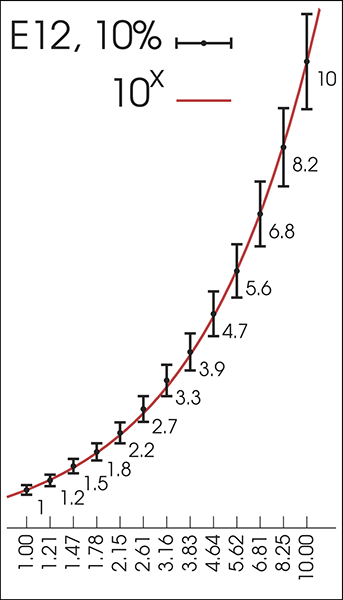
This part is the thing that made me understand the numbering series: > […] Continuing this trend, rounding as needed, and we end up with the series 10, 15, 22, 33, 47, and 68. Components built to the E6 standard have a 20% relative error tolerance, and if we look at the values again we’ll see a trend. Starting with 10 again and adding 20% error we end up with 12. Moving to 15 and subtracting 20% we get… wait for it……

The image it what made it clear to me.

https://digilent.com/blog/wp-content/uploads/2015/01/E12_ser...

Re: Why do electronic components have such odd values? (2021)

#126

Earlier quoted context omitted.

And that's why the really precise resistors are so damn expensive. E.g. VPG makes a 10k 1/5W 0.001% tolerance ±0.2ppm/°C, but they're $116 each with a minimum order quantity of 25 on DigiKey (so $2900 minimum purchase). They've got a really expensive meter for their trimming setup!

I see. I guess that's why high-end audio is so expensive

As both a sound and electrical engineer I think most high end audio electronics is bullshit.

If you know what you're doing a 50 cent opamp will give you results that are beyond what a human could identify in a double-randomized blind test. Same goes for comparing two rusty pieces of wire against highly pure copper speaker cables.

For some reason audiophiles will use darn massive gold (or silver) RCA connectors instead of something like a balanced connection that would actually make sense.

For audio applications 1% resistors are fine. You can use still affordable 0.1% in places where you truly care. Below that it is getting ridiculous, as the influence of harder to match things will take over. Things like speakers or the room they are placed in. How about the speed of sound changing with air temperature and humidity? You better have a room that has uniform and stabilized air temperature and humidity.

A big part of the audiophile game is about psychological impact and the joy of personalized optimization. I spent a lot of money on audio equipment and a lot of time on researching it myself. It is an interesting thing. But in the end it is also physics that are interpreted by your brain and I can't help but feel bad for people who need to (incoming hyperbole) turn every part of their setup into gold in order to be able to enjoy listening to their equipment as music passes through it.

Re: Why do electronic components have such odd values? (2021)

#127

Earlier quoted context omitted.

One fun thing to do when designing high-precision analog stuff (audio) was to choose component values that are about 1.5-2% off of a value in the E12 series. You can then go test a whole bunch of resistors and you will find a lot within 0.1% of each other (even within 0.01%). Everything within 1% of E12 is binned as a 1% resistor so those aren't polluting your stock. Going within 0.1% of an E12 value is a pricey resi…

Raw room temperature value isn't the only reason we use precision resistors. Some parts tend to behave more linearly at higher voltages (especially at the Meg range) and others exhibit much lower tempco's. There is also the problem of long-term stability and value change due to exposure to high temperatures during soldering. In any case, the above trick is neat, thanks for sharing it.

There are solutions to keep matched resistors at the same temperature.

Re: Why do electronic components have such odd values? (2021)

#128
post #126

Earlier quoted context omitted.

I see. I guess that's why high-end audio is so expensive

As both a sound and electrical engineer I think most high end audio electronics is bullshit. If you know what you're doing a 50 cent opamp will give you results that are beyond what a human could identify in a double-randomized blind test. Same goes for comparing two rusty pieces of wire against highly pure copper speaker cables. For some reason audiophiles will use darn massive gold (or silver) RCA connectors instea…

> For some reason audiophiles will use darn massive gold (or silver) RCA connectors instead of something like a balanced connection that would actually make sense.

It's hard to find XLR (or even TRS) balanced connectors on most non-professional (=TV studios, expensive conference room setups, DJs/clubs/similar venues) equipment.

Re: Why do electronic components have such odd values? (2021)

#129

Slight sidetrack: > We have to go back a few years to 1877 France. The French military used balloons for various purposes and of various sizes, and they had to be anchored using cables. Over time, they ended up with 425 different sizes of mooring cables that had to be individually ordered and inventoried. Talk about a nightmare. > > Enter Charles Renard. He was tasked with improving the balloons, but discovered this…

Think about tethering a zeppelin with a curved body shape, where you need to attach in multiple places. Combine that with needing to tether at different elevations and it will get out of hand pretty quick.
Post reply on HN