Live data from Hacker News

The myth of big salaries (it's all marketing)

seths.blog

121–130 of 245 posts

Re: The myth of big salaries (it's all marketing)

#121
post #99

I've said this before, but the managing director of the Norwegian Pension Fund - which currently sits at a cool $1.56 trillion, has a $657k salary. Nothing more, nothing less. The return for last year was around 25% Some of the fund managers there make more than the managing director, but still, we're talking about a "modest" figure in the $1mm-$2mm range. That's paltry pay compared to the big bucks made in hedge fun…

Is the manager of that fund really "top talent?" How hard is it really to make 25% off of $1.6 trillion? I'll bet you could do it. Also, that's a very different job than working at a hedge fund. Hedge funds have to attract investors. How do they do that? By saying, "look at the expensive managers we have!" A government pension fund doesn't have to do that.

I wanted to accuse you of being preposterous, but it looks like S&P 500 grew 24.1%, Dow 13%, and Nasdaq 43% in 2023. A basket of investments spread evenly across those would have returned around 26.7%.
Re: The myth of big salaries (it's all marketing)

#122
post #85
post #18

> After a million dollars or so in salary, the absolute amount that a person is paid has no real impact on their life. They can't eat more meals in a day or wear more shoes. What matters to the manager is the relative amount. Sure, nobody needs more than a million dollars in annual compensation (in 2024 dollars), but relative amount gets you to your never need to work again number faster or slower. You might still wo…

I think this over-estimates the amount required to live a luxurious life in perpetuity. Consider the case of someone wishing to live a luxury lifestyle in the trendy lower east side neighborhood of manhattan. We'll use a 1300 sqft 3 bedroom condo as a baseline. https://www.redfin.com/NY/New-York/455-FDR-Dr-10002/unit-B30... This condo will cost 8k/month with a 20% downpayment at todays interest rates, leaving our hyp…

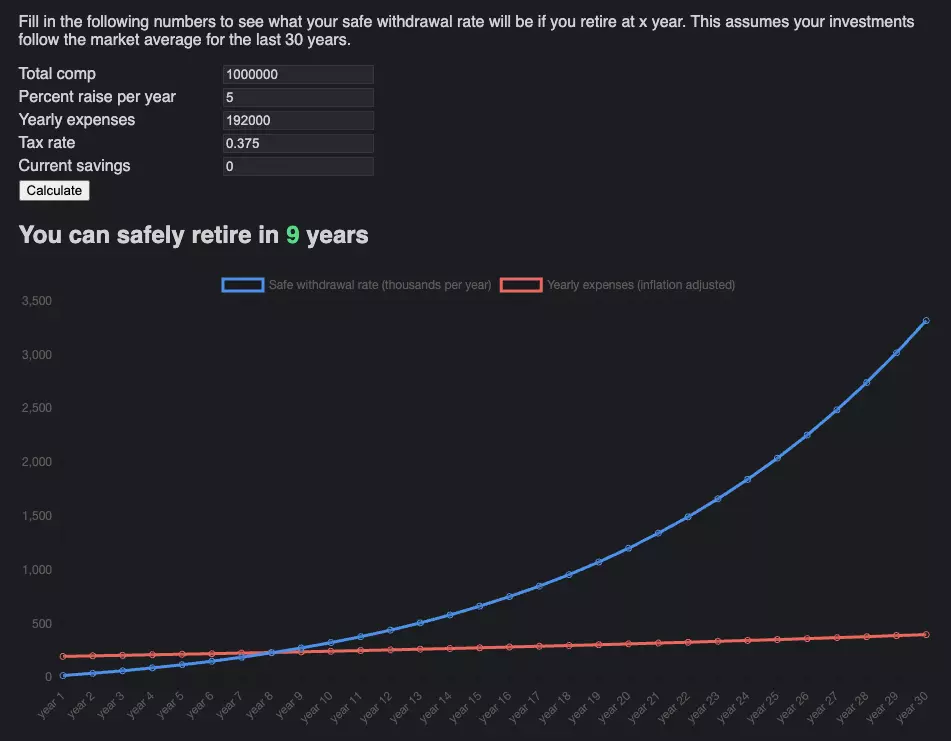
If anyone wants an extremely simplified "when can I retire given x expenses and y income" calculator, I threw together one here: https://html.non.io/simple-retirement-calculator/

Screenshot with op's scenario: https://image.non.io/7865a80e-d1e7-4437-b983-9101ed023024.we... (assumes a 4% safe withdrawal rate, I suspect op is using 3%).

Re: The myth of big salaries (it's all marketing)

#123
post #80
post #56

Earlier quoted context omitted.

A salary cap doesn’t change the market rate! It just obfuscates it. Salaries for public companies locked at 10M/yr? Ok, now firms have to compete on amenities. (Your current firm gives you a free car? Ours gives a jet, a personal Michelin star cook, and complimentary beverages)

Company benefits are also a form of salary. If your company gifts you a free car, they have to tax it as such.

> Company benefits are also a form of salary. If your company gifts you a free car, they have to tax it as such.

The company doesn't gift them a car. The company buys a car held in the name of the company and lets the person use it.

Re: The myth of big salaries (it's all marketing)

#124

This article is pretty shallow and sounds a lot like the people on Reddit calling for the removal of billionaires and how its the fault of the rich that they are struggling without acknowledging the amount of work it takes to become rich. The same people that minimize what people like Musk have accomplished. If I get paid more, I work harder. There is obviously a realistic limit on how hard I can work. The longer I s…

> ... without acknowledging the amount of work it takes to become rich

Being rich has more to do with background, than work.

> The same people that minimize what people like Musk have accomplished.

The son of a property developer and part owner of an emerald mine, and a top model, no less.

What I'm trying to say is that getting a jumpstart, while not guaranteeing a path to success, does provide a massive advantage over those from poorer backgrounds.

Re: The myth of big salaries (it's all marketing)

#125
post #99

I've said this before, but the managing director of the Norwegian Pension Fund - which currently sits at a cool $1.56 trillion, has a $657k salary. Nothing more, nothing less. The return for last year was around 25% Some of the fund managers there make more than the managing director, but still, we're talking about a "modest" figure in the $1mm-$2mm range. That's paltry pay compared to the big bucks made in hedge fun…

Is the manager of that fund really "top talent?" How hard is it really to make 25% off of $1.6 trillion? I'll bet you could do it. Also, that's a very different job than working at a hedge fund. Hedge funds have to attract investors. How do they do that? By saying, "look at the expensive managers we have!" A government pension fund doesn't have to do that.

How hard is it really to make 25% off of $1.6 trillion?

Consistently? Basically impossible.

Re: The myth of big salaries (it's all marketing)

#126

It's pretty absurd of him to talk about how it's ridiculous that people are paid $50mil (I agree) then pivot and say that $120,000 per annum for a new grad is another example of "ridiculous comp." These things are not in the same ballpark, they are qualitatively different. I don't know the author but this is so bizarre it makes me question their analysis overall.

In his defense, he (should be, at least) talking about relative pay for each job. It's like talking about the price of milk and the price of caviar (or some other expensive and rare food, I don't know). You can find both at prices that you would call ridiculous and at prices you would say are a good deal, but those prices would never be in the same ballpark. A wise consumer can save money on both by shopping around.

Re: The myth of big salaries (it's all marketing)

#127
post #85
post #18

> After a million dollars or so in salary, the absolute amount that a person is paid has no real impact on their life. They can't eat more meals in a day or wear more shoes. What matters to the manager is the relative amount. Sure, nobody needs more than a million dollars in annual compensation (in 2024 dollars), but relative amount gets you to your never need to work again number faster or slower. You might still wo…

I think this over-estimates the amount required to live a luxurious life in perpetuity. Consider the case of someone wishing to live a luxury lifestyle in the trendy lower east side neighborhood of manhattan. We'll use a 1300 sqft 3 bedroom condo as a baseline. https://www.redfin.com/NY/New-York/455-FDR-Dr-10002/unit-B30... This condo will cost 8k/month with a 20% downpayment at todays interest rates, leaving our hyp…

A 1300 sqft apt isn't exactly lux with a family of 4. Plus public schools aren't great in most of the city and private will cost you 50k per kid, post tax. Then you have to ask what you're doing during the summer. Camp will cost you easily another 20-50k per kid. And your naive math of tax leaves out a lot city and state tax.

There are a lot of expenses. The fire stuff you read about people retiring after a few million is often heavily biased towards young single people where you can move to Thailand and live well but falls apart with a family.

People don't retire and live in the city after making a million a year for a few years. Maybe they're all stupid, but chances are they aren't and you're severely understimating how much things cost and how much you're taxed.

If you're making a million a year you'll want nice things for your family, that includes space for your kids to enjoy their childhood, vacations together, good food, transportation, and other things, otherwise what the hell is the point of working hard?

Re: The myth of big salaries (it's all marketing)

#128
post #48

What a tone-deaf article. - Salary is absolutely the key factor when people pick jobs. The difference between a fun hobby and a great job is that you get paid a lot to do the latter. - Here he's saying that companies should create a buzz around jobs; but having good feelings about your low-paid job doesn't help you nearly as much as just having lots of extra new wealth. - Saying that because high-end employees are fa…

>Salary is absolutely the key factor when people pick jobs. Eh. It's a key factor. Once you get beyond a certain point, many people take lots of factors into account for jobs that are not otherwise basically interchangeable.

A CEO picking between a $10m / yr gig and a $50m / yr one would have to have rather a lot of soft factors working in favor of the lower paid one to justify it.

Re: The myth of big salaries (it's all marketing)

#129
As with everything, TANSTAAFL.

The danger with offering "marketing" instead of salaries is that it locks your company into valuing (and continuing to offer) the boon that got people to join it in the first place. Google (and HP before it) used to distinguish itself with "We take care of our employees, give you decent work-life balance and flexible working arrangements, and let you work on self-directed projects. We will probably not be the absolute highest compensation you can make, given your skill level." This worked great when it actually offered those. At the very first hint of layoffs, or RTO, or manager-directed product priorities, Googlers ask themselves "Wait - why am I working here again?" In pretty short order, the only ones left are those that actually are motivated by money, but couldn't get a better offer.

Similarly, Apple offers "the ability to work on products that users love", and tends to pay a bit less than similarly-skilled employees can get elsewhere. This works great, until users cease to love your products. Current Apple is lucky that they are still on top, but historical Apple absolutely went through this sort of brain-drain from 1993-1997, when they were not on top in product quality and so there was no real reason for skilled people to work there.

The big advantage of paying a lot is that you know that the type of person you get is motivated by money. If you want them to do something, pay them a lot for it, and make that pay contingent upon them actually doing it. It takes ulterior motives out of the equation and gives the corporation flexibility, because the only reason people work for it is the money.

Re: The myth of big salaries (it's all marketing)

#130
post #98
post #19

I guess I'm not sure that there's a practical difference between "It's marketing" and "This is what the market rate is for a CEO." In other words, firms need to pay this much because that's what other firms are paying (at least.) That's not marketing - that's just the unfettered market at work. Which is why it needs to be fettered. I agree with the salary cap idea, because the market will naturally keep raising the p…

How about no salary cap but a maximum difference factor between the highest paid and the lowest paid in any company? Not sure what the figure should be (x10?, x20?, x50?, x100?). That way companies that want to pay higher saleries to their CEO would have to increase everyone's salary. But there would need to be a way of stopping companies just using shells and subcontracting all the real work to low pay subsidiaries.

You're right, companies would stop hiring employees and just work with contractors.

These kinds of regulations never work like you want them to. Just let the market do it's thing.

Post reply on HN