Live data from Hacker News

Milk alternatives produce up to 4.5x less greenhouse gas emissions as milk

ourworldindata.org

121–130 of 192 posts

Re: Milk alternatives produce up to 4.5x less greenhouse gas emissions as milk

#121

I'm curious the long-term side effects on the body. I'm not sure it's better, we're something like 10,000 years into developing the ability to drink milk. I'm not sure we know what the effects of high soy intake is (only 10-15 years into mass consumer adoption -- we do see massive drops in sex hormones; possibly related, it is correlated). Also, I really dislike how these studies are conducted. They often don't accou…

Most soy is AFAIK used as food for farm animals. I wouldn't worry about it, many cultures were eating soy products since millennia and they were fine the whole time. Tofu is just solid soy milk.

Almond milk contains almost no almonds (and tastes horrible IMO, but YMMV, may also just be the brand I tried), I would assume that it's not that big of a chunk of the global almond production.

But in any case, oat milk should be safe, right? It's just a very watery porridge, isn't it? :D
Re: Milk alternatives produce up to 4.5x less greenhouse gas emissions as milk

#122

Oat milk tastes pretty good and from the charts it’s a good balance between land and water use and emissions given. I keep a smaller carton of milk next to a similar sized oat milk one these days. My only concern is if some studies will come out in a few years showing oat milk health effects similar to what is being discovered about soy. I don’t have all knowledge on this, but apparently soy can mess with hormones. I…

The “soy can mess with hormones” meme comes from the fact that soy contains weak estrogen like compounds, and the internet has blown up about it (particularly in health and fitness circles where there’s a good deal of concern about maintaining one’s manliness). What gets left out is the fact that phytoestrogens are ubiquitous, found in many plant foods. [0] [0] https://en.wikipedia.org/wiki/Phytoestrogen?wprov=sfti1

All our pediatricians strongly advised foregoing soy based alternatives (son had a milk-protein allergy), at least until he is 2, better even longer.

The argument from the less concerned was something along: Better safe then sorry, no one can say what larger amounts of estrogen will do to a boy well below 1.

Re: Milk alternatives produce up to 4.5x less greenhouse gas emissions as milk

#123
I don't drink much milk but when a do there is little better than cold milk in a chilled glass. My experience with the alternatives is that at best they tend to taste like they were strained through a used sweat sock. At worst they're like drinking latex paint.

I'm sure the "but my brand" crowd will disagree based on the subjectivity of their lack of taste but they'll be wrong.

In the end if we believe that milk is a driving force I'm climate change we might as well just start hoping for a giant asteroid to end it all now.

Re: Milk alternatives produce up to 4.5x less greenhouse gas emissions as milk

#124

I'm not vegan or anything, but I've found oat milk not only tastes great on cereal etc, but it also keeps fresh for much longer in the fridge. I've pretty much given up buying cow's milk now days, unless I have a specific recipe or something that calls for it. Cheese, on the other hand, I can't see myself giving up any time soon!

Same - not veggie but switched to oat milk (despite not liking it much at first) and now strongly prefer the taste, texture, and all of the other benefits like fridge longevity, lack of smell if I leave a thermos with a latte for a few days, etc.

Re: Milk alternatives produce up to 4.5x less greenhouse gas emissions as milk

#125

I didn't see it discussed in the article, but I'm very excited about possibilities like Perfect Day [1]. They provide "animal-free" milk. Unlike other alternatives, this product contains actual milk proteins derived from microflora. So it has more of the texture, taste, and nutritional content you expect from milk, but animals are not involved in the manufacturing. I'd love to see how animal-free protein products sta…

Can't wait until such "real milk" replacements are broadly, cheapish-ly available, so we can get "real" vegan cheese, butter, cream and curd. IMO all current options there suck big time (but YMMV, of course) :D

Yeah I've tried a few and haven't found any to my liking. Other plant-based products like meat alternatives I've found to be OK, but dairy not so much.

Also if you read this Perfect Day, I don't eat much icecream but I'd buy vegan whey protein powder from y'all in a heartbeat.

Re: Milk alternatives produce up to 4.5x less greenhouse gas emissions as milk

#126

Oat milk tastes pretty good and from the charts it’s a good balance between land and water use and emissions given. I keep a smaller carton of milk next to a similar sized oat milk one these days. My only concern is if some studies will come out in a few years showing oat milk health effects similar to what is being discovered about soy. I don’t have all knowledge on this, but apparently soy can mess with hormones. I…

Most oat milk people are drinking have half its calories from processed vegetable oils. There have been many threads on HN about the unhealthy issues with these oils. Get the ones that are just oats and water, but they won't be "creamy" like milk without fats.

Re: Milk alternatives produce up to 4.5x less greenhouse gas emissions as milk

#127

I'm curious the long-term side effects on the body. I'm not sure it's better, we're something like 10,000 years into developing the ability to drink milk. I'm not sure we know what the effects of high soy intake is (only 10-15 years into mass consumer adoption -- we do see massive drops in sex hormones; possibly related, it is correlated). Also, I really dislike how these studies are conducted. They often don't accou…

Actually we haven't evolved to digest milk after childhood that well: While most infants can digest lactose, many people begin to develop lactose malabsorption—a reduced ability to digest lactose—after infancy. Experts estimate that about 68 percent of the world’s population has lactose malabsorption.1 Lactose malabsorption is more common in some parts of the world than in others. In Africa and Asia, most people have…

Maybe "we" as in humanity haven't, but "we" as in white people from Northern Europe have. Even in the most lactose-malabsorptive place (Middle East), 3 out of 10 people can digest lactose successfully.

Re: Milk alternatives produce up to 4.5x less greenhouse gas emissions as milk

#128

I really like milk. Why is it anywhere near the front of the list of things we have to be better at, to save the planet? Sorry for the grump take. It feels very silly to be “what about” ish about this. Couldn’t we just tax plane fuel a bit more first or something?

Thankfully, this isn't the only think people are trying to be better about. I think it's good to try and tackle a problem from multiple angles. I also don't think anyone is trying to (realistically) take away your milk. It is useful though to inform people about the impacts of their choice, and let them make an informed decision.

Thanks for the input. I thought about it some more, and gave the article another spin, and the thing that really impacted me was the environmental hazard of cattle — eutrophication to use the technical term.

Bio diversity, while not quite the same risk as climate change, is another hazard well worth focusing on. What’s the point of tackling greenhouse emissions if we live in a Speaker for the Dead biological dead-end with only a handful of ubiquitous species?

Re: Milk alternatives produce up to 4.5x less greenhouse gas emissions as milk

#129
post #115

Earlier quoted context omitted.

Not really super surprising— the volumes are way lower and there's less subsidizing going on. On a grocery store shelf here in Ontario, you can get 4L of 2% regular milk for $5. But the Earth's Own products, which include oat and soy milk? Those are more like $6 for a single litre .

As an European I am always baffled by the humongous containers you have overseas. Here we buy litres or half, and we adore milk, mostly 3.5%. The non-diary alternatives are not even allowed to be called milk (they are now drinks ).

As a parent of young kids, we easily do 1L+ of milk per day, even when we drink water as our meal beverage. It goes on cereal in the mornings + a glass before bed + it's an ingredient for certain meals (think baking, cheese sauces, that kind of thing).

I used to make yogurt and cheese as well, but it wasn't really cost/labour effective to do so, even with milk being as cheap as it is.

Re: Milk alternatives produce up to 4.5x less greenhouse gas emissions as milk

#130

I think the focus on cows is kind of ridiculous. Our world's natural balance before humans included vast numbers of ruminants over vast expanses of the world. (e.g. huge populations of forest buffalo in Europe, vast Mammoth and Bison herds in North America). This is an issue being pushed with the intention of distracting from the real issue: fossil fuel use.

Here's the math: https://mrdrscienceteacher.wordpress.com/2019/09/21/bison-vs...

> This is an issue being pushed with the intention of distracting from the real issue: fossil fuel use.

This part is still horribly true though.

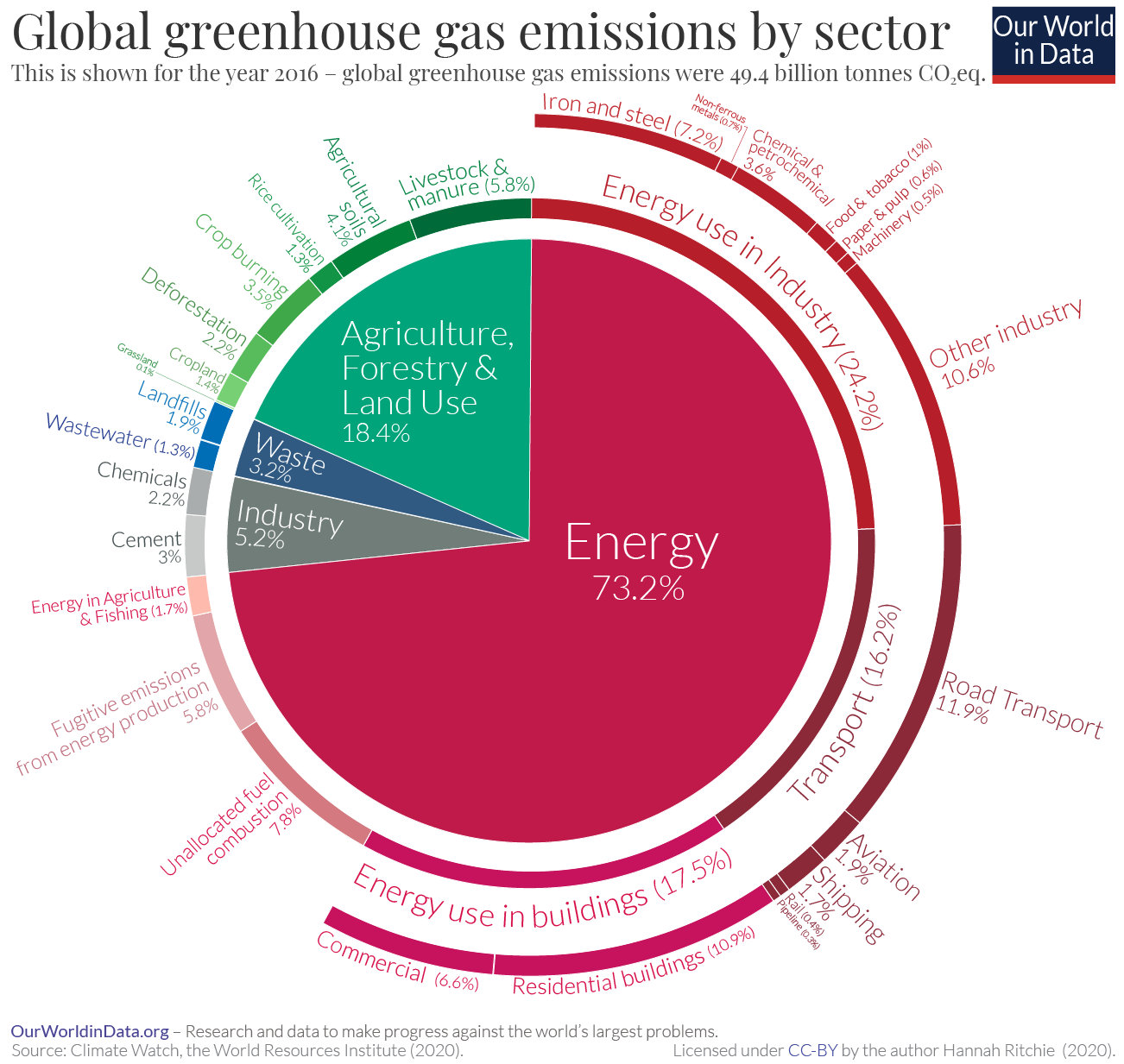
Emmisions related to livestock are 5.8% of _all_ global CO2 and other GHG emissions [0]

In comparison Transport emissions are 16.2%. [0]

The steel industry as a single industry accounts for 7.2% of emissions.[0]

Methane leaks from Oil and gas drill sites and abandoned wells alone account for 5.8% of global emissions. [0]

Sure we need to look into all fronts but before we guilt people into oat milk shouldn't we, via policy, enforce leak cleanup of abandoned Oil&Gas drill sites?

[0] https://ourworldindata.org/uploads/2020/09/Emissions-by-sect...

Post reply on HN