Live data from Hacker News

Ryzen 5800X vs. M1: Programming benchmarks

github.com

121–130 of 318 posts

Re: Ryzen 5800X vs. M1: Programming benchmarks

#121
The most impressive part to me is how the m1 compares to the 3900X. I’ve got a mere 3600X and every laptop I owned or worked on over the past year is noticeably and painfully slower than the 3600X. It’s been a relief to get home and turn on my desktop. It doesn’t matter if the laptops I’m using are very recent i7’s and i9’s, the desktop is always very noticeably faster.

I got my m1 MacBook Pro 16GB yesterday and was pretty confused to find that Rust compilation felt faster than the desktop. To go from recent Intel laptops taking two to three times longer to compile Rust than my budget desktop despite the laptops' whiny fans and extreme heat, to having my desktop be sightly outclassed by an ice cold laptop on battery (which got at least 15 hours of use, including said compiling, with no need to charge) is a world changer. I can’t remember the last time a laptop was this close to desktop performance for my everyday workflow.

Now that I think about it, I haven’t even tried optimising compile times on the MacBook like I usually do with Rust projects. My desktop would have been running lld at least to make its compilation significantly faster, and the MacBook more than kept up in spite of the handicap.

Re: Ryzen 5800X vs. M1: Programming benchmarks

#122
I'm glad someone finally started comparing state of the art vs state of art.

Most comparisons have been M1 vs the frankly dated Intel offerings with the previous Mac product line.

So things to remember would be that power/performance is not linear and so 5800 like CPU could be scaled back in power consumption without sacrificing the same proportion of it's performance. Also, 5800X is on TSMC 7nm process where as M1 is on the 5nm; this difference will have a measurable impact on performance and power consumption.

Re: Ryzen 5800X vs. M1: Programming benchmarks

#123
post #6

In other words, Apple needs to just add 4 more cores to M1 to absolutely mop the floor with the Ryzen?

First, many of these benchmarks are single threaded. Secondly, in the same power envelope as the 5800X you can also find the 16 core 5950X. So perhaps Apple would have to add even more cores.

Finally, in a core count war AMD has an easier task. They scale up their designs with multiple chips. A Zen 3 CCD is about 80mm^2 on 7nm, which is already much smaller than the M1 SoC on 5nm. If Apple adds 4 more cores, their chip size will increase. Meanwhile AMD can add more cores without increasing chip size like Apple's current integrated approach. This is why AMD is already shipping 64 core CPUs (EPYC 7763) using multiple of the Zen 3 CCD as these desktop CPUs.

Re: Ryzen 5800X vs. M1: Programming benchmarks

#124

Earlier quoted context omitted.

The M1 also has overclocked memory (by spec, DDR4 only supports 3200MHz), and the 5800X isn't a 700$ CPU, actually it's at 450$ (and it will fall even further soon, I bought a 3900x recently for below 400$).

Still... $450 for the CPU only vs a $999 laptop, for most use cases the apple's MBA offers much more value and will have slower depreciation.

So, like normal, the value of a Mac is in appealing to others not doing things on the computer.

Re: Ryzen 5800X vs. M1: Programming benchmarks

#125

Earlier quoted context omitted.

Not everyone is a programmer though. Synthetic benchmarks don't just compute prime number or run mandelbrots. They test things like video compression, image processing, zip compression and decompression, etc. - things that most people do. > Geekbench 5 measures the performance of your device by performing tests that are representative of real-world tasks and applications. http://support.primatelabs.com/kb/geekbench/i…

And CPU/GPU companies have been caught multiple times in the past optimizing for these particular benchmarks. To the point where if you changed the name of the executable, the performance would drop significantly.

Do you have sources? I have never heard of any CPU manufacturer optimizing Geekbench scores.

Consumer grade CPUs are driven by a variety of things - marketing, brand loyalty, gaming benchmarks, reviewers such as Anantech and Extremetech, and yes, Geekbench scores. Datacenter processors are a whole another beast and driven by proprietary benchmarks by vendors.

Geekbench runs so many different tests, atleast a couple of dozens of tests. So, if CPU manufacturers are optimizing to those tests, its hard to believe that that's not a good thing and would apply to pretty much what an average user does in the first place.

Re: Ryzen 5800X vs. M1: Programming benchmarks

#127
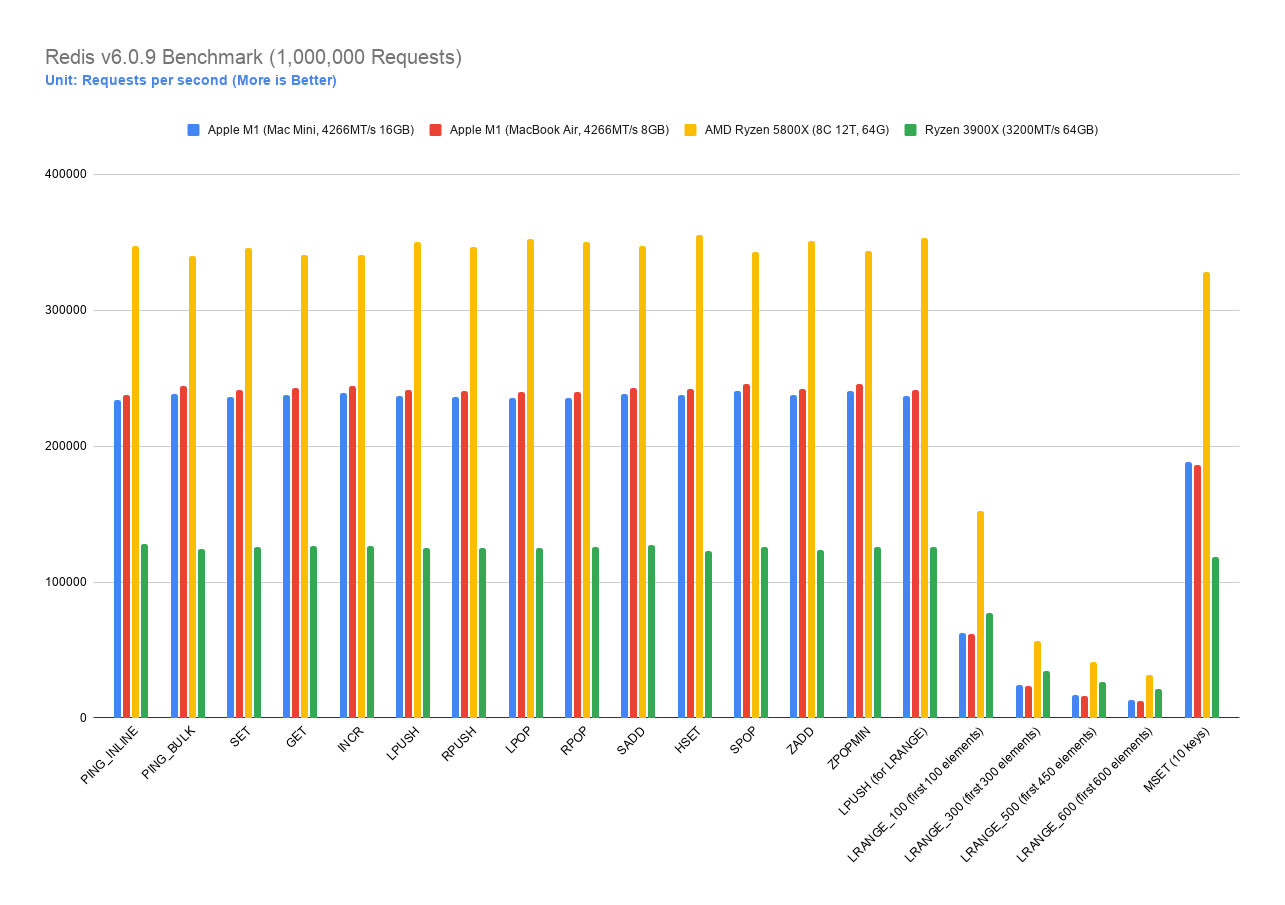
Can anyone explain the Redis numbers, specifically the 3900X versus 5800X [1]? The 5800X is showing numbers easily more than 2x the 3900X. I understand this is a single-threaded test, so the additional cores of the 3900X (12C/24T versus 8C/16T for the 5800X) do it no advantage. But I wouldn't expect the Zen 3 architecture to be that dramatically superior to Zen 2.

[1] https://raw.githubusercontent.com/tuhdo/tuhdo.github.io/mast...

Re: Ryzen 5800X vs. M1: Programming benchmarks

#128

Regarding the 5nm vs 7nm thing, I expect apple to be at least 1 node or intra-node improvement (eg: 5nm vs 5nm+ or 4nm) ahead for foreseeable future. They pay TSMC pretty penny to have access to cutting edge nodes. Not much different from how Intel had node advantage over others albeit here apple paying for it so at-least others aren't locked out of it for too long.

So now each year we can't do proper benchmarks anymore because there will always be the (X)nm vs (X-1)nm argument.

What's wrong with using price-power-performance ratio benchmarks on what's available on the market?

Re: Ryzen 5800X vs. M1: Programming benchmarks

#129
post #127

Can anyone explain the Redis numbers, specifically the 3900X versus 5800X [1]? The 5800X is showing numbers easily more than 2x the 3900X. I understand this is a single-threaded test, so the additional cores of the 3900X (12C/24T versus 8C/16T for the 5800X) do it no advantage. But I wouldn't expect the Zen 3 architecture to be that dramatically superior to Zen 2. [1] https://raw.githubusercontent.com/tuhdo/tuhdo.git…

This is pure speculation, but the Zen 3 cores have access to double the cache. In very specific workloads that could lead to a 2x speedup.

Re: Ryzen 5800X vs. M1: Programming benchmarks

#130

Earlier quoted context omitted.

The M1 also has overclocked memory (by spec, DDR4 only supports 3200MHz), and the 5800X isn't a 700$ CPU, actually it's at 450$ (and it will fall even further soon, I bought a 3900x recently for below 400$).

Still... $450 for the CPU only vs a $999 laptop, for most use cases the apple's MBA offers much more value and will have slower depreciation.

CPU: $450 (5800x)

GPU: $150 (1650 super)

Storage: $60 (samsung 970 evo 250gb)

PSU: $90 (silverstone sfx 500w 80 plus gold - there's probably cheaper options but most PSUs seem sold out on amazon)

RAM: $70 (16gb 3200mhz CL16, gskill or team group)

Case: $70 (Silverstone tek)

Motherboard: $120 (asrock b550-m itx)

There's your $1000 mac killer. I wouldn't call it a sensible build, but it should outperform the mac across the board. Notably the GPU is significantly better but the closest gpu the m1 is to trading blows with is the Radeon 560 which is only $30 cheaper. Also the mac comes with 8gb ram in the base model, and 16gb is a $200 upgrade but I could not find a decent speed 2x4gb ddr4 kit as nobody wants that little ram anymore in a custom build. I could save $40 by going with a 1x8gb kit for $30, but single channel will hurt performance.

I'd also consider $30 to go from the 250gb ssd to a 1tb variant, something apple charges $400 for.

The reason I wouldn't call it sensible is that the 1650 super is a budget gaming card while the 5800x a higher tier cpu. If you were actually planning to build this for gaming I'd suggest dropping down to the 5600x and putting the extra $100. actually for gaming I'd even suggest squeezing the budget for a 2060 (or even better wait for the standard 3060) by dropping to basic ddr4-2133, and going for standard sized case/psu rather than the small form factor to chase the mac.

On the other hand, if you're not gaming and just need a video output, save like 120 bucks and just get a gt 1030. Use that to buy some nicer RAM or more cores via a 5900x depending on what suits your workload better. Sadly you have to get _a gpu_ as Intel is falling behind and AMD won't give us high end APUs in the individual market.
Post reply on HN