Live data from Hacker News

ViperCard – An open source re-creation and re-imagination of HyperCard

vipercard.net

121–130 of 144 posts

Re: ViperCard – An open source re-creation and re-imagination of HyperCard

#121

Earlier quoted context omitted.

Sure, but the goal is that the user sets their brightness for the environment, and not ever for individual software. The per-application brightness should be done in software, and ideally take into account HDR and colorspace capability of the software. Otherwise, like the user above had suggested, you have to switch brightness every time you switch between different programs.

> the goal is that the user sets their brightness for the environment, and not ever for individual software. ...and we've come full-circle: "Keep high contrast, reduce brightness as desired for your environment."

Correct, but software then needs to be explicitly mapped with a brightness range.

Otherwise you can't have on the same screen a game simulating a dark night with low contrast, and a guide for that game which uses the full contrast spectrum.

Your suggestions all break if I want to be able to have at the same time extremely low contrast content and text on the same screen, next to another, and want both to look fine.
Re: ViperCard – An open source re-creation and re-imagination of HyperCard

#122

Earlier quoted context omitted.

...and Myst.

Wait, was Myst in hypercard? I remember watching videos where they talked about how everything was only in 256 colors with adaptive pallets, plus they had Windows, 3DO and Plyastation ports.

It definitely was written in HyperCard, using a couple of custom 'XCMD' extensions for the color images and QuickTime animations, which HyperCard itself did not support at the time.

One of my early contract jobs involved reverse-engineering the entire game and reconstructing it as a screen-saver, with a little AI that would generate plausible game-play activity while you watched. The startup that hired me got sued out of existence approximately ten seconds after shipping the product, despite our scrupulous attention to copyright (everything we used was loaded off the CD at runtime), and that was a valuable lesson about the true nature of the legal system. Even still, the experience of immersing myself in that game world deeply enough to recreate its structure remains a fond memory.

Re: ViperCard – An open source re-creation and re-imagination of HyperCard

#123

Earlier quoted context omitted.

> the goal is that the user sets their brightness for the environment, and not ever for individual software. ...and we've come full-circle: "Keep high contrast, reduce brightness as desired for your environment."

Correct, but software then needs to be explicitly mapped with a brightness range. Otherwise you can't have on the same screen a game simulating a dark night with low contrast, and a guide for that game which uses the full contrast spectrum. Your suggestions all break if I want to be able to have at the same time extremely low contrast content and text on the same screen, next to another, and want both to look fine.

> extremely low contrast content and text on the same screen, next to another, and want both to look fine.

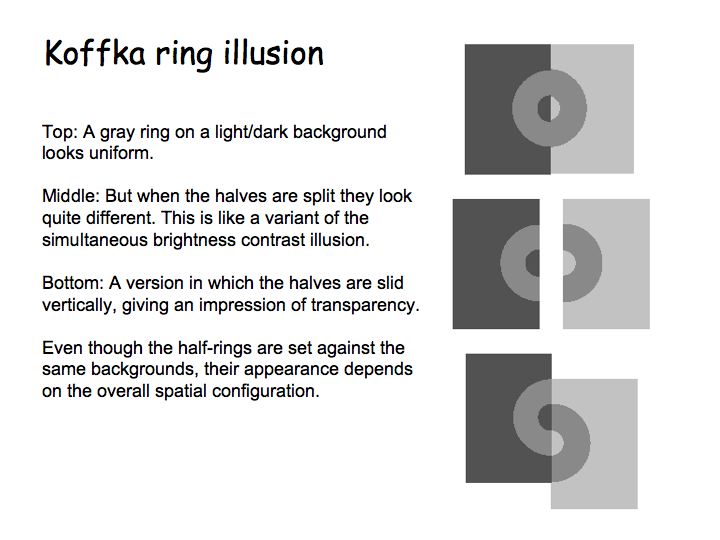
With that scenario, you're dealing with physiological limitations, because if you have a bright region next to a dark night region, your eyes cannot perceive detail in the dark region. You'll also be vulnerable to the optical illusion effects of perception (e.g., see http://www.cns.nyu.edu/~david/courses/perception/lecturenote... and other examples in http://www.cns.nyu.edu/~david/courses/perception/lecturenote...), so "look fine" is going to be rather hard to define, much less guarantee.

But this discussion was really about interfaces, potential interest in monochromatic interfaces, and the issues of low-contrast interfaces.

This article from the Nielsen/Norman group clearly describes the usability problems with the currently trendy low-contrast interfaces. https://www.nngroup.com/articles/low-contrast/

Re: ViperCard – An open source re-creation and re-imagination of HyperCard

#124

Earlier quoted context omitted.

Correct, but software then needs to be explicitly mapped with a brightness range. Otherwise you can't have on the same screen a game simulating a dark night with low contrast, and a guide for that game which uses the full contrast spectrum. Your suggestions all break if I want to be able to have at the same time extremely low contrast content and text on the same screen, next to another, and want both to look fine.

> extremely low contrast content and text on the same screen, next to another, and want both to look fine. With that scenario, you're dealing with physiological limitations, because if you have a bright region next to a dark night region, your eyes cannot perceive detail in the dark region. You'll also be vulnerable to the optical illusion effects of perception (e.g., see http://www.cns.nyu.edu/~david/courses/percept…

> With that scenario, you're dealing with physiological limitations, because if you have a bright region next to a dark night region, your eyes cannot perceive detail in the dark region.

Correct, that's why you meed a software solution that detects this issue and dynamically adapts.

This isn't complicated either, every modern video game has the issue of UI, text, and HDR content in one frame, and has well-working tonemap curves and dynamic exposure adaption algorithms.

Microsoft is also integrating solutions for this into Windows.

Any OS that plans to ever mix HDR and SDR content on one screen needs this anyway, and if you do that, you can also easily add minor changes to allow text content to be annotated so its contrast can also be dynamically adjusted.

Re: ViperCard – An open source re-creation and re-imagination of HyperCard

#125
I wrote a program called Virtual Journal 1.0 that was simply an infinite paged, password protected text journal app.

I put it into AOL's ftp area as shareware and got checks from around the world for $2. I was about 8 years old!

EDITED: I'm offering a $100 reward if anyone can find a copy of this software in an archive or old shareware disc somewhere! I'd love to find it again. Also, bonus points for finding my OneClick Palette called "AOL ROVER".

Re: ViperCard – An open source re-creation and re-imagination of HyperCard

#126
post #93

Earlier quoted context omitted.

The Mac version was in Hypercard, all of the other versions were different engines written from scratch for Myst. They actually had to use the same color palette for each age to ensure there wasn't any strangeness as they flipped between cards to move around in the game.

I thought it used Macromedia (Shockwave or precursor?) edit: I guess not, neat!

I know an earlier game by the same studio (Cyan) called Cosmic Osmo, did use a precursor to MacroMedia, called at the time "MacroMind VideoWorks".

Re: ViperCard – An open source re-creation and re-imagination of HyperCard

#128

Ironically, doesn't support Safari :)

Click the "Click here to continue anyway" button. Like most sites that advertise that they don't work on Safari, it actually works just fine.

(Reminder: If you're doing browser feature detection via User-Agent string, you seriously need to re-examine your life.)

Re: ViperCard – An open source re-creation and re-imagination of HyperCard

#129
HyperCard was about empowering users, the opposite of what many tech companies want today, including Apple. It was a "predecessor" to the web (hypertext, HyperTalk scripting language), of Flash (animations, graphics), of user programmable databases (ok, Filemaker is older). It enabled users to smoothly dive into programming, as it not only offered a simple but extremly powerful concept of document-applictions called "stacks", drag-n-drop setup of your own graphical user interfaces, but behind all this a very powerful, extendable object oriented programming language with kind of "real" objects, as every item of your stack could have it's own method. Thankfully we have web technology today, else computer technology would miss its most democratic tool. But still HyperCard was the only way to simply have your own data on your own computer in your own application and not relying to a server, cloud or even paid service.

Re: ViperCard – An open source re-creation and re-imagination of HyperCard

#130
post #41
post #23

HyperCard together with Qbasic both fell into that forgotten realm of democratising programming; making it so that even your aunt could write a simple program herself. A lot of people ended up learning programming because of these simple languages/tools, and I used to love playing with their projects I'd download from Geocities and the like. It's a bit of a shame the industry gave up on the idea, and abandoned these…

People have written a lot about programming languages that try to use natural-language syntax, but one idea that I remember is that both HyperTalk and AppleScript are a lot easier to read than to write , because you can relatively easily use your knowledge of English to understand what the code is doing, but you can't easily use your knowledge of English to figure out how to phrase instructions in a way that the inte…

Considering code is read more frequently than it is written [0] [1], seems like a trade-off that could be helpful... I wonder if autocomplete to a language like this would help a lot. There was nothing like that for HyperCard.

[0] https://blogs.msdn.microsoft.com/oldnewthing/20070406-00/?p=... [1] https://blog.codinghorror.com/when-understanding-means-rewri...

Post reply on HN