Live data from Hacker News

In Fed and Out, Many Now Think Inflation Helps

nytimes.com

111–120 of 236 posts

Re: In Fed and Out, Many Now Think Inflation Helps

#111
post #53

Absolutely no discussion of inflation is complete without recognition of the fact that inflation and inflation expectations are at historically low levels [1] right now. Economists aren't arguing that we should inflate our way out of debt--they are arguing that we should return to the historical norm. Of course, it's possible that these economists are secretly just pushing inflation as the "hidden tax" we're all up i…

Here's a question: how many "professional" economists sounded the alarm about the last bubble?

How would an economist get information about a bubble? Magic? Until they burst, anything you could say about them is speculative. Everyone talks about how education is the next big one, but education and real estate are such different markets they might as well be on different planets. It's impossible to know what's going to happen until it happens.

The housing bubble caught a lot of really smart people off guard. Housing was overpriced, but it's been overpriced for years. You had to have special, insider information about just what sorts of crazy tricks were being pulled behind the scenes, and you had to understand that it wasn't sustainable and what would happen once people started defaulting. Looks easy in hindsight, but you go out there and try to predict what's going to happen in two years.

Re: In Fed and Out, Many Now Think Inflation Helps

#112

Any comment in this thread that doesn't contain the words "liquidity trap" can safely be ignored. I know that a lot of HNers don't believe that economics is a real science and would rather go with gut feelings or whatever Ron Paul says, but please take a few minutes to read the seminal paper on liquidity traps: http://www.brookings.edu/~/media/projects/bpea/1998%202/1998... You may not agree with it, but at least you…

I live in Japan and the Japanese government, under its Abenomics movement, decided on another round of QE and injected 20% more currency into the market earlier this year.

I get that the yen is too strong and needs to weaken in order to protect the trade balance between itself and other countries.

But the inflation eventually reached us consumers and every day items have gotten that much more expensive.

Now my 10,000 yen only gets me ~8333 yen worth of stuff. If I could go back in time and not contribute the lost 1/6th of my savings in labor I might not be angry, but I can't.

My salary isn't going up either and there is even talk of pay reduction due to a worsening economy.

So to protect myself my choices seem to be:

1. Buy things up before the inflation reaches me as a consumer, passing the purchasing power theft on to the merchants. (possible, but I blow all my money away)

2. Convert that currency to something else that hedges against inflation (and retains its value over time) if I want to not spend it.

I chose #2 in the form of gold.

If you want to call me a goldbug, go ahead.

I'm getting into REITs soon too so maybe you can come up with clever derogatory name for that as well.

I'll try to help you win your bingo round.

Re: In Fed and Out, Many Now Think Inflation Helps

#113
post #60

Earlier quoted context omitted.

Austrian school not holding much weight with academics is like wondering why creationism doesn't hold much weight with academics. Lots of things can be explained with creationism, but it doesn't mean it's right. Many Austrian economists rail against the use of quantitative models and such. But without them, how can you measure the efficacy of your policies? Faith that the policy works... But most academics like to be…

> ...the use of quantitative models and such. But without them, how can you measure the efficacy of your policies? Here's a better question: if you measure the efficacy of your policies and find that they have not achieved the intended effect, on what would you base the extension and expansion of those policies? Faith? Insanity? The reason I ask is that a few months ago, two senior economists at the SF and NY Feds pu…

Right. There's no way to disprove theories that are tested in this way. Proponents of the theories being tested could always say that the attempt wasn't large enough, that the officials didn't believe enough in the policy, that the gods were angry that quarter, etc., etc. At some point you need a sound theory to draw back on that does not require this sort of testing to stand on its' own.

Re: In Fed and Out, Many Now Think Inflation Helps

#114

Earlier quoted context omitted.

The price of labor is a price and should rise with everything else. Average income should track inflation.

Average income grows faster than inflation because of real economic growth. In the U.S. we've had positive inflation numbers for most of the last 80 years, which has coincided with significant across-the-board improvements in standard of living.

Tell me again about that across the board improvement:

http://www.bloomberg.com/news/2012-10-02/top-1-got-93-of-inc...

Re: In Fed and Out, Many Now Think Inflation Helps

#115
post #74
post #59

Earlier quoted context omitted.

My (layman's) understanding of it is that central banks seek to keep inflation within a target range; in Australia this is between 2 and 3 percent [1]. The primary tool to manage inflation is interest rates, however interest rate movements also have other effects, positive and negative, so it's not as simple as turning on a tap. It's important not to let inflation get too high because that makes new investment unattr…

The other important thing is to reduce uncertainty as much as possible. You don't want your inflation rates to bounce around like crazy from day to day. Instead, you'd like to be able to keep them within certain limits so people can plan ahead to the future. If I'm not sure what inflation will be day-to-day, I can't make an accurate prediction as to whether I should save my money or spend it.

And if inflation is really high and fluctuating everyone makes the decision to never save in cash which isn't healthy.

But a bit of low level inflation is generally seen as a good thing. The questions over the efficacy of monetary policy as a stimulus tool in all situations is certainly questionable though.

It's also worth noting that independent central banks are a fairly new thing. Inflation levels used to be set by politicians who would notoriously let short term interest over ride price stability.

The Bundesbank was the first independent bank drawing lessons from the horrors of hyper-inflation. Most (all?) developed countries now follow that model.

Re: In Fed and Out, Many Now Think Inflation Helps

#116
I'm happy to see this article written, and it will hopefully start to change the attitude of evaluating central bank actions through the lens of 'high inflation bad, low inflation good'.

This whole debate is an unfortunate example of what's called "Partial Equilibrium Reasoning" (as opposed to "General Equilibrium Reasoning"). All things being equal, higher inflation is bad. That's clear. But all things aren't equal, and so appeals to logic about how inflation is a hidden tax on 'the people' and so forth are essentially worthless when applied to real-world situations.

Here's why. One weird thing about inflation is that inflation expectations become a self-fulfilling prophecy, because when people predict inflation, they demand escalating prices on things like 10-year leases and labor contracts, and when they don't predict inflation, they don't.

The situation today, in 2013 America, and not fake-year hypothetical-country in your economics textbooks, is that inflation expectations are extremely low. They are low because inflation is essentially a by-product of economic expansion, and most people predict that economic expansion will be weak for the foreseeable future.

As it turns out, the reverse of this is true. If people expected the economy to start growing strongly, their inflation expectations would likely rise, which would probably be enough all-on-its-own to cause inflation to rise. Weird, right?

So it turns out that if the economy were to strengthen, one thing you'd notice in the data would be slightly higher inflation. And you'd go, "Well that's no good, but at least the economy is improving!" And you would be looking at a General Equilibrium in which most people are better off even though inflation is slightly higher, because many other things (Nominal Growth, Real Growth, Unemployment, Long-Term Interest Rates for savers) would be moving in the _good_ direction.

This dynamic is why the Fed needs to break the attitude that its job is to keep inflation as low as possible. The worst thing that could happen in the above scenario is for people to think 'Uh oh, inflation is going up, that means the Fed will probably raise interest rates', which would have the (expected) effect of reducing economic growth. But we need growth! And we need to accept that a few percentage points of inflation will be a by-product of that in a healthy economy.

So to summarize, the issue here is not that inflation is good. It's that there is more to this picture than inflation, and that if you have a dogmatic belief that inflation is evil in all situations and should be avoided, you've probably read too much Hayek and it has melted your brain.

[sorry, had to drop a snipe]
Re: In Fed and Out, Many Now Think Inflation Helps

#117

Earlier quoted context omitted.

Inflation is only theft if you insist on storing value in cash--a financial instrument that is not designed to hold value. A major reason to manage for low, consistent inflation is to train people to put their money into real assets.

I agree that people should get into real assets but this sounds a lot like it's okay to beat your kids in order to train them to run faster.

Beating a kid is obviously wrong, but parenting (and coaching and managing) does involve creating incentives to encourage desired behaviors, and discourage undesirable behaviors.

Re: In Fed and Out, Many Now Think Inflation Helps

#118

Earlier quoted context omitted.

Here's a question: how many "professional" economists sounded the alarm about the last bubble?

Zero unless they are rewriting history to claim they saw it 6 months to a year out when it was obvious to anyone who wasn't drunk on soaring home and equity prices.

https://en.wikipedia.org/wiki/Nouriel_Roubini

Re: In Fed and Out, Many Now Think Inflation Helps

#119

Earlier quoted context omitted.

Inflation is only theft if you insist on storing value in cash--a financial instrument that is not designed to hold value. A major reason to manage for low, consistent inflation is to train people to put their money into real assets.

Where do you think cash goes if not into someone else's hand? It's like a game of hot potato constantly tossing it around to someone else so they hurt from it losing value, and not you. But in the end everyone handles it for some amount of time and gets burned the same amount.

In the U.S., the Fed creates and destroys dollars to manage the inflation rate.

Re: In Fed and Out, Many Now Think Inflation Helps

#120
post #43

Earlier quoted context omitted.

Really? Is this a joke or one of those terrible 'end-of-the-world' advertisements you hear on Bloomberg radio? Precious metals and real estate haven't done very well compared to equities in the last year or two... Yes, inflation reduces purchasing power if you assume that wages don't track inflation, but historically they do.

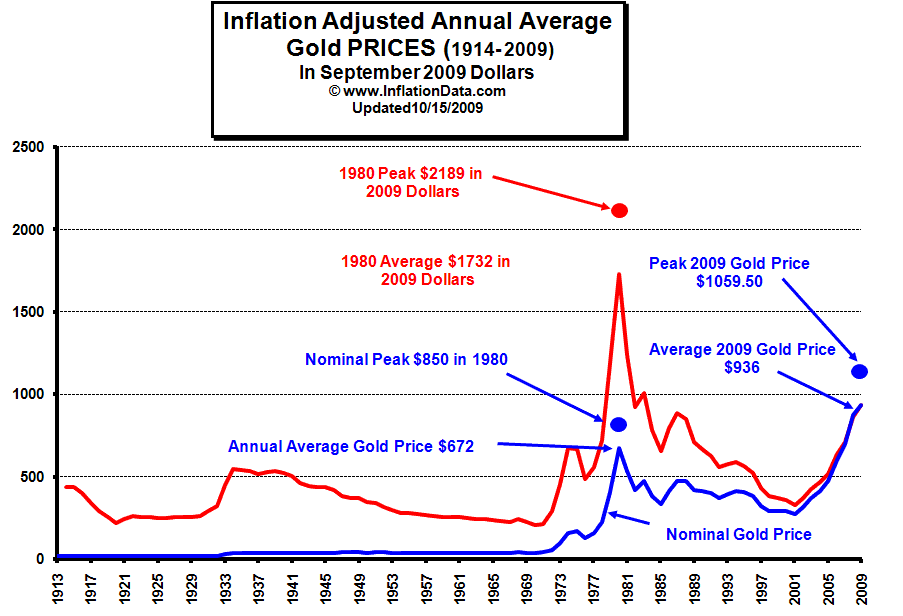
I would invite you to look at gold prices over the last 20 years. I only wish I could go back in time and tell my 20 year old self to buy lots of it back when it was in the $300/toz range. Right now it's sitting pretty at $1351/toz.

Just don't go too far and look at gold prices from 35 years ago.

http://static.seekingalpha.com/uploads/2010/3/19/saupload_go...

Post reply on HN