Live data from Hacker News

Where to Find the Colors Your Screen Can't Show You

moultano.wordpress.com

111–120 of 138 posts

Re: Where to Find the Colors Your Screen Can't Show You

#111
post #51

Earlier quoted context omitted.

This is truly an (accidental?) setback of color reproduction as it has progressed over time. For LED lights R9 is also crucial for skin tones which makes it so bad to just leave that out. Now, the mass produced LEDs are even optimized for CRI at all are virtually all excluding R9, which may be one of the main quality issues that many people perceive with LEDs vs eg incandescent. There’s of course more to it but R9 pr…

what's the alternative metric to look for as a consumer?

Few bulb manufacturers even bother to report CRI, unless it is decent (CRI > 90). If CRI is not reported, you can be sure it's bad, 80 or less.

Unfortunately, there isn't really a way for a consumer to know short of buying a spectrometer like my Sekonic C-800 Spectromaster.

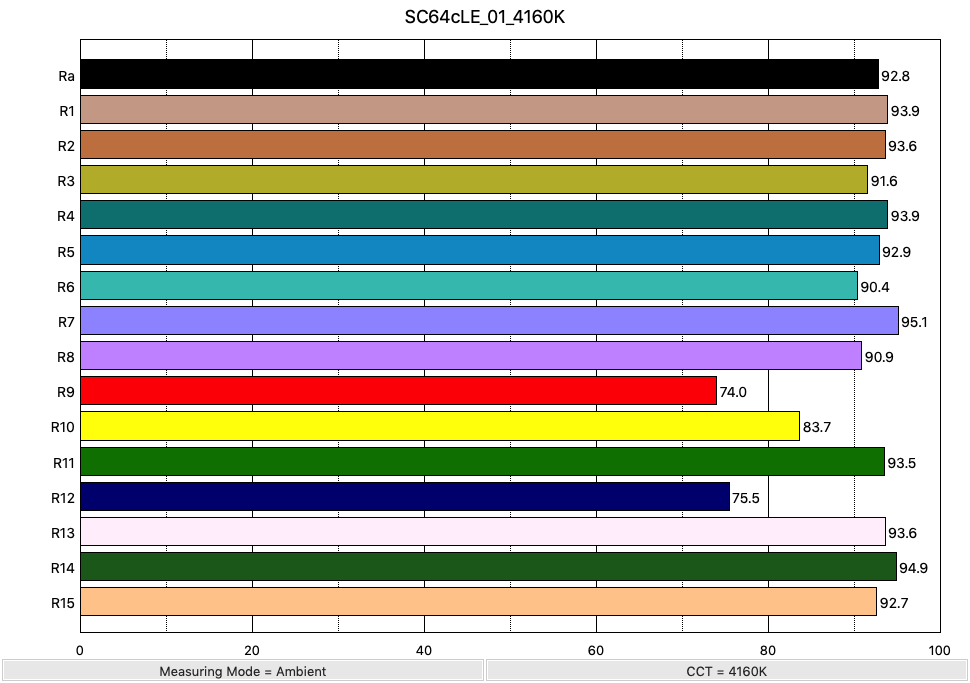
For illustration, I have uploaded a few readings here, mostly flashlights, not LED bulbs: https://majid.info/images/reddit/spectro/

If you look at the Zebralight SC64c LE, for instance, it has an excellent Ra of 92, but only 75 for R9:

https://majid.info/images/reddit/spectro/ZL_SC64cLE/SC64cLE_...
Re: Where to Find the Colors Your Screen Can't Show You

#112
post #10

That was incredibly well-explained. Kudos. I do have a question that the article doesn't seem to attempt to answer, though. The article says (paraphrased in my new understanding) that any spectra which makes the cones in your eyes react the same way will result in seeing the same colour. Do we know of any examples of this? (Colour-blindness seems like an obvious example; I'm curious though if there are any examples o…

Everyone is pointing out examples around image reproduction, which are valid and interesting… but the case that comes up in nature is violet (beyond blue in spectrum) vs purple (mix of red and blue) pigments.

Re: Where to Find the Colors Your Screen Can't Show You

#113
post #44

While it is true that some saturated blue-green colors will never be reproducible with only 3 primary colors, the CIE 1931 chromaticity diagram used in TFA overemphasizes their importance, because human vision cannot distinguish many colors in that area of the diagram. In reality, the greatest defect of the sRGB color space, which is still too frequently the default color space, is that it is not able to reproduce ma…

Not to mention the Color Rendering Index (CRI) metric Ra does not weigh the R9 (deep red) so many forms of lighting don't try to render it correctly to save costs.

Ugh. CRI doesn't include R9, so CRI 100 doesn't mean 100% replicating sun light / Incandescent Light bulb? Are there any LED that actually does a decent job in colour representation?

Re: Where to Find the Colors Your Screen Can't Show You

#114
post #51

Earlier quoted context omitted.

This is truly an (accidental?) setback of color reproduction as it has progressed over time. For LED lights R9 is also crucial for skin tones which makes it so bad to just leave that out. Now, the mass produced LEDs are even optimized for CRI at all are virtually all excluding R9, which may be one of the main quality issues that many people perceive with LEDs vs eg incandescent. There’s of course more to it but R9 pr…

what's the alternative metric to look for as a consumer?

TM-30 for general illumination, since it's based on human perception, not on what's best for a sensor like TLCI. Particularly the overall Rf and the h1 bin (skin tones) will tell you the most. Also color temperature accuracy if you want to match it with natural lighting and other lights.

Re: Where to Find the Colors Your Screen Can't Show You

#115
post #54

Earlier quoted context omitted.

> Only very rarely I have seen examples with obvious differences between monitors when showing green objects, e.g. some documentaries with certain vividly colored animals, like some insects, birds, frogs or lizards. According to the article you get purified greens from transmittance through foliage, ie backlight in eg a maple forest. This makes me suspect that it may be more important than just exotic animals, and ma…

I think the lack of depth perception in a 2D photo is another big factor in why the magic of a forest can’t be captured. There are so many different layers that all get flattened!

I have another article about that! https://moultano.wordpress.com/2025/02/24/you-should-make-cr...

Re: Where to Find the Colors Your Screen Can't Show You

#116

While it is true that some saturated blue-green colors will never be reproducible with only 3 primary colors, the CIE 1931 chromaticity diagram used in TFA overemphasizes their importance, because human vision cannot distinguish many colors in that area of the diagram. In reality, the greatest defect of the sRGB color space, which is still too frequently the default color space, is that it is not able to reproduce ma…

Stupid question: does the computer or whatever the monitor is hooked up to need to know to do something special to then show those colors, or it's just normal rgb color levels and in a less-good-color-space monitor those would have been shifted to less accurate colors?

Re: Where to Find the Colors Your Screen Can't Show You

#118
post #92

I took up acrylics painting a few years back and I've been surprised by how much is lost in photos and videos. The two colors with which I've noticed this the most are ultramarine blue and prussian blue. I don't think it's just the color though, part of it comes down to how light is reflected off the painting and where you're standing, as well as the texture and the brush strokes. I have a few paintings hanging in my…

Thanks mentioning acrylics. Now I'm wondering if new technology will eventually improve our printing to allow better colors in news media, and even in prints in art exhibits? Does anyone have any comments on the future of printed media?

Ive been on a meeting with a painter who paints on acrylic and she said that acrylic paints are relatively new, thus nobody knows how long will the paintings last. Of course modern varnish is applied, but it is unclear what will happen in the future.

Re: Where to Find the Colors Your Screen Can't Show You

#119
post #89

Earlier quoted context omitted.

There's color space and there's color depth. You may be using D-P3 with 8 bit, which is worse (less accurate?) than sRGB with 8 bit. And there's bandwidth. Your monitor may not be able to handle 4k 240fps 16 bit.

> 4k 240fps As a cinema enthusiast, I say 24 fps ought to be enough for anyone.

As a painting enthusiast, I say that's way too many. One should be enough for at least a few minutes.

Re: Where to Find the Colors Your Screen Can't Show You

#120
post #99
post #92

Earlier quoted context omitted.

Thanks mentioning acrylics. Now I'm wondering if new technology will eventually improve our printing to allow better colors in news media, and even in prints in art exhibits? Does anyone have any comments on the future of printed media?

The way this is done (has been done) is printing with custom colors. Standard printing is done with CMYK (three colors and black). Purportedly high-end printers (I don't care if the printer is gold plated and diamond studded, if the driver / host-based preprocessor was written in 1999 using Visual BASIC then the printer is sh*t) have had an extra blue, or an extra red, for years. In the back of my mind, I find it odd…

>hired by an eastern european country as an anti-counterfeiting advisor and then he disappeared

Oh man the stories write themselves

Post reply on HN