Live data from Hacker News

How Madrid built its metro cheaply (2024)

worksinprogress.co

111–120 of 189 posts

Re: How Madrid built its metro cheaply (2024)

#111
post #81

Earlier quoted context omitted.

I think it is for this reason that Switzerland has a fixed budget for their railway construction. And it seems to pay off, Swiss railway is exceptional.

With a small country, stable government, and national level funding, that's perfectly feasible. I wish that would work in the US, but we have hundreds of transit agencies that do capital projects.

Has nothing to do with size, see Japan and China.

Re: How Madrid built its metro cheaply (2024)

#112
post #8

> Unlike infrastructure projects in Britain or America, which are heavily reliant on external consultants to handle all stages of the project, this group of well-paid in-house engineers led much of the Madrid Metro expansion. The team stayed largely the same throughout the different projects, meaning that they were able to learn from their experience and apply it to future projects. Imagine that: building expertise i…

The UK used to have that with its railway projects - the old government owned British Rail had massive and extensive knowledge on large rail infrastructure projects and no need for expensive external "consultants". That all got lost when the Tories tore it apart into private companies... hopefully now they are being renationalised as their contracts expire, at some point in the future they can regain all that experti…

Its much more pernicious than that.

Timetables, expansion any kind of change to rail running is approved centrally in DfT. The private operators are just that, they only run the trains to spec, on the track provided. In some cases they don't even run the stations they stop at.

What is criminal, and why the same mistakes that keep on being made, is that there little apatite or budget to retain expertise in house. This means that the DfT is reliant on consultants for most things.

THis would be fine if the people making the decisions were not people like chris grayling or grant schapps, who have no care for long term issues, only short term career success.

It costs a shit ton more, and there is less accountability. Its basically like asking claude to design the system for you. Sure it appears faster, but in the end it you'll have to redo all of it manually with no context.

The whole great british railway shit is basically just re-branding the regional franchises, and nothing more.

Re: How Madrid built its metro cheaply (2024)

#113
post #43
post #8

> Unlike infrastructure projects in Britain or America, which are heavily reliant on external consultants to handle all stages of the project, this group of well-paid in-house engineers led much of the Madrid Metro expansion. The team stayed largely the same throughout the different projects, meaning that they were able to learn from their experience and apply it to future projects. Imagine that: building expertise i…

In the UK infrastructure projects are about creating jobs and making their friends rich first, and providing some kind of useful infrastructure last (and also optional) There is so much thievery of public funds it's just corruption disguised as incompetence and the public believe it every time

> the UK infrastructure projects are about creating jobs and making their friends rich first,

So out and out corruption is rare in the UK. For example Farage has just received 5 million in dodgy money, which is more money than all of the previous political money scandals since Mandelson.

But to your point, most of the time and money in uk infra is spent trying to navigate planning laws and nimbys

Re: How Madrid built its metro cheaply (2024)

#114
post #60

Meanwhile, bay area has companies with market cap of 30T (50T?), has nonexistent/incompatible and the slowest public transit. 1) BART 'works' for a subset of the population. 2) ACE train is one route only, from Stockton to San Jose. 3) Caltrain is one straight line. Caltrain has a bullet train that takes an hour for ~20-30 miles. 4) There is a ferry service for some parts of north bay. There are probably dozens of ot…

Why would anyone prefer public transit over a self driving comfortable personal car?

Collectively (as in, the collective action problem):

- Areas with few/no cars are nicer to be in. To breathe, to talk quietly and hear others talking, to walk around safely.

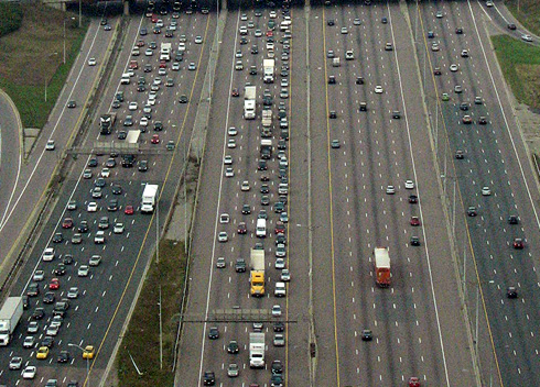
- Transport moves more people in less space and less overall investment. Toronto Highway 401[1] is an eighteen lane road and it moves fewer people per day than Metro line 1.

- Low car areas are better for local economies. People object to reducing traffic saying it will hurt local businesses, and the opposite is true. Where it's nice to exist outside of a car, that attracts people, and local businesses thrive.

- Reduced costs on health services from reduced pollution. Fewer doctor and hospital visits and prescriptions, for lung infections, breathing problems, asthsma and COPD in London after Low Emissions zones.

- Reduced environmental impact of fewer cars, fewer trips taken by car.

- Many people can't drive; all children, many injured or disabled people, many poorer people, many elderly people (can't or shouldn't), some people with e.g. DUI convictions. Some 20% of households in the UK have no access to a car. A matter of fairness and not prioritising the wealthy car owner.

Personally:

- No need to find parking, return to that carpark.

- Transit is more spacious. Being strapped into a carseat, elbows hitting doors, head hitting roof, knees hitting steering wheel, shins hitting dash, feet constrained in footwell, surrounded by explosives "for your protection" is a really unpleasant place to be.

- Less concentration needed. Driving requires constant attention. Even when transit is crowded, you don't have to do anything.

- Implemented well, transit takes priority over cars at turnings, crossings, junctions, roundabouts, and moves faster. Toronto trams do this especially poorly, apparently.

- Freedom. No need for a government approved license and ID. Not beholden to dragging a ton of steel boat-anchor around everywhere with you.

[1] https://3.bp.blogspot.com/-IRDiOiNYl9s/UEwAA79O2NI/AAAAAAAAG...
Re: How Madrid built its metro cheaply (2024)

#115

Earlier quoted context omitted.

Metro doesn't use PPP or directly public in any Indian city I can think of, they setup SPVs and actually have stable engineering and finance teams across contracts. And most of the engineers are taken from railways only in any case. And it's a really good promotion path, ministers are known to select successful metro spv administrators for lucrative roles in the state secretariat. They even have lateral movement betw…

Some metros are PPP Some are by contractors However, all are perpetually delayed Pune metro line 3's construction status was 85+% for over 1yr now Land acquisition was over a long time ago. Progress on road is just invisible despite being built by a private company which will operate it for the next 30yrs

All Indian metros without exception are managed by SPVs.

Land acquisition is not something that gets over. It is a continuous process. Then the court cases if any always show up with some delay, and that can revoke transfers. Then you have to look for alternative land parcels, which may involve minor reroutes in the worst case. It's the same with finances, everything comes in tranches, land, money, everything.

> Pune

You can see this entire documentation[1], make sure to click on the two section headers to reveal content. While no doubt the document might mislead you about the extent of the delay, and really % done means nothing in these projects where the unknowns are unknown, you can clearly see it's the exact coordination issues I had mentioned earlier: utility coordination, handling expanding flyovers/roads, etc.

> All are perpetually delayed

Because, it's not an internal organisation issue or a personnel issue (i.e "hire more engineers"). The exact organisation does not matter when the problems are of the external kind mentioned above.

Now, the problems mentioned in TFA don't occur here because the SPVs house long term employees with - for government standards - fairly robust institutional knowledge.

The top comment now has content refuting the article: https://news.ycombinator.com/item?id=48582433

> Look at the memes for Pune metro line 3 and for Karnataka metro (forgot which line)

The same memes exist everywhere: https://news.ycombinator.com/item?id=48582563

> Even though private

If you want real private efficiencies, you have to give the entire responsibility of many departments to the private company. So, a near-private whole sub-municipality. Just making the metro SPV private is meaningless, although definitely better than having it under PWD...

[1] https://www.pmrda.gov.in/en/pune-metro-line-3/maan-hinjawadi...

Re: How Madrid built its metro cheaply (2024)

#116

Earlier quoted context omitted.

Sounds like Spain all right. The article also makes a big deal out of country-level factors like the system of autonomous communities, governance, in-house expertise etc. But all of those should apply to Malaga as well, which also built a metro in the 2000s. But that one became a city-wide joke for always being supposed to open "this year" and that continued for at least 5 years... There was definitively none of the…

> in-house expertise This is under-appreciated. > I believe that the U.S. suffers from a distinct lack of state capacity. We’ve outsourced many of our core government functions to nonprofits and consultants, resulting in cost bloat and the waste of taxpayer money. We’ve farmed out environmental regulation to the courts and to private citizens, resulting in paralysis for industry and infrastructure alike. And we’ve le…

> * https://www.noahpinion.blog/p/america-needs-a-bigger-better-...

Woah, this is really a “worst person you known just made a great point” moment for me.

Re: How Madrid built its metro cheaply (2024)

#117

Meanwhile, bay area has companies with market cap of 30T (50T?), has nonexistent/incompatible and the slowest public transit. 1) BART 'works' for a subset of the population. 2) ACE train is one route only, from Stockton to San Jose. 3) Caltrain is one straight line. Caltrain has a bullet train that takes an hour for ~20-30 miles. 4) There is a ferry service for some parts of north bay. There are probably dozens of ot…

The two things you reference are very loosely related. I studied Transportation Engineering in the Civil department at UC Berkeley. I have always been very interested in public transportation. But I work as a Data Scientist in Silicon Valley rather than at one of the public transportation agencies. Because it pays roughly 10x as much. Every single one of the smartest people I went to school with is also now working in tech in Silicon Valley. A lot work on stuff like advertising optimization. Sigh.

Re: How Madrid built its metro cheaply (2024)

#118
post #60

Earlier quoted context omitted.

Why would anyone prefer public transit over a self driving comfortable personal car?

Because public transit, done well, is the fastest way to move around. It gets you everywhere, even to places personal vehicles can't reach. It's a lot cheaper. It generates hubs of activity that keep cities lively and relevant. It doesn't get stuck in traffic. It doesn't need to be parked. The benefits of good public transport are so mind blowing that it's difficult to explain unless you have lived on a city that has…

It takes 30 minutes to reach my workplace by bike, or alternatively 50 minutes by public transport.

Re: How Madrid built its metro cheaply (2024)

#119
post #60

Meanwhile, bay area has companies with market cap of 30T (50T?), has nonexistent/incompatible and the slowest public transit. 1) BART 'works' for a subset of the population. 2) ACE train is one route only, from Stockton to San Jose. 3) Caltrain is one straight line. Caltrain has a bullet train that takes an hour for ~20-30 miles. 4) There is a ferry service for some parts of north bay. There are probably dozens of ot…

Why would anyone prefer public transit over a self driving comfortable personal car?

Why would anyone prefer to drive when you can be driven?

Re: How Madrid built its metro cheaply (2024)

#120
post #60

Meanwhile, bay area has companies with market cap of 30T (50T?), has nonexistent/incompatible and the slowest public transit. 1) BART 'works' for a subset of the population. 2) ACE train is one route only, from Stockton to San Jose. 3) Caltrain is one straight line. Caltrain has a bullet train that takes an hour for ~20-30 miles. 4) There is a ferry service for some parts of north bay. There are probably dozens of ot…

Why would anyone prefer public transit over a self driving comfortable personal car?

Well, first of all, there is no such thing.

However, even if such a thing did exist, you still have to contend with traffic and total road capacity. So, for instance, taking local systems (details will vary by city, but not much), a double-decker bus is ten meters long and takes ~100 people. A tram is 55m long and takes about 550 people. A commuter train is 160m long and takes a thousand people (and doesn't share roads, of course). A car is 4-5m long and typically carries one or two people. Take any large city, attempt to replace the public transport with private cars, and there simply _will not be space_.

Fully-segregated metros in particular can also be much faster than cars in urban areas; they don't have to contend with traffic or intersections at all.

Post reply on HN