Live data from Hacker News

Memory access is O(N^[1/3])

vitalik.eth.limo

111–120 of 139 posts

Re: Memory access is O(N^[1/3])

#111

Earlier quoted context omitted.

Honestly, i doubt it. That exposes many details to the programmers that many of them would prefer not to know. The higher level the language, the less interest there is to manually manage memory. It is just something to offload to the gc/runtime/etc. So, i think this is a no-go. The market wont accept it.

You already don’t have a choice. The reason we are all in the cloud is that hardware stopped scaling properly vertically and had to scale horizontally, and we needed abstractions that kept us from going insane doing that. If you really want to dumb down what I’m suggesting, it’s is tantamount to blade servers with a better backplane, treating the box as a single machine instead of a cluster. If IPC replaces a lot of…

It's tricky to decode all this but there are a lot of misconceptions.

First, amdahl's law just says that the non parallel parts of a program become more of a bottleneck as the parallel parts are split up more. It's trivial and obvious, it has nothing to do with being able to scale to more cores because it has nothing to do with how much can be parallelized.

Second in your other comment, there is nothing special about "rust having the semantics" for NUMA. People have been programming NUMA machines since they existed (obviously). NUMA just means that some memory addresses are local and some are not local. If you want things to be fast you need to use the addresses that are local as much as possible.
Re: Memory access is O(N^[1/3])

#112
post #78

Earlier quoted context omitted.

It says that for a sufficiently large storage system, the information within will ultimately be limited by the surface area and not the volume. That you can indeed judge a book by its cover. For the sake of asymptotic analysis of galactic algorithms, one need only consider schemes for reading and writing information on the surface of a sphere. Where it comes to "real hardware," this sort of analysis is inapplicable.

The book you are presenting says nothing about latency. I judge the book as fine but not answering the right question.

It's obviously about latency. How do you not see the latency aspect of it?

Latency is directly bound by the speed of light. A computer the size of the earth's orbit will be bound by latency of 8 minutes. A computer the size of 2x of earth's orbit will be bound by a latency of 16 minutes, but have 4x the maximum information storage capacity.

The size of the book is directly proportional to the speed of light. Ever heard of ping? Does the universe you live in have infinite speed of light, and therefore you don't see how R contributes to latency?

Re: Memory access is O(N^[1/3])

#113
post #68

Earlier quoted context omitted.

> infinite-time or infinite-memory computer That doesn't apply for the Bekenstein Bound though. Literally the first line of the wikipedia article: > In physics, the Bekenstein bound (named after Jacob Bekenstein) is an upper limit on the thermodynamic entropy S, or Shannon entropy H, that can be contained within a given *finite* region of space which has a *finite* amount of energy—or equivalently, the maximum amount…

I'm arguing against the use of Big-O "in the limit" as GP puts it; our tech is far away from that limit and O(N^{1/3}) is a better model.

I mean, if you want to talk about our actual tech, it's bound by lithography of silicon chips, which are largely n^2, on printed circuit boards, which are n^2, on the surface area of the earth, which is n^2.

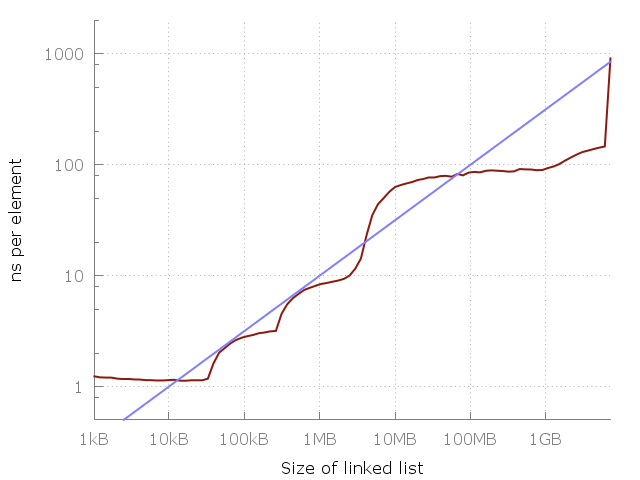
This has been observed since at least 2014: https://www.ilikebigbits.com/2014_04_21_myth_of_ram_1/3_fit....

Pretty much every physical metric pegs memory access as O(n^1/2).

Re: Memory access is O(N^[1/3])

#114
post #50

> The empirical argument > We can ask a question: how long (in nanoseconds) does it take to access a type of memory of which an average laptop has N bytes? Here's GPT's answer: "Here's what GPT says" is not an empirical argument. If you can't do better than that (run a benchmark, cite some literature), why should I bother to read what you wrote?

The empirical argument actually states that memory access is O(n^1/2)

https://www.ilikebigbits.com/2014_04_21_myth_of_ram_1/3_fit.... "The blue line is O(√N)."

This has been rehashed many times before, and the best blog post on this topic is here: https://www.ilikebigbits.com/2014_04_21_myth_of_ram_1.html

Re: Memory access is O(N^[1/3])

#115
post #19

Earlier quoted context omitted.

I hate big O notation. It should be O(N) = N^(1/3) That way O is the function and it's a function of N. The current way it's notated, O is the effectively the inverse function.

O(N) is not a function, though, so the notation is doing a good job of saying this. When we say "the complexity class of an algorithm is O(log N)", we mean "the function WorseCaseComplexity(N) for that algorithm is in the class O(log N)", The function "WorseCaseComplexity(N)" measures how much time the algorithm will take for any input of size N in the worse case scenario. We can also say "the average case complexity…

There are a lot of misconceptions and things being confused together in your post. For one complexity classes are related to decision problems, not algorithms. An algorithm does not have a complexity class, rather it's decision problems that belong to a complexity class. 3SAT is a decision problem that belongs to the NP-complete complexity class regardless of any particular algorithm that implements a solution to it.

Secondly, it's a common misconception that O(f(n)) refers to worst case complexity. O(f(n)) is an upper bound on the asymptotic growth of f(n). This upper bound can be used to measure best case complexity, worst case complexity, average case complexity, or many other circumstances. An upper bound does not mean worst case.

For example I often perform code reviews where I will point out that a certain operation is implemented with the best case scenario having O(log(N)), but that an alternative implementation has a best case scenario of O(1) and consequently I will request an update.

I expect my engineers to know what this means without mixing up O(N) with worst-case scenarios, in particular I do not expect an improvement to the algorithm in the worst case scenario but that there exists a fast/happy path scenario that can avoid doing a lot of work.

Consequently the opposite can also happen, an operation might be implemented where the worst case scenario is o(N), note the use of little-o rather than big-o, and I will request a lower bound on the worst case scenario.

Re: Memory access is O(N^[1/3])

#116
post #107

Earlier quoted context omitted.

Better than "according to Google" (pre ai) which I saw cited too many times. I have a feeling that people who have such absolute trust in AI models have never hit regen and seen how much truth can vary.

In no way is it better than "according to Google".

Maybe when google actually did searches. A coworker today was unable to find a very straightforward quoted text on google, on duckduckgo the first few hits were exactly what we were looking for.

Re: Memory access is O(N^[1/3])

#117
post #50

> The empirical argument > We can ask a question: how long (in nanoseconds) does it take to access a type of memory of which an average laptop has N bytes? Here's GPT's answer: "Here's what GPT says" is not an empirical argument. If you can't do better than that (run a benchmark, cite some literature), why should I bother to read what you wrote?

> why should I bother to read what you wrote?

The better question is: Why should you bother to read what the author didn't bother to write?

Re: Memory access is O(N^[1/3])

#119

Earlier quoted context omitted.

O(N) is not a function, though, so the notation is doing a good job of saying this. When we say "the complexity class of an algorithm is O(log N)", we mean "the function WorseCaseComplexity(N) for that algorithm is in the class O(log N)", The function "WorseCaseComplexity(N)" measures how much time the algorithm will take for any input of size N in the worse case scenario. We can also say "the average case complexity…

There are a lot of misconceptions and things being confused together in your post. For one complexity classes are related to decision problems, not algorithms. An algorithm does not have a complexity class, rather it's decision problems that belong to a complexity class. 3SAT is a decision problem that belongs to the NP-complete complexity class regardless of any particular algorithm that implements a solution to it.…

> An algorithm does not have a complexity class, rather it's decision problems that belong to a complexity class. 3SAT is a decision problem that belongs to the NP-complete complexity class regardless of any particular algorithm that implements a solution to it.

Both algorithms and problems have their own complexity. The complexity of an algorithm is the time it takes that algorithm to finish. For example, quicksort is an algorithm, and its average case complexity is in O(n log n). I called O(n log n) a complexity class, this was indeed sloppy on my part - I was just trying to find a name for this set.

> Secondly, it's a common misconception that O(f(n)) refers to worst case complexity.

I know, and my post was very explicitly avoiding this misconception. I explicitly gave the example that the average case complexity of quicksort is in O(n log n).

> Consequently the opposite can also happen, an operation might be implemented where the worst case scenario is o(N), note the use of little-o rather than big-o, and I will request a lower bound on the worst case scenario.

I'm not sure what you're trying to say in this part. o(n) is basically the set of all sublinear functions, e.g. log(n), but also 1. Any function in o(n) is also in O(n), though the converse doesn't hold. So, if you know an algorithm has worse complexity in o(n), you know more information about the algorithm than if I tell you it has worse case complexity in O(n). Knowing a lower bound is still useful in either case, of course, since a constant time algorithm and a logarithmic time algorithm are still both in both sets.

Re: Memory access is O(N^[1/3])

#120
post #50

> The empirical argument > We can ask a question: how long (in nanoseconds) does it take to access a type of memory of which an average laptop has N bytes? Here's GPT's answer: "Here's what GPT says" is not an empirical argument. If you can't do better than that (run a benchmark, cite some literature), why should I bother to read what you wrote?

The empirical argument actually states that memory access is O(n^1/2) https://www.ilikebigbits.com/2014_04_21_myth_of_ram_1/3_fit.... "The blue line is O(√N)." This has been rehashed many times before, and the best blog post on this topic is here: https://www.ilikebigbits.com/2014_04_21_myth_of_ram_1.html

Empirical arguments do not apply to asymptotics anyway.
Post reply on HN