Live data from Hacker News

No evidence social media time is correlated with teen mental health problems

psycnet.apa.org

111–120 of 137 posts

Re: No evidence social media time is correlated with teen mental health problems

#111
post #89
post #63

Earlier quoted context omitted.

Yes, that's academic discourse for you. Why do you assume this critique is more authoritative than the paper? Would you dismiss the critique if it was the other direction?

Neither is more authoritative, but if we lay aside science to rely on our common sense, then we'll get to "we don't really know, but my guts say me that X is true", aren't we? If we look at the scientific consensus once again, we'll see that there is no scientific consensus. So the whole situation boils down to "we don't really know".

I agree! Which is why I'm so surprised that folks feel so strongly one way or another about it when there's been so little consensus. To me the jury is very much still out on this one.

Re: No evidence social media time is correlated with teen mental health problems

#112

Anecdata isn't useful, but each of three children in our family experienced "externally observable" and self-reported improvements to their "mental health" each and every time they were banned from devices they used for "social media time", with immediate regressions/worsening once the bans were over. You could say maybe they needed better friends, and I wouldn't argue that, but that's three very different teenagers…

Again, anecdotal, but as a father of teenage children, there is 0% doubt in my mind that large amounts of social media consumption is detrimental to their development, wellbeing, and academic performance

Nothing says scientific method like "0% doubt in my mind the hypothesis is true."

Re: No evidence social media time is correlated with teen mental health problems

#113
post #111
post #89

Earlier quoted context omitted.

Neither is more authoritative, but if we lay aside science to rely on our common sense, then we'll get to "we don't really know, but my guts say me that X is true", aren't we? If we look at the scientific consensus once again, we'll see that there is no scientific consensus. So the whole situation boils down to "we don't really know".

I agree! Which is why I'm so surprised that folks feel so strongly one way or another about it when there's been so little consensus. To me the jury is very much still out on this one.

Sounds like skepticism.

Re: No evidence social media time is correlated with teen mental health problems

#114

Earlier quoted context omitted.

Why is this "scathing"? He's literally just positing simple facts, which may or may not be true. This tendency of people nowadays to focus on tone and other irrelevant characteristics of an argument (as it is made) is dumb.

Humans commonly engage in deceptive rhetoric, and tone is one of the methods they use. Often, the individual may not even be doing it with substantial intention. Wordplay is another, and there is plenty of it in this HN thread.

But surely someone reading what is purportedly a scientific argument should be interested entirely in the scientific argument, don't you think?

Boy that Einstein fellow's paper sure had a gruff tone I'm sticking with Newton!

Re: No evidence social media time is correlated with teen mental health problems

#115
post #49

Earlier quoted context omitted.

As a layperson who doesn't understand psychology but is interested in science and peace, I felt that Ferguson's article (this HN post) was much less directed at a person (as opposed to the person's work or theories put forward) and more professional, versus the linked blog post -- so I tend to believe the former. Even a simple sentence like, "Ferguson did both of these things and his findings thus do not “undermine”…

Why is this "scathing"? He's literally just positing simple facts, which may or may not be true. This tendency of people nowadays to focus on tone and other irrelevant characteristics of an argument (as it is made) is dumb.

I argue it's relatively scathing, because Haidt's wording is much more dramatic, negative, and more aimed at a person than Ferguson's wording is. By "facts" I assume you mean claims, no?

I'm not sure how tone would be irrelevant; similar to what a sibling commenter said, tone conveys quite a bit of information. It seems unwise or "dumb" to ignore that, because we're still humans talking to each other, even if it's bits over a wire, and we're working together in good faith to learn and solve problems, aren't we?

Re: No evidence social media time is correlated with teen mental health problems

#116

Earlier quoted context omitted.

Humans commonly engage in deceptive rhetoric, and tone is one of the methods they use. Often, the individual may not even be doing it with substantial intention. Wordplay is another, and there is plenty of it in this HN thread.

But surely someone reading what is purportedly a scientific argument should be interested entirely in the scientific argument, don't you think? Boy that Einstein fellow's paper sure had a gruff tone I'm sticking with Newton!

That's an interesting point, doesn't this depend on the expertise of the audience? I'm not a psych expert, so if I'm unwilling to go back to school to interpret both sides "perfectly" then I'd be unsuccessful judging both sides on their factual/scientific merit. I only have other tools to choose from, ie. my personal experience, reading skills, being a (hopefully good) judge of character, etc.

Re: No evidence social media time is correlated with teen mental health problems

#118

Earlier quoted context omitted.

Humans commonly engage in deceptive rhetoric, and tone is one of the methods they use. Often, the individual may not even be doing it with substantial intention. Wordplay is another, and there is plenty of it in this HN thread.

But surely someone reading what is purportedly a scientific argument should be interested entirely in the scientific argument, don't you think? Boy that Einstein fellow's paper sure had a gruff tone I'm sticking with Newton!

The scientific argument originates from a human, and science has well demonstrated that human perception is untrustworthy (this thread offers plenty of evidence, but that tends to be categorized as "just X", so the ubiquitousness of the problem can never be realized...aka: there "is no evidence" that what I say is true).

Science uses a watered down but more ~practical form of epistemology, for example equating the knowledge of scientists with all of reality (There is no evidence [that I know of]). Some disciplines (military) use special language to circumvent this problem, at least sometimes.

There is what is true, and then there is the human experience of it, and scientists like most other humans mix the two up regularly. Doing otherwise is "pedantic", and is strongly culturally discouraged.

Re: No evidence social media time is correlated with teen mental health problems

#119
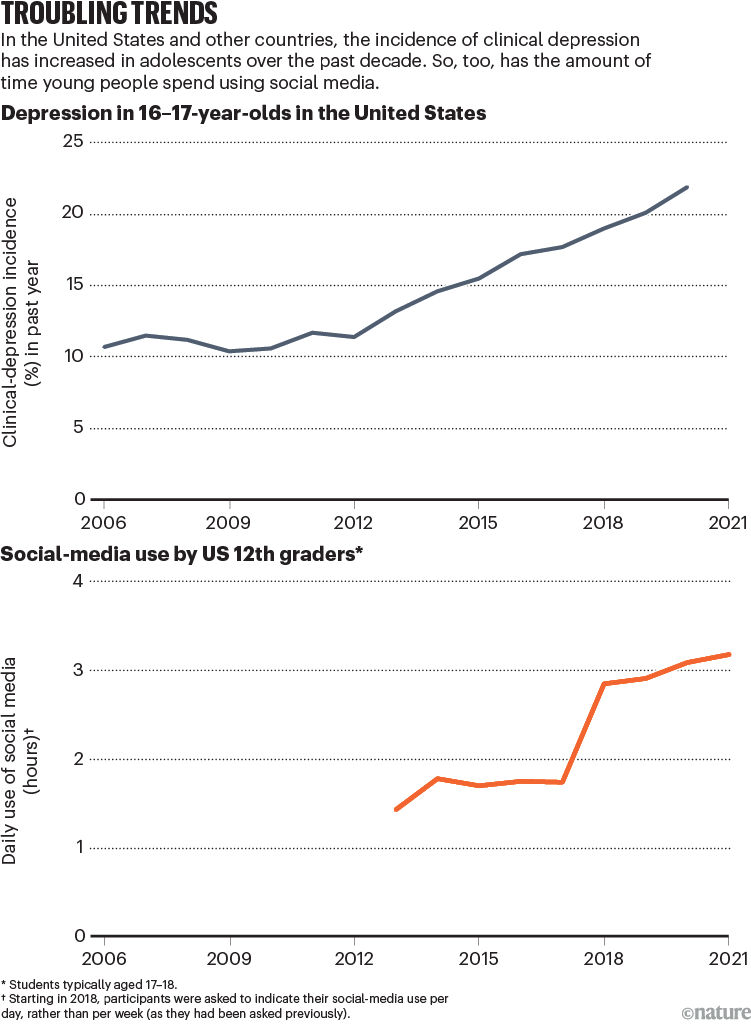
The Surgeon General's report [0] cited 3 studies showing 1) that limiting social media to 30 minutes per day among college students for 3 weeks significantly reduced loneliness and depression [1], 2) deactivating Facebook before the 2018 midterm elections increased subjective wellbeing and polarization,[2] and 3) that 10,904 14 year olds in the UK Millennium Cohort Study experienced an increase in depressive symptoms in association with greater daily social media use, with a stronger association for girls than boys (depressive symptoms in adolescents using social media for 3 to Fully 57% of high school aged girls--(more than half!)--experienced feelings of persistent sadness or hopelessness in 2021, up from 36% in 2011 [4]. Over the same timeframe, average time spent using social media each day among teens doubled from about 1.5 hours to more than 3 hours [5].

I am not waiting for a randomized controlled study. There are serious harmful effects of the environment our kids are growing up in today, and part of that is a growth in social media. Let us not forget that Mark Zuckerberg, "personally and repeatedly thwarted initiatives meant to improve the well-being of teens on Facebook and Instagram...[overruling] Instagram CEO Adam Mosseri and President of Global Affairs Nick Clegg, who had asked Zuckerberg to do more to protect the more than 30 million teens who use Instagram in the United States." [6] Not enough evidence? In the words of Bob Dylan, "you don't need a weatherman to know which way the wind blows."

Sources

0.https://www.hhs.gov/sites/default/files/sg-youth-mental-heal...

1.https://guilfordjournals.com/doi/10.1521/jscp.2018.37.10.751

2.https://www.aeaweb.org/articles?id=10.1257/aer.20190658

3. https://www.thelancet.com/journals/eclinm/article/PIIS2589-5...

4. https://www.cdc.gov/healthyyouth/data/yrbs/pdf/YRBS_Data-Sum...

5. https://images.nature.com/lw1200/magazine-assets/d41586-023-...

6. https://www.cbsnews.com/sacramento/news/zuckerberg-rejected-...
Re: No evidence social media time is correlated with teen mental health problems

#120
post #94

"I conducted a meta analysis of 46 studies and concluded that there is _no correlation with social media and teen mental health issues" What about the studies that that _do_ show a correlation, of which there are more than one. Why were those discounted?

Meta analyses look across published studies and essentially do statistics on these. The claim of the paper is that the studies that show adverse effects are explainable by fluke, and presumably are outnumbered by studies that don't show adverse effects.
Post reply on HN