Live data from Hacker News

Mercedes and Ferrari’s edge in the electric car age: high-end axial motors

bloomberg.com

111–120 of 283 posts

Re: Mercedes and Ferrari’s edge in the electric car age: high-end axial motors

#111
post #16

Current motors are enough for public road non-tow performance. I don't see practical significant advantage.

Sure, we all know the big bottleneck for EV's is the batteries. But there's a lot of individually tiny things that can be improved to make that battery last longer. Like high-strength steels, aluminum or even composite construction to save weight, aerodynamic improvements, low rolling resistance tires, and yes, light-weight high-efficiency motors like this article talks about.

Could we make do with ye olde three-phase induction motor? Sure, that is an extremely good design, simple and yet pretty high efficiency and with a century-long track record. But if we can make something lighter-weight and with even better efficiency, why shouldn't we do it?
Re: Mercedes and Ferrari’s edge in the electric car age: high-end axial motors

#112

Earlier quoted context omitted.

With regards to your general rule statement. There has been a lot of discussion/reporting around the manufacturing and design of Tesla cars that is way behind that of the likes of Toyota, Nissan and Honda. The computer systems are state of the art, but in with regards to the design and manufacturing of its chassis, Tesla has been historically behind the times. Just because Tesla doesn’t do it, doesn’t mean it’s not t…

Partly I agree and its the reason I have been disappointed specially in Toyota trying to protect it cash cow and supply chain. They are not really getting into electric cars. Even today they are trying to hedge with hydrogen fuel cars its as they feel hydrogen cars will require the least amount of changes for their supply chain.

Even Toyota isn't large enough to influence the market like that, they will have to cave sooner or later if they want to stay in business.

Re: Mercedes and Ferrari’s edge in the electric car age: high-end axial motors

#113
post #80
post #17

Earlier quoted context omitted.

- Tesla doesn’t offer LiDAR sensors, even if it’s clearly the best technology to use for the autopilot.

Not even close. Psuedo-LiDAR approach is the way to go and everyone knows it. Waymo and others using LiDAR placed the wrong bet and now have nothing to show for it.

You work on autopilot at Tesla. You are _the_ demonstration that Tesla's camera based approach is insufficient, has awful deficiencies and is a dangerous product. I wouldn't be saying much if I were you.

Re: Mercedes and Ferrari’s edge in the electric car age: high-end axial motors

#114
post #7

Earlier quoted context omitted.

The idea of a motor on each wheel independent has obviously been considered, but what is often ignored is the sprung vs unsprung weight. You could develop a pretty amazing off-road vehicle with independent electric motors in each wheel, but it would be a relatively bumpy ride.

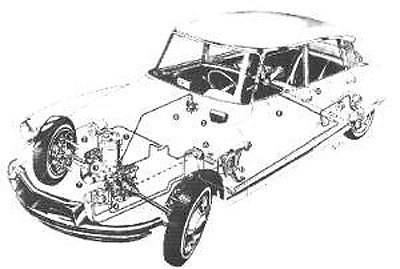
The Mercedes 300SL, the Gull Wing of 1954, already had inboard-mounted brakes to reduce unpsrung weight. I would assume that any Mercedes engineer would be familiar with the concept...

Citroen DS as well:

http://www.citroenet.org.uk/passenger-cars/michelin/ds/image...

Re: Mercedes and Ferrari’s edge in the electric car age: high-end axial motors

#115
post #98

Earlier quoted context omitted.

I'm talking about experts on how we should live and structure society as a whole. Climate science is one tiny part of that calculus. And no climate scientist has told me I should lock myself in my house and eat cockroaches while they gallivant in their private jets from mansion to mansion and gorge themselves on quail tongues and sturgeon eggs. EDIT: I didn't mean to say climate change is not happening or having nega…

> With such renown and respected experts as Gore, Obama, Trudeau, Gates, and DiCaprio as my guiding stars on this matter, it's clear that the experts are firmly on my side, and anybody saying otherwise is a dangerous extremist denier. I think a big flaw in your thinking is that for these people climate change won't have big consequences equals in climate change won't have big consequences for you. They can pay there…

If society degenerates to the point I need to buy another house somewhere more habitable or pay personal security to protect myself from looters, or cease being able to afford necessities within my lifetime, it will almost certainly be due to the effect of climate regulations and policies, rather than climate change itself. So if you think I should look at it from a purely selfish perspective, then I should actually demand inaction.

Re: Mercedes and Ferrari’s edge in the electric car age: high-end axial motors

#116
post #29

While I like the technology aspect, I am secretly rooting for expensive cars to become uncool. Small boring self-driving cars, possibly collectively owned instead of big expensive individually owned cars often used as a proof of social status.

call me a skeptic, I've worked in the auto industry as a heavy engine master tech for over 20 years, but the same luxury manufacturers who can't make a v8 that lasts longer than 60k miles without a recall or major defect are not qualified to skip class and start making Ev's. Mercedes rolled out the 250 largely because biturbo has been a loss leading qc dumpster fire for the last decade. Audi can barely handle infotai…

> Audi can barely handle infotainment that doesn't brick and reboot on a road trip

This is a feature of all recent VAG cars. Nothing quite like your navigation and climate control freezing on a 1000 km road trip but there's no way to reset the computer so you have to wait a hour for it to fully crash and reboot.

Re: Mercedes and Ferrari’s edge in the electric car age: high-end axial motors

#117

Earlier quoted context omitted.

Partly I agree and its the reason I have been disappointed specially in Toyota trying to protect it cash cow and supply chain. They are not really getting into electric cars. Even today they are trying to hedge with hydrogen fuel cars its as they feel hydrogen cars will require the least amount of changes for their supply chain.

Even Toyota isn't large enough to influence the market like that, they will have to cave sooner or later if they want to stay in business.

Toyota are the largest car manufacturer in the world...

Re: Mercedes and Ferrari’s edge in the electric car age: high-end axial motors

#118
post #36

The perspective of this piece is a little suspicious: -ferrari still maintain that they will never produce electric cars -the concept of hub motors is a fad that has come and largely gone. Putting the motors inside the wheels leads to reliability concerns -motors with smaller diameter will need more power for the same performance of a larger diameter motor, and the battery is the heavy part Normally each of these i'd…

Ferrari's making the SF90 stradale as a Plug-in Hybrid Electric Vehicle.

https://www.ferrari.com/en-US/auto/sf90-stradale

Re: Mercedes and Ferrari’s edge in the electric car age: high-end axial motors

#119

Earlier quoted context omitted.

The Mercedes 300SL, the Gull Wing of 1954, already had inboard-mounted brakes to reduce unpsrung weight. I would assume that any Mercedes engineer would be familiar with the concept...

Citroen DS as well: http://www.citroenet.org.uk/passenger-cars/michelin/ds/image...

And a bunch of Alfa Romeos (Suds and Sprints from the 80s/90s at least)

Re: Mercedes and Ferrari’s edge in the electric car age: high-end axial motors

#120
post #7
post #4

> Putting a motor on each wheel — or at least one on each axle — could translate into hair-raising EV driving performance. I don't understand this. My Plaid Tesla has a motor on each of the rear axles, and it's direct coupled to the wheel. The already are doing torque vectoring. Like all things in engineering, the trade-off's are critical. This article doesn't go at all into the pros/cons of the approach Tesla (and o…

The idea of a motor on each wheel independent has obviously been considered, but what is often ignored is the sprung vs unsprung weight. You could develop a pretty amazing off-road vehicle with independent electric motors in each wheel, but it would be a relatively bumpy ride.

There are several cars that use this already. The issue is not so much ignored; but been dealt with. Multiple EV manufacturers have now successfully used this technology in vehicles. It seems the benefits outweigh the theoretical downsides.

Of course the question remains what happens in a high performance car at extreme speeds. But presumably, Ferrari and Mercedes know what they are doing and have considered this as well.

As for suspension; I'm sure there are ways to deal with that as well. I don't see how this should be any more bumpy than other vehicles for off-road.

A bigger concern would be what you'd do in case of a flat tire as that basically means losing an engine. And when you are in the middle of nowhere, getting some road assistance would not be that easy.

Post reply on HN