Live data from Hacker News

Why we need Lisp machines

fultonsramblings.substack.com

111–120 of 220 posts

Re: Why we need Lisp machines

#111
The problem with language wars is the people whom cannot be trusted with pointers, also cannot be trusted with lambdas or recursion.

The name of the game has always been to avoid directly insulting the bad programmers by making fun of the languages they use. Bad programmers have clustered in several languages over the course of my long career. Mostly they are the easiest most expressive languages, which would superficially seem to be an advantage, however they make it easy to express amazingly bad ideas. The harder to express languages require more work to express a bad idea thus somewhat filtering them out of that language's pool.

People whom don't understand the game think the game will be won if the bad programmers would have access to better languages for the first time in history. Despite the idea being decades old its always presented as a new idea.

There's an authoritarian streak where if only we could remove access to the inferior languages then they'd have to use the better languages and we'd have better code. However you can't force people to not use inferior tools and you can't force them to learn to use better tools.

The graph of easy to write and code goodness is interesting and nonlinear. You can express very complicated ideas in lisp easier than in vb6 or perl or interpreted basic or spaghetti fortran. However, you can express very bad ideas easier in a "bad" language, so it accumulates interesting authors. There is always a crossover point where an intermediate complexity idea is equally hard to express in a simple language or a complex language. Frankly most of IT needs are and always will be below that point. So its counterproductive to demand difficult language for simple tasks, everyone laughs at "Enterprise Java Hello World" that is 100K lines of enterprise patterns.

Expressing ideas in computer languages is much like expressing ideas in everyday language. Some esoteric philosophy texts require a VERY large precise complicated hard to use and hard to learn vocabulary. Road signs do not. For in between jobs, trying to use a minimum number of language vocabulary words and lexical complexity would be wise. It would be a fools errand to try to cut half the vocab words from street signs to "make driving safer", or an equally bad idea to force all road signs to be expressed as Shakespearean sonnets. The real world counterpart of "Enterprise Java Hello World" would be forcing the "No U Turn" street sign to be in the form of a Shakespearean sonnet.

The difficulty of tasks is usually under a power law, so its nice that we have lisp, but usually a bad idea to use lisp.

Re: Why we need Lisp machines

#112
Hardware LISP machines didnt survive the 1980s because you could emulate LISP on a general purpose CPU faster than a special machine. That is because faster new general purpose CPUs cane out every year or so, while it took 3-5 years for the next special purpose CPU.

Re: Why we need Lisp machines

#114

> You could open up system functions in the editor, modify and compile them while the machine was running. Why would you want to do that other than hot patching a system that can't go down? Testing new changes requires more time than rebooting. If you just want to test simple changes, most debuggers can do that. > Everything worked in a single address space, programs could talk to each other in ways operating systems…

> Testing new changes requires more time than rebooting.

no it doesnt

> Lisp is not type safe.

yes it is

Re: Why we need Lisp machines

#115

I'm as big of a Lisp fan as can be. I'm a proud owner of Symbolics and TI hardware: a MicroExplorer, a MacIvory, two 3650, and two 3620. Not to mention an AlphaServer running OpenGenera. Today, we have computers that run Lisp orders of magnitude faster than any of those Lisp machines. And we have about 3–4 orders of magnitude more memory with 64-bits of integer and floating point goodness. And Lisp is touted to have…

I'd say it's both. It seems most lisping is done high on the stack. Some are doing assembler level lisp (or scheme) but less bare metal / OS / system oriented lisp.

I wonder what the lisp os guy are thinking about OS / UI these days.

Re: Why we need Lisp machines

#116

I'm as big of a Lisp fan as can be. I'm a proud owner of Symbolics and TI hardware: a MicroExplorer, a MacIvory, two 3650, and two 3620. Not to mention an AlphaServer running OpenGenera. Today, we have computers that run Lisp orders of magnitude faster than any of those Lisp machines. And we have about 3–4 orders of magnitude more memory with 64-bits of integer and floating point goodness. And Lisp is touted to have…

> We don't "need" Lisp machines. We "need" Lisp software. What made a Lisp machines extraordinary wasn't the hardware, it was the software. Nothing today is impeding one from writing such software, except time, energy, willpower, and/or money. Discussed here https://news.ycombinator.com/item?id=30800520 The main issue is that Lisp, for all its inherent "power", has very limited tools for enforcing modularity boundari…

agreed, and well said

in broadstrokes, imo, Lisp's endless plasticity of infinitely nested parentheses is both its greatest strength and... its greatest weakness

I love it at Write time. hate it at Read/Maintain time. why I've avoided it for serious work. Python, Java, Go Rust etc are all easier for my brain & eyes to quickly parse on the screen

which is unfortunate. because I still drool at Lisp's linguistic power

Re: Why we need Lisp machines

#117

The key thing about those type of systems was the ability to reach down into the system and edit the code of the system currently in operation. Here's a demonstration of Symbolics Open Genera (TM) 2.0, demonstrated running in a virtual machine. It is noted by the author of the video in the first minute or so that even in emulation, it is much faster than the original machines. - https://www.youtube.com/watch?v=o4-YnL…

Why would you reach down into the system and edit the code of the system currently in operation? Because it doesn't already do what you want. Isn't it a bit pathalogical to start by building a system which doesn't do what you want, then building in the tools to let you fix it, so you can use those make it do what you want? Why not skip all the middlemen and make what you want in the first place?

If you arrive at "we can't do that because everyone wants different things", you're in this weird place where you can't build one system to suit everybody so as a fix for that you will ... make one dev system to suit everybody? Why is that going to work out any better? If people are going to have to build the system they want anyway, why not skip all the middlemen and leave people to build the system they want from scratch their own way?

"Well we can't do that, having to build everything from scratch is hard, people don't want that. And we don't know what people want (and can't be bothered to ask) and won't try to build it for them, but we can give everyone Our Blessed System and Our Blessed Tooling which we presume they will want to use, while we abandon them to have to build what they actually want using it". It's patriarchal and preachy and still unhelpful. The kind of person willing to put up with your system and language and its edge-cases and limitations instead of making their own, is quite likely the same person who would have put up with your spreadsheet and its edge-cases and limitations if only you'd built it.

It's the "all progress depends on the unreasonable person" meme; you need the person who can't tolerate a system which isn't perfect and demands to be able to tune it to their perfection, but is simultaneously fine with a customizable-system built by someone else for someone else's ideas. Then you say "ah but they can rebuild as much of the system as they want!" they're now having to build it themselves from scratch but based on what you built, which is even more work for them, not less.

And the whole thing says little about working with other people/organizations; everyone building their own thing isn't great for that. One could argue that Microsoft did a lot of good for the world by strongarming companies into .doc and .xls formats for interchange, in a similar way that HTTP/HTML did (but more tyrannically). Microsoft-Word-documents-over-email should probably go down in history as one of the big enablers of distributed human organization, like the telephone. Moreso than SMTP alone or TCP/IP alone which enabled computers to connect, not people. More than HTTP/HTML which ordinary people can't use without setting up a webserver and publishing first.

> "I think a future platform could take code in a number of languages, compile it to an abstract syntax tree, but preserve the context required to recreate the source. In fact, it's reasonable that you could import a routine in a language you aren't familiar with, and reverse the compilation to get it expressed in an equivalent (but less elegant) form in your language of choice, along with the original comments."

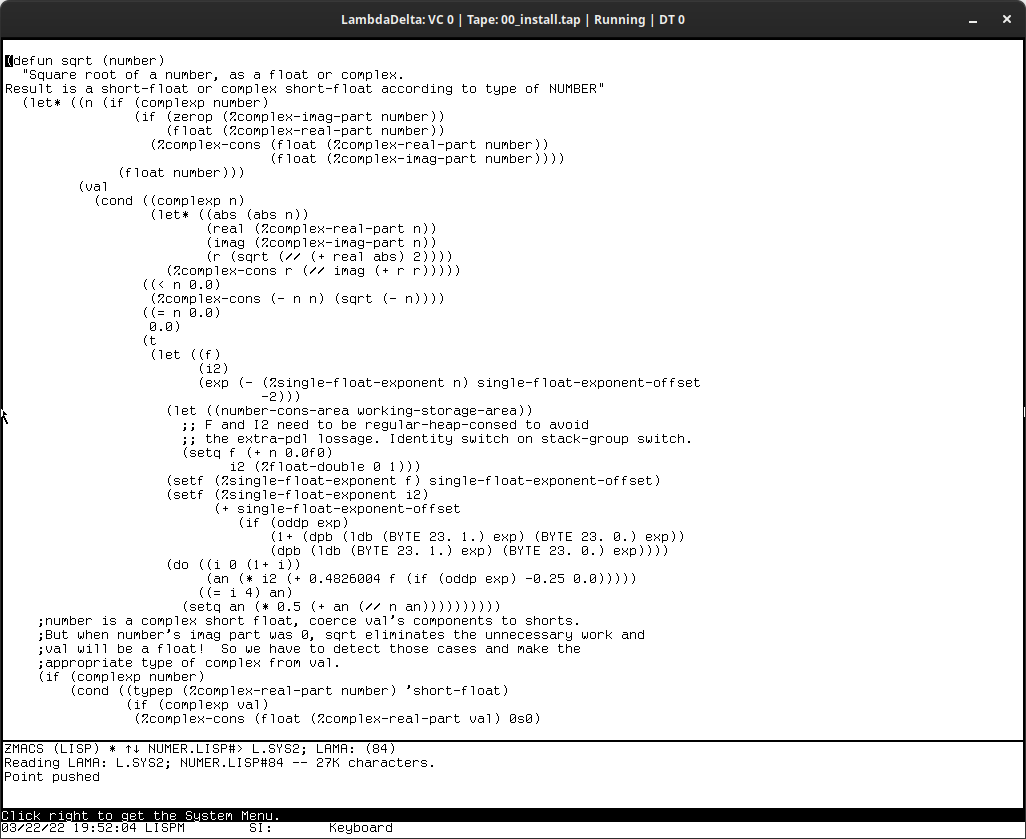
Would that even work? What about "code is primarily for people to read"; loss of indentation, of alignment, of variable names if you're changing language with different variable naming rules, loss of separate files/folder/module-context of how it was built in the first place, and loss of idiomatic patterns from changing one language to another, or to languages with different scoping behaviour. Look at the image in The Article for the square root code[1], can you decompile the syntax tree for a language which doesn't have a complex number type? What about one which doesn't have a short-float for the result, or has different floating point precision assumptions? What does "F and I2 need to be regular-heap-consed to avoid the extra-pdl lossage" mean for JavaScript or Python or Clojure? What's the magic 0.4826004 for, without any comments next to it?

And that square root function alone is a screenful of code, the very idea of being able to rebuild the system to your desires falls out the window if it's going to take you a lifetime to do that, and if not then we're back to my original paragraph where you're building a massive programmable system so someone can tweak one or two tiny things occasionally, which seems hella overkill.

> "Of course, if you are required to run code you didn't write and don't trust, your operating system must provide means to run it only against the files or folders you wish to let it operate on. The principle of least privilege needs to be supported at a fundamental level. This is one of the big shortcomings of the Unix model."

The XKCD comment that malicious code can ransomware all my documents and upload them to the cloud, but at least it can't add a new printer. One of the big shortcomings of the principle of least privilege is the effort of carefully and precisely describing the privileges needed - see the complexity and quantity of SELinux rules for a whole system. Even then you get immediately to the point where "my editor can edit all my text files" and that's now a large blast radius.

[1] https://cdn.substack.com/image/fetch/w_1456,c_limit,f_auto,q...
Re: Why we need Lisp machines

#118
post #95
post #72

Earlier quoted context omitted.

You are aware that Lisp machines understood several different flavors of Lisp? The Symbolics ones understood Zetalisp and Common Lisp at least. Were they on the market today they could be convinced to run Clojure and Scheme as well. There are a few old-timers developing Common Lisp applications to run on modern hardware, using Symbolics hardware. In fact, Symbolics shipped compilers for other non-Lisp programming lan…

OK interesting, I will check out the link. I still think various Lisps don't interoperate enough today, but I'm not very familiar with the Lisp machines of the past. If it can interoperate with C and Ada that's interesting. But I also wonder about interop with JavaScript :) i.e. not just existing languages but FUTURE languages. These are the M x N problems and extensibility problems I'm talking about on the blog.

If you’re fine with ES3, there’s https://marijnhaverbeke.nl/cl-javascript/ (I’ve been intending to use Babel to compile modern JS to ES3 and then load it into CL, but no time)

Or parenscript: https://parenscript.common-lisp.dev/

Or CLOG: https://github.com/rabbibotton/clog

And, there’s always the option of writing an HTTP or websocket server and serving JSON.

I personally use the SLIME repl in emacs for a ton of things I used to use bash one-liners for and you can push it pretty far (this is an experiment, I’ve wrapped it up more nicely into my .sbclrc since):

https://twitter.com/fwoaroof/status/1502881957012668417?s=21...

Re: Why we need Lisp machines

#119
The trend seems to be toward statically-typed languages, with the exception of the adoption of Python being used for data. I also prefer having more problems being found before deploying and running on production data.

Dynamic typing is great for prototyping, early development, and for small teams. If your definition of success is greater than that I would choose differently, or port at a good time early on.

And if someone were to ask me to join a company using lisp, I would hope that it's Clojure, though arguably not a Lisp, is better it that it will vary less between usages. This gives it a better chance of a growing ecosystem.

Re: Why we need Lisp machines

#120
post #48

Meh the problem is "Which Lisp?" There are dozens of incompatible Lisps. Even this site is written in a Lisp dialect written by its author (Arc). In fact I conjecture that this is the reason Unix is more popular than Lisp -- because Lisps don't interoperate well. They haven't built up a big ecosystem of reusable code. Whereas Python, JavaScript, R, C, C++, and Rust programmers can reuse each others' code via Unix-sty…

> Honest question: how do you communicate between two Lisp processes on two different machines?

Depends what level of integration you want: custom tcp/udp protocols, HTTP and websockets are all pretty easy. But, you can also use something like this over a trusted network/vpn: https://github.com/brown/swank-client

Post reply on HN