Live data from Hacker News

Rendering on the Apple M1 Max Chip

blog.yiningkarlli.com

111–120 of 328 posts

Re: Rendering on the Apple M1 Max Chip

#111
post #27

Earlier quoted context omitted.

and quite false. there are many laptop xeon CPUs. while costing more than the M1 Max, they beat the pants off it.

xeon branded workstation laptops aren't using Icelake-SP or similar server chips, they are using Tiger Lake-S or Ice Lake-S or Skylake-S client chips. They are what would previously have been branded as "Xeon E3" series chips - on the desktop platform they used to share a socket and be drop-in upgrades with consumer desktop chips, because they're basically the same chips with "enterprise" features like ECC turned on.…

Yes, your Xeon from 2013 example would be nowhere near the 2021 CPU from Apple. The outdated Xeon Apple had in their old laptops - a year behind everyone else, is also slower. The Xeon W-11955M however makes the M1 look like a kid's toy. In fact, if you remove 2 cores from that Xeon, you'll have my 6-core Xeon. Which also smokes that 10-core M1 in a bong.

I'm also not sure why you're sarcastic about ECC RAM. I have 128GB of RAM in my laptop. If it wasn't ECC, I'd have crashes in my VMs and errors in my calculations. When you go 32GB+ and actually use the RAM, anything that doesn't support ECC cannot be taken seriously for professional use. Like the M1 Max.
Re: Rendering on the Apple M1 Max Chip

#112
post #94

Earlier quoted context omitted.

it's launching this week fwiw

It's crazy that I can't get a bicycle chain for the next six months, but these chipsets are shipping?

> I can't get a bicycle chain for the next six months

Why?

Re: Rendering on the Apple M1 Max Chip

#113
post #80

Earlier quoted context omitted.

It has to be 3x faster to match M1's efficiency given the TDP is 30 vs 105.

I could care less about efficiency, it's still 2x faster for 2/3x less expensive. Isn't the m1 max tdp between 60 and 90w?

If you could conceivably run a chip at a much higher TDP before hitting thermal limits you could get significantly more performance. Not that you can (probably) OC these chips at all but it suggests there may be more rabbits in the bag.

Re: Rendering on the Apple M1 Max Chip

#114
post #19

I mean apple have it "easy", they control the hardware and the software, they don't need to to something that work with pci, old ram, thousands of different configs, different disk etc ... They can do whatever they want with 0 compatibility or backward compatibility. Why is the test not testing against some AMD CPU, CPU that cost $400, 5800x or 5900x for example.

You’ve correctly identified one reason Apple’s hardware is so effective: they have a hardware-accelerated standard library, something that requires cooperation between their software and silicon developers. The nearest comparison is if Dell released a line of servers that, when paired with Ubuntu LTS, provided a hardware-accelerated glibc. They could do this at any time, but it’s not easy; the capital cost is incredi…

A lot of good it does them. MacOS is an incredibly poor performing OS. For years, Windows and especially Linux have been more responsive and load faster than macOS on similar hardware, despite not being in a vertically-integrated hardware/software system.

It's difficult to imagine how anyone can think that M1 is "competing" with Intel or AMD because of this. You won't be getting macOS on any new x86 processor, and you won't be getting Windows on an M1.

For the vast majority of people, M1 provides no meaningful decision point. It's not like I'm going to stop using Linux on my servers, pull out of the cloud, and build a closet full of M1 Mac Minis. I could write my day job software from a Mac, but again, I'm not really getting much of a benefit from that because of the rest of the issues with the OS. And gaming is a no-go. So what is the point?

Re: Rendering on the Apple M1 Max Chip

#115

The new Alder Lake CPU from Intel for laptops is faster than M1 MAX: https://wccftech.com/intel-alder-lake-mobility-cpu-benchmark... So, nothing special about M1, especially if you consider that Adler Lake will use an older manufacturing process (7nm vs 5nm used by Apple).

Assuming a 100-watt battery and/or a 3.5-pound weight restriction, how many hours of battery life would you get from an Alder Lake laptop in those rendering tasks, in comparison to the M1 MAX laptop?

How many pounds of battery would an Alder Lake laptop required to match the uptime of the M1 MAX laptop performing those rendering tasks?

My mental napkin math suggests extremely unfavorable answers for an Alder Lake laptop, to the degree that the laptop's viability in the market would be severely compromised by sustaining the power and cooling required by Alder Lake for long-duration workloads such as rendering.

Re: Rendering on the Apple M1 Max Chip

#116
post #27

Earlier quoted context omitted.

xeon branded workstation laptops aren't using Icelake-SP or similar server chips, they are using Tiger Lake-S or Ice Lake-S or Skylake-S client chips. They are what would previously have been branded as "Xeon E3" series chips - on the desktop platform they used to share a socket and be drop-in upgrades with consumer desktop chips, because they're basically the same chips with "enterprise" features like ECC turned on.…

Yes, your Xeon from 2013 example would be nowhere near the 2021 CPU from Apple. The outdated Xeon Apple had in their old laptops - a year behind everyone else, is also slower. The Xeon W-11955M however makes the M1 look like a kid's toy. In fact, if you remove 2 cores from that Xeon, you'll have my 6-core Xeon. Which also smokes that 10-core M1 in a bong. I'm also not sure why you're sarcastic about ECC RAM. I have 1…

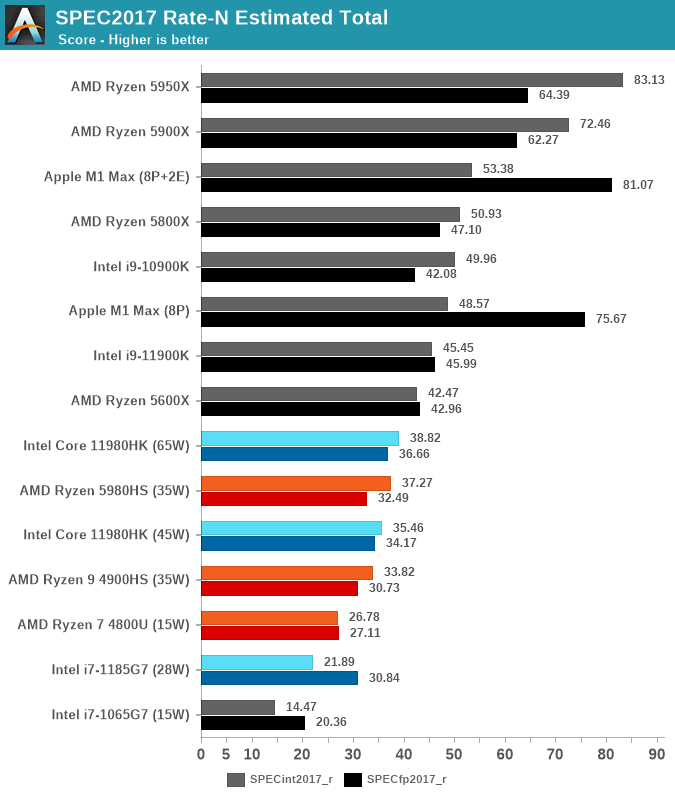
The point is that a laptop Xeon from 2021 is also going to be the same as an 1185G7 or something similar - because they’re the same silicon. It’s not like you’re getting more silicon because it’s a Xeon, it’s not a server chip, it’s just a laptop chip with the enterprise features enabled.

So, really no need to test them specifically. Go get an 1185G7 or something and you know what “Mobile Xeon” benches will look like. Anandtech already did those benches.

https://images.anandtech.com/graphs/graph17024/117496.png

Re: Rendering on the Apple M1 Max Chip

#117
post #11

Earlier quoted context omitted.

Mmh, perhaps the fixed width instruction set makes ultra wide decoders easier.

I am not a chiphead either (but I used to live with some) I think easier decoders => shorter pipeline, less silicon footprint for decode, possibly more silicon for reordering logic, less dark silicon, etc. To be fair the chipheads I lived with were gaga about VLIW, so there was certainly a bias there.

I mean, VLIW is fantastic as long as you have very predictable workloads with high parallelism and little branching that are very easily statically scheduled.

If you want to design a DSP or something, where you know it’ll be 100% saturated all the time with an absolutely predictable workload, it’s extremely efficient. Same for AMD Terascale GPUs back in the days before async compute and other GPGPU style tasks took over.

Re: Rendering on the Apple M1 Max Chip

#118

>in order to give the M1 Max some real competition, one has to skip laptop chips entirely and reach for not just high end desktop chips, but for server-class workstation hardware to really beat the M1 Max this is really interesting

Not really, because the first Xeon CPU he compares against is ten years old . That kind of system isn't worth the cost of shipping it somewhere. A current generation desktop i3 is likely faster in almost any workload. It's not even interesting that the M1 is "slightly" beaten by a Mac Pro's Xeon, because nobody is doing raytracing on CPUs . A Pascal nvidia GPU will render scenes in Blender faster than a current mid-t…

Almost every Blockbuster film you watch has raytracing done on the CPU. A lot of studios have dabbled with GPU pathtracing, and indeed it works for smaller projects like commercials and TV. However big set pieces just don't jive well with GPU rendering, and most GPU path tracers are too young to feature all the bells and whistles productions want.

Re: Rendering on the Apple M1 Max Chip

#119
post #2

> There’s really no way to understate what a colossal achievement Apple’s M1 processor is; compared with almost every modern x86-64 processor in its class On the other hand I'm sure there's more than a few chipheads out there who are saying "it's about time", there was a longstanding prediction that the arm architecture would overtake x86.

Yeah, your quote is a bit unfair to x86 - after all the x86 architecture is hampered by having to maintain compatibility not only with the original 8086, but also with most other instruction set extensions that Intel and/or AMD came up with during the last 40 years. Compared to that, the M1 is almost a "clean sheet" design. So, while still a great achievement, its dramatically better efficiency is not that surprising. I wonder however if Apple leading the way will also enable the PC (Windows/Linux) platform to leave its x86 past behind. Microsoft has been trying to sell ARM-based tablets for years, but without a lot of success, because there's not enough native software available.

Re: Rendering on the Apple M1 Max Chip

#120
post #116

Earlier quoted context omitted.

Yes, your Xeon from 2013 example would be nowhere near the 2021 CPU from Apple. The outdated Xeon Apple had in their old laptops - a year behind everyone else, is also slower. The Xeon W-11955M however makes the M1 look like a kid's toy. In fact, if you remove 2 cores from that Xeon, you'll have my 6-core Xeon. Which also smokes that 10-core M1 in a bong. I'm also not sure why you're sarcastic about ECC RAM. I have 1…

The point is that a laptop Xeon from 2021 is also going to be the same as an 1185G7 or something similar - because they’re the same silicon. It’s not like you’re getting more silicon because it’s a Xeon, it’s not a server chip, it’s just a laptop chip with the enterprise features enabled. So, really no need to test them specifically. Go get an 1185G7 or something and you know what “Mobile Xeon” benches will look like…

>enterprise features enabled

Right. That's what a pro laptop is. 128G of ECC RAM so you don't get crashes and errors. 24MB of cache. Fast and solid. That's a workstation - we use those for work.

But... Now you're saying the xeon I listed is the same as a 1 year old CPU, with half the cache of the Xeon, a lower clock, and half the core count. The mental gymnastics you have to perform are funny as hell to watch. Trump voter?

Post reply on HN