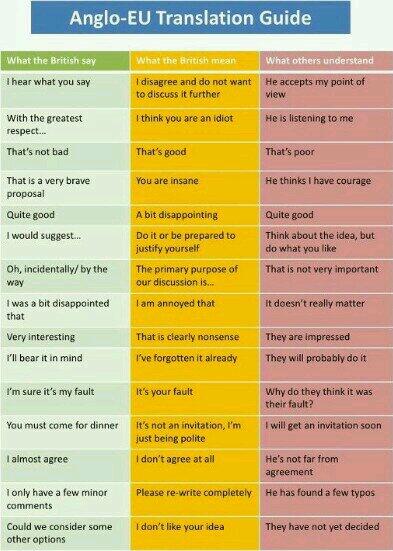
There is a British English version of this, which has been around on the internet for a few years. A friend of my partner's, who works at a high level in the European commission told us that it is passed around in diplomatic circles as a (non-ironic) instruction manual. The American/British preference for avoiding direct communication is apparently not normal in Europe at all, and causes a lot of confusion amongst pe…
American Phrase Book
111–120 of 177 posts
Re: American Phrase Book
#112Yup. One of the great mysteries of the world is how Americans think they are so straightforward and direct and honest... and then they ask a German if their butt looks big in these pants, and burst into tears on hearing the answer. On a mildly more serious note, I remember well my first ever serious business meeting in the US, where we pitched a potential joint venture to another company. 30 minutes of mutual praise…
This is something of a misunderstanding of American culture. It's far more complex than can be summarized in a HN comment, but it's more accurate to say that American culture prides itself on accessibility, egalitarianism, and a "lack of barriers" more than directness, defined as pure unfiltered honesty, per se. A good example to illustrate this phenomenon: in most American cities, it is considered fairly normal, eve…
This resonates with my recent experience. I'm Indian, but I live in Europe, and during a recent trip to the US, I was amazed by how easy going the people were. I was able to have nice conversations with random locals. From a nice uncle spontaneously telling us about the history of Santa Cruz to a stranger helping us park the car properly in SF, to jolly waiters in restaurants, it all felt very human. I find it quite hard to make small talk in European cities. I used to think it's the language barrier, but I realize now that it might be more than that.
Re: American Phrase Book
#113There's a bit of a directness/politeness spectrum, and even in the US there are different places on the spectrum, with the Northeast being more direct, the West and South being more polite. I would say we're not nearly as polite as the English--who can often get away with completely insulting an American without the American ever realizing it--but we're also not Dutch :)
Re: American Phrase Book
#114Earlier quoted context omitted.
Non-Americans always harp on this yet don't understand that "How are you?" is just functioning as a generic "Hello" and not as a literal question. This happens in every language with various phrases. For example, the phrase for "Hello" in most European languages directly translates to "Good Day." It is not as if people are saying "Good Day" in any literal sense of the words; the meaning implied is "Hello."
> Non-Americans always harp on this yet don't understand that "How are you?" is just functioning as a generic "Hello" and not as a literal question. This happens in every language with various phrases. We very much understand that. Our problem/concern/issue is that you don't seem to expect/appreciate the outpour of how one has been in the first place, whereas elsewhere it's a natural part of meeting the other person.…
"How's it going?" when used as a greeting, is typically only used in brief interactions, like passing someone in the hallway.
In a longer conversation, there are numerous phrases (including "How are you?") which, combined with the fact that the conversation is extended (i.e. you are both sitting at a table, or haven't seen each other in awhile) are universally assumed to mean that the person wants to know "how you are." It's a sort of game that one does subconsciously.
I can see how it appears to be nonsensical and random, but there is definitely a method to the madness, and I wouldn't say that American people care less about asking people how they are.
Re: American Phrase Book
#115Yup. One of the great mysteries of the world is how Americans think they are so straightforward and direct and honest... and then they ask a German if their butt looks big in these pants, and burst into tears on hearing the answer. On a mildly more serious note, I remember well my first ever serious business meeting in the US, where we pitched a potential joint venture to another company. 30 minutes of mutual praise…
Americans who think of themselves as straightforward and direct and honest are usually thinking of themselves in comparison to other Anglophone cultures. Since very few of us speak German or go to Germany, we wouldn't know how direct they are anyway.
Re: American Phrase Book
#116Nice
Re: American Phrase Book
#117Earlier quoted context omitted.
"restroom" Is "loo" any less ambiguous? Speaking of Brits, they did point out the perils of faulty phrase books many years ago: https://youtu.be/bNP7uQQT-oo
Strictly speaking it is less ambiguous. I understood it to be a shortened corruption of lavatory and it's worth noting that the English definition of that gives toilet, and the American definition gives the sink in the toilet, which kind of reinforces my point.
I took "loo" to be from "gardy loo", which in turn is a corruption from the French "gardez l'eau", meaning "watch out down there, I'm tipping this bucket out of the window".
So "loo" would be from "l'eau", meaning "water"; so possibly "water closet", or WC, a.k.a. crapper.
Re: American Phrase Book
#118[deleted]
Re: American Phrase Book
#119Earlier quoted context omitted.
Which cultures would be considered high-context? (Genuinely curious)
Not sure if everybody would agree, but here's one chart I found: https://online.seu.edu/wp-content/uploads/795x400-Internatio... > In high-context communication, a message cannot be understood without a great deal of background information. Asian, African, Arab, central European and Latin American cultures are generally considered to be high-context cultures. https://online.seu.edu/articles/high-and-low-context-cultu…
Cultures that differ the most from author’s require most context to be understood by author? Hardly surprising.
The quoted source is an anthropological work from 1959, a time when anthropology still wanted to be a natural science. These sort of generalizations do not go over well in contemporary cultural anthropology.
Re: American Phrase Book
#120Earlier quoted context omitted.
Non-Americans always harp on this yet don't understand that "How are you?" is just functioning as a generic "Hello" and not as a literal question. This happens in every language with various phrases. For example, the phrase for "Hello" in most European languages directly translates to "Good Day." It is not as if people are saying "Good Day" in any literal sense of the words; the meaning implied is "Hello."
These things are complicated though. I’m a kiwi and on moving to the UK it took ages to figure out that “alright?” meant “hello”, not “what’s wrong?”
Where I live (a corner of Ireland) people say "Well?" for hello. I think it's short for "Are you well?"