Live data from Hacker News

Lessons of an MIT Education

math.tamu.edu

111–120 of 263 posts

Re: Lessons of an MIT Education

#111
post #63
post #53

Earlier quoted context omitted.

I can't speak for MIT, but I can speak for a couple of Ivies. The content covered in the curriculum and the speed at which it is covered is one potentially challenging aspect of one school over another. The more important aspect, imho, is your peers. Speaking for myself and what I have heard others experience, peers can push your thinking to more sophisticated levels -- this can be in terms of something like elegance…

Then one should prefer the universities in Singapore, Hong Kong, Taiwan and Japan. Students from those countries outclass everyone else on every level of the education system. Just look at PISA results and TIMSS -- it is almost scary how good they are. In fact, one should avoid all American colleges since American students are quite a bit below the international average on those rankings!

Students in elite American universities (ivy-plus) come from the top 1% of all American students in their cohort, not to mention other countries. However dismal American performances in PISA/TIMSS and other tests have been, the top 1% of roughly 3 million students every year are still bound to be generally smarter and more motivated than the average Singaporean or Japanese student.
Re: Lessons of an MIT Education

#112

Earlier quoted context omitted.

This would be true if the only listeners you’d encounter were computers. But we live in the world of people, and demonstrating proficiency in only one insistent cultural mode because it is the most dedicated to rationalism is an impoverished worldview.

And "the world of people" needs to be driven by a coherent set of principles. So far the western world subscribed to rational thought and the socratic method. The question is, to what extent the current shape of humanities is aligned to those principles?!

Defining rational thought and Socratic principles is pretty much exclusively within the wheelhouse of the humanities, I would think. Philosophy is a humanities subject.

Re: Lessons of an MIT Education

#113

Earlier quoted context omitted.

I could give GUI design a tenuous connection if pressed, but what on Earth does advertising have to do with computer science?

As I understand things, it's possibly the biggest employer of people with computer science degrees, as well as the biggest revenue driver for the software industry. But perhaps to generalize, the relationship between "look at how creative this discipline is" and "look at what people actually do with it in the real world" is an issue facing every academic field.

Perhaps this is a local thing; almost no one in advertising where I'm from comes out of university computer science.

Agreed on the generalisation though. I'd even wager that the "creativity of this discipline" idea is what is attracting new students to fields that aren't too viable after graduation.

Re: Lessons of an MIT Education

#114
post #41

> Lesson Six: You must measure up to a very high level of performance. I can imagine a propective student or parent asking, "Why should I (or my child) take calculus at MIT rather than at Oshkosh College? Isn't the material practically identical, no matter where it is taught, while the cost varies a great deal?" Is there any truth to this? Because it seem like classical university jingoism to me. "My institution is b…

As an MIT alum, I don't see a ton of value in competing over whose classes were the hardest. I've met super impressive people from everywhere from community colleges to Rhodes scholars and do not subscribe to the idea that MIT alums are uniquely good. But having taken some physics and math courses at multiple universities MITs went much deeper in a shorter period of time. This isn't necessarily reflected in the sylla…

As a fellow alum, you summed it up nicely. I did my full eight years there, so I can't compare. But, what mattered to me was that I was always encouraged to question, always encouraged to excel, and always allowed to discover.

I think that mattered more than difficulty and speed, at least to me. Having smart people able to answer very specific questions and being encouraged to check their answers really helped with how I continue to view the world and to learn.

Re: Lessons of an MIT Education

#115

Earlier quoted context omitted.

This would be true if the only listeners you’d encounter were computers. But we live in the world of people, and demonstrating proficiency in only one insistent cultural mode because it is the most dedicated to rationalism is an impoverished worldview.

And "the world of people" needs to be driven by a coherent set of principles. So far the western world subscribed to rational thought and the socratic method. The question is, to what extent the current shape of humanities is aligned to those principles?!

To the extent that the humanities are not "rational", whatever that means, they are a valuable and useful complement, and the world need not be driven by rationalism alone.

The humanities teach how to look from multiple perspectives, our values, what we believe and why, our self and our relation to society. It teaches critical thinking and analysis of complex, nonquantifiable factors, such as: should we declare war on North Korea? What does it mean to be Chinese American? Should I trust this person, website, or TV station? The humanities are about life, and virtually all the themes are immediately applicable in daily life.

Re: Lessons of an MIT Education

#116
post #30

Earlier quoted context omitted.

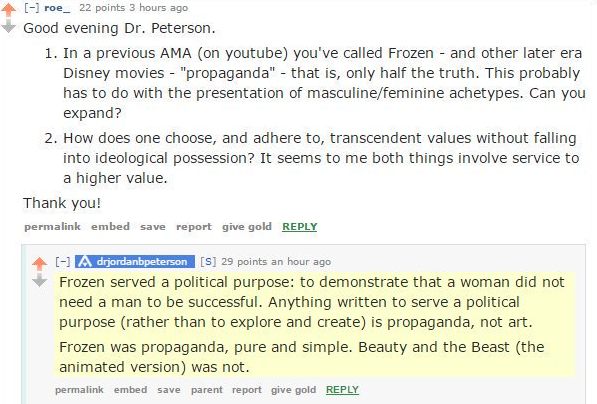
For anyone interested in learning more about people (and yourselves) I highly recommend Jordan Petersons' lectures on youtube. I believe he has started working on an online university for the humanities with all the money he's bringing in from patreon (he wisely hid it recently but it was close to 60k per month last time it wasn't)

your mileage may vary. https://nicemangos.blogspot.com/2017/07/professor-jordan-pet...

Oh god I didn't know he was that crazy.

>"Frozen was propaganda, pure and simple."

https://2.bp.blogspot.com/-b2VPRvIfTvs/WXt9SllI4XI/AAAAAAAAC...

Re: Lessons of an MIT Education

#118
post #27
post #6

The author was quite harsh on the soft sciencies and humanities and I'm going to attempt a defense. First, he characterises these subjects as merely what, facts to be learned, instead of how, skills to be mastered. Let's take history, which seems very what, full of dates and names. A great course in history teaches you how to think differently and with deeper context about world events and your country's politics. I…

The charactetization is incorrect. The liberal arts do teach “how.” Creative writing or political philosophy or history teaches you skills you can use to analayze scenarios and communicate with people in different ways to different effect. Where the author is correct is that in those fields the output isn’t falsifiable. Your math skills allow you to construct proofs that can be verified. Your study of history allows…

> and which makes their lifestyles possible

Arguably computing as a discipline is an important part of what makes contemporary lifestyles possible, and most of it, especially the practical parts, resembles the liberal arts more than it resembles mathematics. Especially areas like programming languages overall operate more through argumentation and analogy than through proofs. Sure, there are subsidiary proofs involved that can tell you something useful about the building blocks, but the type-related theorems you find in appendices of POPL papers are just low-level machinery, not the real goal, which is a usable programming language that people can do real work with. That requires constructing an overall language and ecosystem through a pretty liberal-arts style methodology: looking at what worked previously, reasoning what went well and badly about that, critically considering illustrative examples (often carefully constructed examples designed to illustrate a point, similar to the thought experiments in philosophy), and attempting to improve things on the basis of all that. If you look at a Rich Hickey talk, for example, that's pretty much entirely how he proceeds. And even in POPL papers, that's what you find in the meat of most influential papers (as opposed to the appendices): the real result of an influential paper is typically a qualitative argument about programming constructs, where the argument is convincing and well supported by examples, by not "proven" in any mathematical sense.

Re: Lessons of an MIT Education

#119
post #46
post #27

Earlier quoted context omitted.

The charactetization is incorrect. The liberal arts do teach “how.” Creative writing or political philosophy or history teaches you skills you can use to analayze scenarios and communicate with people in different ways to different effect. Where the author is correct is that in those fields the output isn’t falsifiable. Your math skills allow you to construct proofs that can be verified. Your study of history allows…

I think you're mischaracterizing humanities as not falsifiable as if it should be like mathematics. The content is not wrong in the same way a math question is, but many humanities classes are explicitly about taking arguments presented in essays, books, journals, by the government, by public interest groups, by private industry, and testing them against "objective reality and truth that exists around them." No human…

>No humanities course just takes every argument at face value. Every argument is subject to intense scrutiny

Here is Orwell on the matter:

>"When the nautical screw was first invented, there was a controversy that lasted for years as to whether screw-steamers or paddle-steamers were better. The paddle-steamers, like all obsolete things, had their champions, who supported them by ingenious arguments. Finally, however, a distinguished admiral tied a screw-steamer and a paddle-steamer of equal horsepower stern to stern and set their engines running. That settled the question once and for all."[1]

Feynman:

>"It doesn't matter how beautiful your theory is, it doesn't matter how smart you are. If it doesn't agree with experiment, it's wrong."

People lived for a very long time without a proper appreciation of controlled, repeatable experiments, and progress was very slow.

1 - www.orwell.ru/library/essays/lion/english/e_saw

Re: Lessons of an MIT Education

#120

Earlier quoted context omitted.

As I understand things, it's possibly the biggest employer of people with computer science degrees, as well as the biggest revenue driver for the software industry. But perhaps to generalize, the relationship between "look at how creative this discipline is" and "look at what people actually do with it in the real world" is an issue facing every academic field.

Perhaps this is a local thing; almost no one in advertising where I'm from comes out of university computer science. Agreed on the generalisation though. I'd even wager that the "creativity of this discipline" idea is what is attracting new students to fields that aren't too viable after graduation.

I think you've raised a good point. I appreciate that every discipline wants to present itself in the best possible light. Claiming to be "creative" is one way. As a math major, I certainly felt that I was more creative than those students in other fields. Abandoning that idea is a benefit of old age. ;-) And every discipline also claims "there will be a worker shortage in our field soon" and "what we really teach is critical thinking."
Post reply on HN