Live data from Hacker News

For only the second time in our history the ownership of The Economist changes

economist.com

111–120 of 151 posts

Re: For only the second time in our history the ownership of The Economist changes

#111

Earlier quoted context omitted.

What's wrong with News Corp?

News Corp biases its companies in favor of News Corp. The Economist has always been the hallmark of an independent newspaper that published a consistent of opinions in line with reality. http://www.smh.com.au/federal-politics/political-news/news-c... http://www.theguardian.com/world/2013/dec/21/attacks-on-abc-... And I don't think anyone reasonable believes Fox is anything but a Conservatives-centric news network tha…

The Economist does in fact have a marked and explicit editorial mission to promote free trade principles, set forth in their Prospectus[1], specifically, that "ORIGINAL LEADING ARTICLES, in which free-trade principles will be most rigidly applied to all the important questions of the day—political events—and parliamentary discussions; and particularly to all such as relate immediately to revenue, commerce, and agriculture; or otherwise affect the material interests of the country", and "POPULAR MOVEMENTS: A report and account of all popular movements throughout the country in favour of Free Trade."

Unlike some organisations (e.g., NewsCorp), these biases are at least explicitly stated, if not widely known.

While I generally respect it, I find its skew at times quite painful to swallow. At least the writing is generally well executed.

━━━━━━━━━━━━━━━━━━━━━━━━━━━━━━━━

Notes:
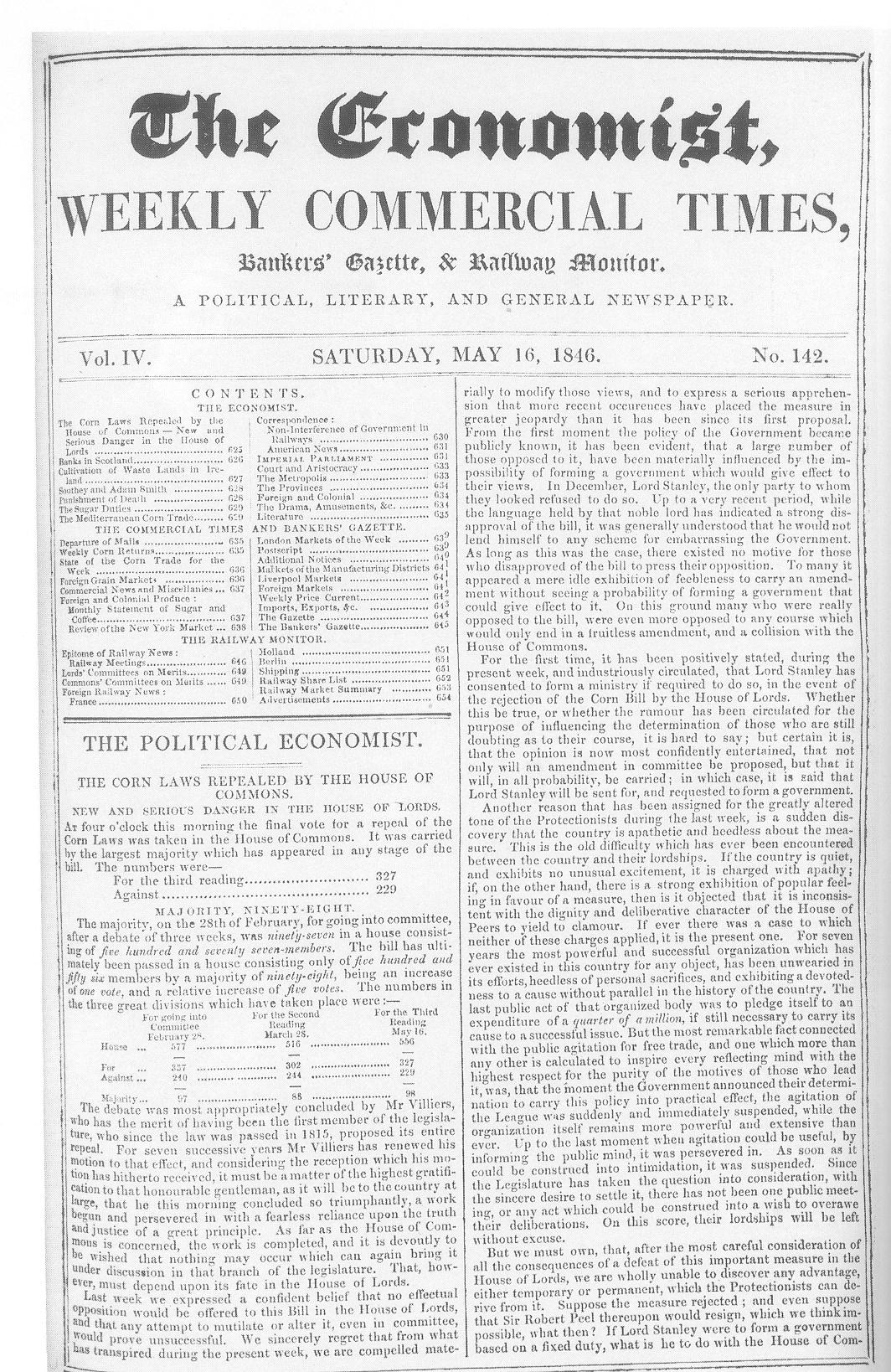
1. http://www.economist.com/node/1873493

Re: For only the second time in our history the ownership of The Economist changes

#112

Earlier quoted context omitted.

The job the Times has is at least an order of magnitude harder than the Economist . I enjoy reading the Economist , but I don't know if I'd say well researched. A few times I've come across articles in my own field that seem really off, which makes me uneasy about the articles on banana plantations in Uruguay. AFAIK the gold standard in copy editing and fact checking is the New Yorker .

The New Yorker has a sterling reputation what it comes to copy editing, not sure if they have the same reputation regarding fact checking. The New Yorker isn't a destination for me though whereas the Economist most certainly is one of the few sites I will directly type into the URL bar in a browser, I buy their end-of-year year in review religiously, I am neither politically nor economically aligned with them but the…

[deleted]

Re: For only the second time in our history the ownership of The Economist changes

#113
post #110

Earlier quoted context omitted.

My main complaint with the Economist (as a subscriber) is that it doesn't display it's biases openly - it often presents controversial economic or social positions as settled fact in a neutral style. If you didn't know the subject it was writing on you would think they were presenting the orthodox position.

If you didn't catch The Economist's biases on a cursory reading of one issue, that's on you. Simply skimming one of the leader opinion pieces and comparing it to, e.g., a Krugman column, should tell you that the authors would come to blows. Besides, what is an "orthodox" position? Whose?

I'm not talking about their overall world view I'm talking about their "Coffee growing in Guatamala" or "Cement production in the far east" articles - the ones where they are providing information on a relatively obscure subject. The articles present very matter of fact tones when in reality they are often reporting on one side of genuinely contraversial issues.

Re: For only the second time in our history the ownership of The Economist changes

#115
post #95
post #76

Earlier quoted context omitted.

I was a subscriber for 4 years and I can confirm that the Economist is crap. It looks good compared to other choices like 'Times' or 'Newsweek' which are totally unreadable. * It has totally absurd double-standards: Russia, Iran, China and their puppets (e.g. Syria and so forth) are 'bad' and 'evil'. US, EU and the UK stand for 'justice and peace in the world'. If your world-view is so naive, then you deserve the eco…

Well, the Economist is a newspaper with an officially non-neutral stance. I can hardly view it "the worst form of manipulation" when it's not different from every blog and personal column ever in this sense. As to the Iraq war, it might have been the case that they supported the invasion right at the beginning (someone could point me to links), but since the casus belli turned out to be bogus I can't remember reading…

Yeah, but since the casus belli was ALWAYS OBVIOUSLY bogus, that's on them. Saddam held the world dicatatorship record for "number of times deterred as a rational actor after a little brinksmanship". He could have had the keys to the Russian arsenal and still not nuked anybody. Someone can say, with integrity, that they thought Iraq was a good strategic decision aside from the WMD nonsense, and can even say with integrity that they still think it was. Saying "Oh, I believed the intelligence and thought he was an imminent threat" is admitting up front that you can't read past the first 5 words of a headline.

Re: For only the second time in our history the ownership of The Economist changes

#116

Earlier quoted context omitted.

I was subscribed to the economist for several years, and unsubscribed once I figured out that much of their content on non-western countries is either heavily tinted, or outright false.

The economist is very good at providing readers with the illusion of being informed. Think about how multifaceted US policy is on any given day of the year. The economist boils down similar issues to a blurb on a page with a heading that says "middle east." So now you can turn that page and be confident that for this week you know what's going on in the middle east. The truth is the economist fills a void. Before rea…

Of course you won't learn much about a country from reading a single article about it in the relevant section of a weekly newspaper. But if you read it regularly, you'll read numerous articles about that country over the course of a year - probably more than 50 in the case of a moderately powerful and dynamic country like India. Over time you'll realize that some predictions made in the articles pan out, some don't, some is consequential, some not and so on.

Reading a single issue will not make you well-informed; at most it will provide you with something to chat about at a cocktail party (if you're the sort of person who likes to chat about the news) or a point of reference if you meet someone from a foreign country and want to ask a topical question.

I've found that reading over time is advantageous, not because one collects more and more trivia about more and more places (although that's true) but because the more important themes emerge of their own accord most of the time. By this is I mean that one tends to become aware of major issues long before they rise to the top of the 24 hour news cycle.

Re: For only the second time in our history the ownership of The Economist changes

#117
post #97

Earlier quoted context omitted.

Your comment simply says that your politics don't align with The Economist's. I personally find the "he said, she said" style of reporting that purports to give a fair account of all sides intolerable and hypocritical. It often allows complete idiots to air their opinions in the name of presenting a "different" view. This lets the reporter subtly influence the reader while preserving the illusion of impartiality. The…

My main complaint with the Economist (as a subscriber) is that it doesn't display it's biases openly - it often presents controversial economic or social positions as settled fact in a neutral style. If you didn't know the subject it was writing on you would think they were presenting the orthodox position.

it doesn't display it's biases openly

It actually does for some of them, in its prospectus, mentioned by me earlier in this thread.

http://www.economist.com/node/1873493

Wikipedia's article has more on the Newspaper's history.

https://en.wikipedia.org/wiki/The_Economist

Re: For only the second time in our history the ownership of The Economist changes

#118
post #97

Earlier quoted context omitted.

Your comment simply says that your politics don't align with The Economist's. I personally find the "he said, she said" style of reporting that purports to give a fair account of all sides intolerable and hypocritical. It often allows complete idiots to air their opinions in the name of presenting a "different" view. This lets the reporter subtly influence the reader while preserving the illusion of impartiality. The…

My main complaint with the Economist (as a subscriber) is that it doesn't display it's biases openly - it often presents controversial economic or social positions as settled fact in a neutral style. If you didn't know the subject it was writing on you would think they were presenting the orthodox position.

it doesn't display it's biases openly

It actually does for some of them, in its prospectus, mentioned by me earlier in this thread.

http://www.economist.com/node/1873493

Wikipedia's article has more on the Newspaper's history.

https://en.wikipedia.org/wiki/The_Economist

Re: For only the second time in our history the ownership of The Economist changes

#120

Earlier quoted context omitted.

Economist is the only publication i pay for. I'm not sure how many newspapers/magazines could really follow suit. There is only so many high quality sources anyone can read, its a small niche I think. Also the average economist reader is probably quite high on income so I suspect thats a skews their ability to charge

Quality and accountability is what happens when we pay. We've traded quality and accountability for "free" garbage floating in a sea of ads. The NYTimes is still too dependent on advertising. That they consider "native advertising" acceptable shows compromised journalistic principles. "The best minds of my generation are thinking about how to make people click ads. That sucks." – Jeff Hammerbacher, fmr. Manager of Fa…

Micropayment solutions don't work, won't work, and will never work.

http://szabo.best.vwh.net/micropayments.html

Post reply on HN