Live data from Hacker News

Disassembling the Amazon Dash

bitsofcents.com

101–110 of 115 posts

Re: Disassembling the Amazon Dash

#101
post #47
post #39

Earlier quoted context omitted.

Sure, but just a few decades ago there were people dismissing all of e-commerce saying "why would I order online when I can just pick up the phone and call in my order?" I'm sure before that there were people saying, Why do I need phone ordering when I can just mail an order form to Sears? I think it's a mistake to bet against a more convenient form of consumerism.

The problem with Dash is that it doesn't really scale.

This isn't the scaling phase. Dash is also an API for automated ordering. And the button is a test to measure the usefulness of such API.Once there's data proving the idea, and an available API, Amazon and it's partners will scale this.
Re: Disassembling the Amazon Dash

#102
post #58

I'm bummed that it's apparently vendor-locked. A configurable Dash would make it applicable to all things Amazon. There are perhaps 100 places in our facility that a '"consumable X needs a refill/attention". We don't need a specific brand, and the brand we use can vary over time as needs and pricing change.

Maybe this could help:

http://www.ecinews.eu/index.php?option=com_content&view=arti...

Re: Disassembling the Amazon Dash

#103
post #70
post #30

Earlier quoted context omitted.

What if the Dash becomes very popular? I believe we'd see an explosion of companies funding dash buttons which would, in my opinion, be a bad thing for the customer. I don't like the idea of locking myself into a brand for the life of the device. I'd like to see a configurable button that orders, say, the cheapest paper towels that have at least a 4-star rating. The suppliers probably wouldn't be happy about the comp…

> I don't like the idea of locking myself into a brand for the life of the device. You're not the target market. Some people exhibit strong brand loyalty for some stuff. In the UK you'll get people saying that baked beans must be Heinz and no other brand. I tend to agree with you. I want a button I can push to order the cheapest washing detergent. But that gets complicated. Do I mean actual cheapest price at the till…

> Some people exhibit strong brand loyalty for some stuff

..but the point is that these people can _choose_ to exhibit such loyalty.

This is well-studied and understood. People can stick with a brand for years, until suddenly they change it for another and completely forgot about the other.

The dash seems like just another convenient lockin

Re: Disassembling the Amazon Dash

#104

Earlier quoted context omitted.

To me, the choice to use off the shelf hardware reflects Amazon's dedication to lean values. In this sense, they're doing the absolute minimum (using off-the-shelf hardware instead of spending 2 years spinning their own SoC) to verify that their product (on-demand household commodity ordering) is actually something people want. Makes a lot more sense in terms of turnaround time and money - if the idea proves valuable…

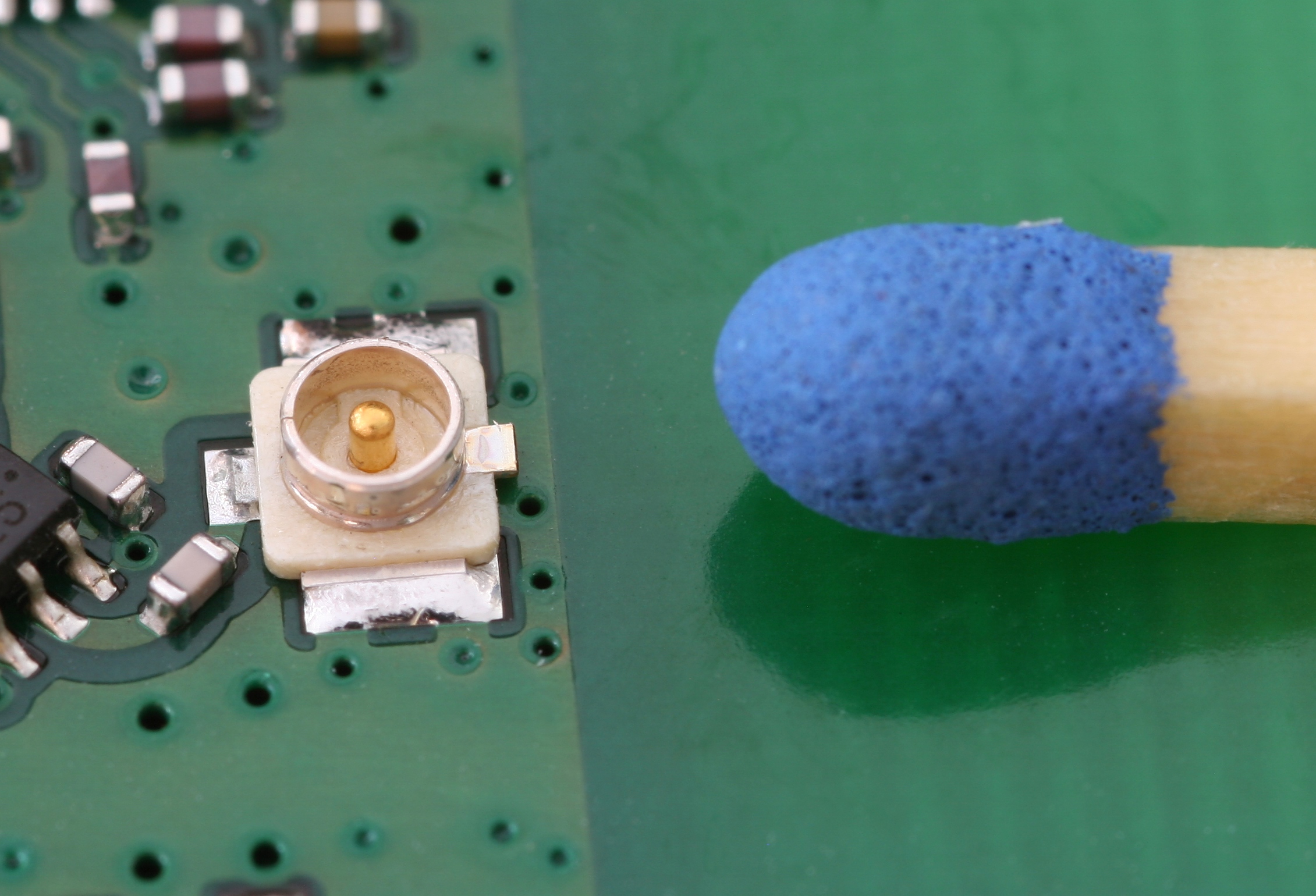
What's also interesting is that the circuit board left on the micro-SMA connector for an external antenna. The early press releases mention deeper hardware integration with consumer products. I'm guessing they're going to be dropping this board into other things besides the Dash product.

That's actually an RF testpoint, not an SMA connector (by which I think you mean UF.L connector, like this guy: http://upload.wikimedia.org/wikipedia/commons/c/ca/U.FL_conn...). It functions like a switch that is closed when the RF tester connects to it.

Re: Disassembling the Amazon Dash

#105
post #80
post #71

Earlier quoted context omitted.

I don't see this becoming a single button for ever item in the house. I see the Dash button riding the middle ground between objects that you have highly predictable usage patterns or have a proscribed life span like toothbrushes where recurring orders make sense and less predictable items like paper towels where usage is harder to predict. I think the goal is also to make using the button easier than just opening th…

Or have it built into the bottle, perhaps even measuring the current fill level.

Like inkjet cartridges, it can simultaneously add electronics to landfill while increasing your spend on consumables!

Re: Disassembling the Amazon Dash

#106
post #101
post #47

Earlier quoted context omitted.

The problem with Dash is that it doesn't really scale.

This isn't the scaling phase. Dash is also an API for automated ordering. And the button is a test to measure the usefulness of such API.Once there's data proving the idea, and an available API, Amazon and it's partners will scale this.

Good point about being an API. When combined with RFID, I can imagine smart fridges / washing machines utilizing this API to automatically order (or suggesting human do a 1-click order) when your Tide is about to run out.

Re: Disassembling the Amazon Dash

#107
post #93
post #82

Earlier quoted context omitted.

If each button is seen as ad and paid for by the brand shown on it, the costs likely look good from both Amazon's perspective and the brand's perspective. A button that costs somewhere between $5 and $10 might result in something like $240 worth of sales over its lifetime. (eg. 1 sale per month x $10 sale price x estimated 24 month lifetime) Seems scalable to me.

I think the concern is that I have, for example, around sixty different spices on my spice rack. Do I stick a button behind each one? My cluttered cabinet with AA batteries, AAA batteries, CFLs, compressed air, WD40, several dozen other items? How about each item in my cluttered fridge? I think the Amazon Fresh Direct concept mentioned elsewhere by mason55 makes a lot more sense. Stuck to the front of my fridge I wan…

How frequently do you replenish your spices/WD40? If you are a restuarant, then a button would make sense. The dash, in its current form, seems suited to high-turnover products where the sales generated over the devices lifetime can cover the initial cost.

As someone else mentioned though, think of it as "Dash, the physical button" + "Dash, the API". The API is probably the long term goal, the physical button is just a (temporary) drop-dead simple API client that people can use today. Amazon is likely betting on smart-fridges/-pantries/-homes catching up in the future

Edit: in the near-future, I imagine Amazon adding a touchscreen (so it's not product specific) without adding much to BoM. They can also charge manufactures for on-device screen-time (who doesn't like ads that convert to an immediate sale?)

Re: Disassembling the Amazon Dash

#108

Earlier quoted context omitted.

What's also interesting is that the circuit board left on the micro-SMA connector for an external antenna. The early press releases mention deeper hardware integration with consumer products. I'm guessing they're going to be dropping this board into other things besides the Dash product.

That's actually an RF testpoint, not an SMA connector (by which I think you mean UF.L connector, like this guy: http://upload.wikimedia.org/wikipedia/commons/c/ca/U.FL_conn... ). It functions like a switch that is closed when the RF tester connects to it.

If you were to hook one of these up to the connector:

https://www.sparkfun.com/products/11320

Would it not function as an external wifi antenna?

(and yeah you're right about the ufl. thanks for the correction)

Re: Disassembling the Amazon Dash

#109

Earlier quoted context omitted.

I think the idea is that this is eventually built right into the products. The washer with the built-in Amazon button for detergent, etc.

That's an interesting thought. There would be deals by detergent companies to include their button in a washer. Also maids could order the products themselves if they're responsible enough.

I'm thinking more about P&G giving you a free washing machine if you agree to automatic delivery and billing of their detergent.

You can certainly choose other brands to put in the machine, but every 40 cycles another box of Tide Pods will show up on your doorstep.

Re: Disassembling the Amazon Dash

#110

Earlier quoted context omitted.

That's actually an RF testpoint, not an SMA connector (by which I think you mean UF.L connector, like this guy: http://upload.wikimedia.org/wikipedia/commons/c/ca/U.FL_conn... ). It functions like a switch that is closed when the RF tester connects to it.

If you were to hook one of these up to the connector: https://www.sparkfun.com/products/11320 Would it not function as an external wifi antenna? (and yeah you're right about the ufl. thanks for the correction)

In a sense, you're right - it's meant as a quick release testpoint for conducted radio performance on a manufacturing line. Theoretically, you COULD hook up an antenna to it, but you'd have to know some substantive details about the integrated PCB antenna (impedance, center frequency, etc) to get good or even comparable performance out of the external one. Probably not to a male UFL connector, in any case - I'm 99% sure this type of connector is not compatible with UFL.

Mileage may vary, of course, but in my experience this type of connector is more frequently used to get conducted power RF measurements in manufacturing settings.

Post reply on HN