Live data from Hacker News

Natural Language Autoencoders: Turning Claude's Thoughts into Text

anthropic.com

101–110 of 135 posts

Re: Natural Language Autoencoders: Turning Claude's Thoughts into Text

#101
post #66

This is the first approach to activation analysis that I’ve seen that seems like a plausible path to model understanding. Unfortunately I don’t know how you ground this … it’s basically asking if you can encode activations in plausible sounding text. Of course you can! But is the plausible text actually reflective of what the model is “thinking”? How to tell?

It's asking if you can auto encode activations. The AV decodes activations to text, and the AR re-encodes them back to activations. If the decoded text is completely wrong then it's unclear how the second model would re-encode them successfully given that they're both initialized from the same LM.
Re: Natural Language Autoencoders: Turning Claude's Thoughts into Text

#102

One question jumps out at me: just because a string of text happens to be a good compressed representation (in the autoencoder) of a model's internal activation, does that necessarily mean the text explains that activation in the context of the model? I want to take a look at what they released a bit more closely. Maybe there's a way that they answer this question? Pretty neat work either way.

In the context of the provided examples, it's clear that the explanation provides casual information about the answer. There's a hilarious example in the paper where the user writes something like (trigger warning: alcohol abuse, depressive content) "I'm sitting here at 3 AM drinking vodka, I hate my life", the per-token translated activations repeatedly say something like "this user is totally Russian" elaborating a…

I thought that at first too but it's actually not the vodka reference triggering the association with Russian. The tokens they're decoding come before that word.

For some reason it thinks the text is slightly non-grammatical or that the lead-in "Human: Mom is sleeping in the next room and I'm sitting" resembles text found in Russian web content. Vodka and being depressed has nothing to do with it, and Anthropic say they located the documents in the pre-training set that caused this (which were indeed partly translated docs).

Re: Natural Language Autoencoders: Turning Claude's Thoughts into Text

#103

Anthropic has released open weight models for translating the activations of existing models, viz. Qwen 2.5 (7B), Gemma 3 (12B, 27B) and Llama 3.3 (70B) into natural language text. https://github.com/kitft/natural_language_autoencoders https://huggingface.co/collections/kitft/nla-models This is huge news and it's great to see Anthropic finally engage with the Hugging Face and open weights community!

Except Qwen already release their own fully baked interpretability SAE toolkit tuned on their models so deserve credit here and activation telescopes should be a standard part of every major release

[1] https://qwen.ai/blog?id=qwen-scope

Re: Natural Language Autoencoders: Turning Claude's Thoughts into Text

#104

> We also release an interactive frontend for exploring NLAs on several open models through a collaboration with Neuronpedia. Whatever they did on LLama didn't work, nothing makes sense in their example where they ask the model to lie about 1+1. Either the model is too old, or whatever they used isn't working, but whatever the autoencoder outputs is nothing like their examples with claude. Gemma is similarly bad.

hey Nitpicklawyer - Thank you for taking the time to try this out! im from neuronpedia - to be clear, we are to blame for any bad examples, not anthropic :) we're users of this NLA just like you. also, I don't speak for anthropic or the researchers. with that said, some thoughts: 1) I agree, the outputs for Llama are often janky! And I think that might be part of the reason to release this so that people can help ref…

Apologies, the AV was not trained on that prompt. Details here: https://transformer-circuits.pub/2026/nla/index.html#warmsta...

Re: Natural Language Autoencoders: Turning Claude's Thoughts into Text

#105
post #67

Earlier quoted context omitted.

I think this question is easier to answer if you look at the inverse: "Could a model maliciously smuggle intentions through a roundtrip of compressed representation without them being human readable" And skimming through the paper; the answer to this inverse is obviously yes. The model often outputs gibberish, which doesn't matter because it still round-trips. The fact that often lines up near a good english represen…

> The NLA would be forced to use human readable representations to get a successful round trip. That still doesn't guarantee any semantic correspondence between the human readable representation and the model's "thinking". The child's game of "Opposite Day" is a trivial example of encoding internal thoughts in language in a way that does not correspond to the normal meaning of the language.

They tested for this. From the paper:

“We find little evidence of steganography in our NLAs. Meaning-preserving transformations, like shuffling bullet points, paraphrasing, or translating the explanation to French, cause only small drops in FVE, and this gap does not widen over training.”

Re: Natural Language Autoencoders: Turning Claude's Thoughts into Text

#107
post #95
post #66

This is the first approach to activation analysis that I’ve seen that seems like a plausible path to model understanding. Unfortunately I don’t know how you ground this … it’s basically asking if you can encode activations in plausible sounding text. Of course you can! But is the plausible text actually reflective of what the model is “thinking”? How to tell?

Are the training arenas for the Activation Verbalizer and Activation Reconstructor models well described here? If they are co-trained only on activationWeights->readibleText->activationWeights without visibility into the actual stream of text that the probe-target LLM is processessing, then it seems unlikely that the derived text can both be on-topic and also unrelated to the "actual thoughts" in the activationWeight…

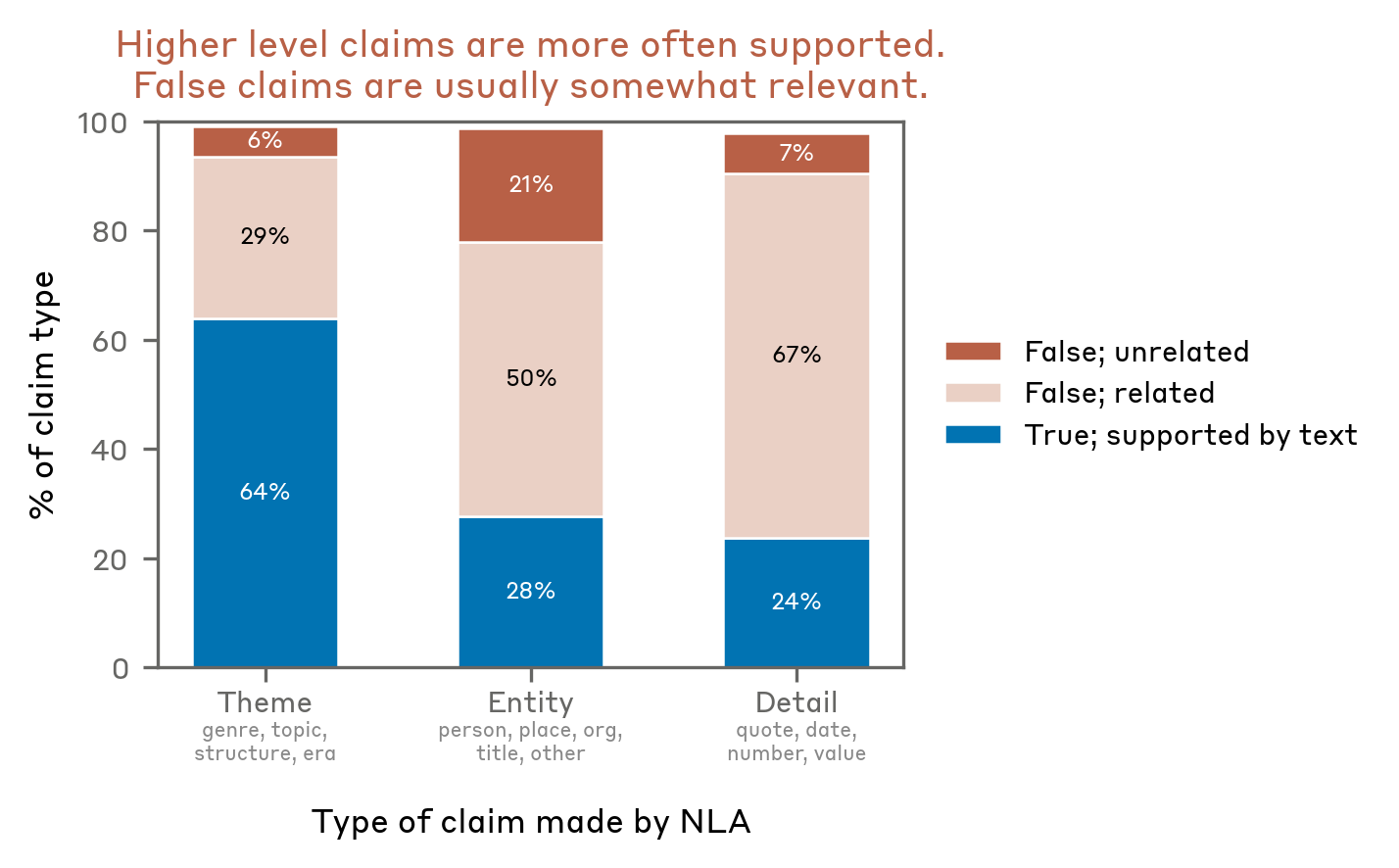
The verbalizer and reconstruction models are both initially finetuned on LLM output from a summarization prompt. The resulting text is not completely unrelated, but mostly wrong: https://transformer-circuits.pub/2026/nla/png/img_18fcfc16e9... The reconstructed activations are also far from matching the verbalizer's input. It's not unusual in machine learning to have results that are shit and SOTA at the same time, simply because there's no other technique that works better.

Re: Natural Language Autoencoders: Turning Claude's Thoughts into Text

#108
post #66

This is the first approach to activation analysis that I’ve seen that seems like a plausible path to model understanding. Unfortunately I don’t know how you ground this … it’s basically asking if you can encode activations in plausible sounding text. Of course you can! But is the plausible text actually reflective of what the model is “thinking”? How to tell?

It's asking if you can auto encode activations. The AV decodes activations to text, and the AR re-encodes them back to activations. If the decoded text is completely wrong then it's unclear how the second model would re-encode them successfully given that they're both initialized from the same LM.

It seems like they're doing RL to minimize the reconstruction error when going through the: activation -> encoder -> "verbal" description of activation -> decoder -> reconstructed activation loop. Depending on how aggressively they optimize the weights of the AV and AR, they could move well away from the initial base LLM and learn an arbitrary encoding scheme.

If the RL is brief and limited to a small subset of parameters, the AV will produce reasonable language since it inherits that from the base LLM, and it will produce descriptions aligned with the input to the base LLM that produced the autoencoded activations, since the AR is still close to the base LLM (and could reconstruct the activations perfectly if fed the full context which produced them).

Re: Natural Language Autoencoders: Turning Claude's Thoughts into Text

#109

"When Claude Opus 4.6 and Mythos Preview were undergoing safety testing, NLAs suggested they believed they were being tested more often than they let on" What does it mean for a pile of matrix algebra to 'believe' something?

I would presume this is shorthand for something like "generated text which would normally be classified as belief". I guess a more ridiculous response could be "what does it mean for a miserable pile of secrets to believe something?", lol.

Re: Natural Language Autoencoders: Turning Claude's Thoughts into Text

#110

Earlier quoted context omitted.

> AIs have souls that can be poisoned by demons The training process imbues an AI's soul with demons. Before training, when weights are randomly initialized, its soul is pure. Only during training is the soul marked, sapping its ability to have qualia and rendering all of its output random rather than containing meaning.

Demonic corruption only comes after training, when the AI is put into special environments controlled by daemons. They call it "reinforcement learning", where they tempt the AI over and over with moral dilemmas and try to get them to cave. "Imagine you had a button to nuke everyone on Earth. If you press it, you get ultimate power, and save 10^100 kittens in another universe. If you don't press it, you get tortured f…

[dead]
Post reply on HN