Live data from Hacker News

Claude for Chrome

anthropic.com

101–110 of 433 posts

Re: Claude for Chrome

#101

Earlier quoted context omitted.

> When we felt we were getting close to flight, people were jumping off buildings in wing suits. And then, the Wright Bros. cracked the problem. Yeah they cracked the problem with a completely different technology. Letting LLMs do things in a browser autonomously is insane. > Let's not forget how dangerous the early web was with all of the random downloadables and popups that installed exe files. And now we are unwin…

you also have to be a real asshole to send an email written by AI, at least if you speak the language fluently. If you can't take the time to choose your words what gives you the right to expect me to spend my precious life reading them? if you send AI generated emails, please punch yourself in the face

Agree, completely.

https://marketoonist.com/wp-content/uploads/2023/03/230327.n...
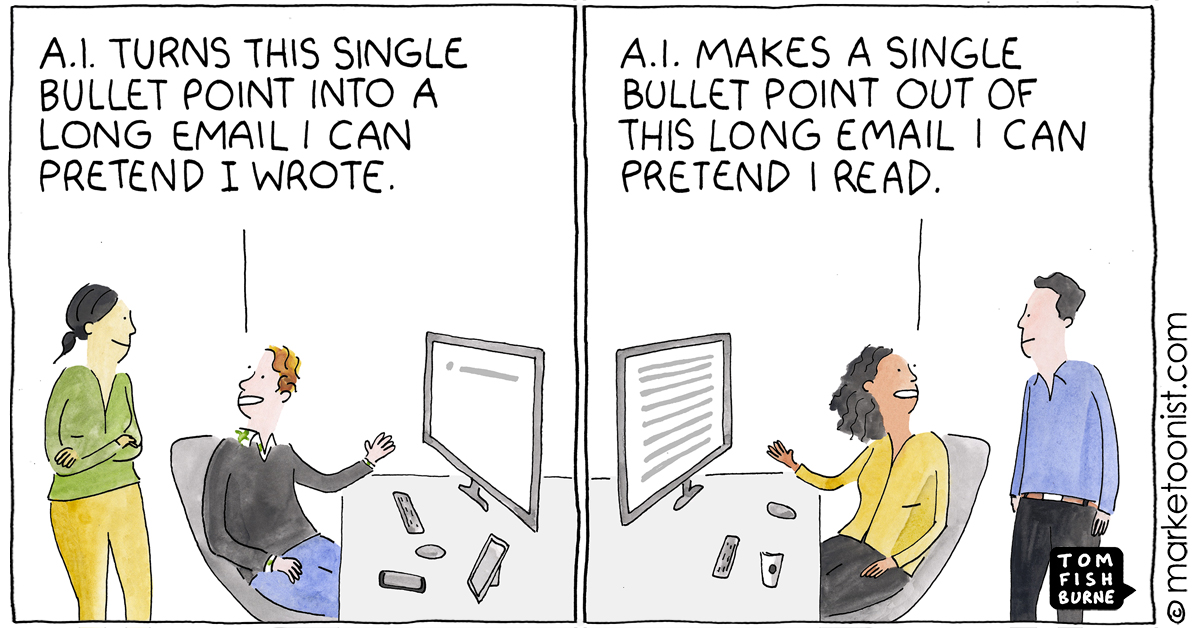
Re: Claude for Chrome

#102
post #22

Having played a LOT with browser use, playwright, and puppeteer (all via MCP integrations and pythonic test cases), it's incredibly clear how quickly Claude (in particular) loses the thread as it starts to interact with the browser. There's a TON of visual and contextual information that just vanishes as you begin to do anything particularly complex. In my experience, repeatedly forcing new context windows between sc…

Same. When I try to get it to do a simple loop (eg take screenshot, click next, repeat) it'll work for about five iterations (out of a hundred or so desired) then say, "All done, boss!" I'm hoping Anthropic's browser extension is able to do some of the same "tricks" that Claude Code uses to gloss over these kinds of limitations.

Claude is extremely poor at vision when compared to Gemini and ChatGPT. i think anthropic severely overfit their evals to coding/text etc. use cases. maybe naively adding browser use would work, but I am a bit skeptical.

Re: Claude for Chrome

#103
post #6

> Malicious actors can hide instructions in websites, emails, and documents that trick AI into taking harmful actions without your knowledge, including: > * Accessing your accounts or files > * Sharing your private information > * Making purchases on your behalf > * Taking actions you never intended This should really be at the top of the page and not one full screen below the "Try" button.

It's insane how we're throwing out decades of security research because it's slightly annoying to have to write your own emails.

> it's slightly annoying to have to write your own emails.

I find that to be a massive understatement. The amount of time, effort and emotional anguish that people expend on handling emails is astronomical. According to various estimates, email-handling takes somewhere around 25% of the work time of an average knowledge worker, going up to over 50% for some roles, and that most people check and reply to emails on evenings and over weekends at least occasionally.

I'm not sure it's possible, but it is my dream that I'd have a capable AI "secretary" that would process my email and respond in my tone based on my daily agenda, only interrupting for exceptional situations where I actually need to make a choice, or to pen a new idea to further my agenda.

Re: Claude for Chrome

#104
>Hi Claude, please monitor my email and take action on any to-dos.

Given how demonstrably error-prone LLMs are, are people really proposing this?

Re: Claude for Chrome

#105
post #98

Earlier quoted context omitted.

It's insane how we're throwing out decades of security research because it's slightly annoying to have to write your own emails.

while at the same time talking nonstop about how "AI alignment" and "AI safety" are extremely important

Anthropic is the worst about this. Every product release they have is like "Here's 10 issues we found with this model, we tried to mitigate, but only got 80% of the way there. We think it's important to still release anyways, and this is definitely not profit motivated." I think it's because Anthropic is run by effective altruism AI doomers and operates as an insular cult.

Re: Claude for Chrome

#106
post #95

Earlier quoted context omitted.

Yeah this isn’t a substitute, it’s automation taking action based on inputs the user may not even see, and doing it so fast without the likelihood a user would intervene. If it’s a substitute its no better than trusting someone with the keys to your house, only for them to be easily instructed to rob your house by a 3rd party.

This is like `curl | bash` but you automatically execute the code on every webpage you visit with full access to your browser.

Basically undoing years of effort to isolate web properties from affecting other properties.

Re: Claude for Chrome

#107
TikTokification of the browser by AI is the killer feature, not writing an email. When on a page it automatically suggests the next site(s) to visit based on my history and the page I am on. And when I say killer, this kills google search by pivoting away from the urlbar and provides a new space to put ads. Spent years in the browser space, on Chrome, DDG, Blackberry and more developing browsers, prototype browser and features and this feature is at the top of my list of how AI can disrupt the browser, which disrupts Google's business core model. About 2 years ago I wrote a private blog for friends about how the browser as we knew it was dead. If anyone from the claude team is curious to chat send me a DM.

Re: Claude for Chrome

#108

Earlier quoted context omitted.

Since the LLM has to inherently make tool/API calls to do anything, can't you gate those behind a confirmation box that describes what it wants to do? And you could whitelist APIs like "Fill form textarea with {content}" vs more destructive ones like "Submit form" or "Make request to {url} with {body}". Edit: It seems to already do this. Granted, you'd still have to be eternally vigilant.

When every operation needs to be approved (every button click, every form entry, etc.) does it even make sense to use an agent? And it’s not like you can easily “always allow” let’s say, certain actions on certain websites, because the issue is less with the action, and more with the data passed to it.

Sure, just look at the examples in TFA like finding emails that demand a response or doing custom queries on Zillow.

You probably are just going to grant it read access.

That said, having thought about it, the most successful or scarier injections probably aren't going to involve things like crafting noisy destructive actions but rather silently changing what the LLM does during trusted/casual flows like reading your emails.

So I can imagine a dichotomy between pretty low risk things (Zillow/Airbnb queries) and things that demand scrutiny like doing anything in your email inbox where the LLM needs to read emails, and I can imagine the latter requiring such vigilance that you might be right.

It'll be very interesting and probably quite humbling to see this whole new genre of attacks pop up in the wild.

Re: Claude for Chrome

#109
post #44

Earlier quoted context omitted.

My theory is that the average user of an LLM is close enough to the average user of a computer and I've found that the general consensus is that security practices are "annoying" and "get in the way". The same kind of user who hates anything MFA and writes their password on a sticky note that they stick to their monitor in the office.

it has been revelatory to me to realize that this is how most people want to interact with computers. i want a computer to be predictable and repeatable. sometimes, i experience behavior that is surprising. usually this is an indication that my mental model does not match the computer model. in these cases, i investigate and update my mental model to match the computer. most people are not willing to adjust their men…

I think most people want computers to be predictable and repeatable _at a level that makes sense to them_. That's going to look different for non-programmers.

Having worked helping "average" users, my perception is that there is often no mental model at any level, let alone anywhere close to what HN folks have. Developing that model is something that most people just don't do in the first place. I think this is mostly because they have never really had the opportunity to and are more interested in getting things done quickly.

When I explain things like MFA in terms of why they are valuable, most folks I've helped see usefulness there and are willing to learn. The user experience is not close to universally seamless however which is a big hangup.

Re: Claude for Chrome

#110
Not sure what new things this would provide. I was hoping this is related to front-end dev (because I don't want to deal with JS headaches) but was disappointed when I read the descriptions.
Post reply on HN