Live data from Hacker News

How Dowries Are Fuelling a Femicide Epidemic

newyorker.com

101–110 of 114 posts

Re: How Dowries Are Fuelling a Femicide Epidemic

#101
post #26

Earlier quoted context omitted.

"based on just a verbal accusation, so the threat of this is often used as a tool during divorce for the wife to get what she wants" Sounds a lot like protective orders in US divorce.

Getting arrested and getting a protection order are different.

Sure, but the same basic concepts are involved. The result is just a different level of restriction by the government - seizing property and restricting some movement vs confinement.

Re: How Dowries Are Fuelling a Femicide Epidemic

#102
post #57

Earlier quoted context omitted.

Because obviously, the only thing a household needs for success… is linens

> Because obviously, the only thing a household needs for success… is linens I think you take for granted just how difficult and time-consuming it is to produce cloth and material for clothing. If a woman got married and had one child, there'd be little to no time to make clothing for the second child that followed almost immediately after[1]. [1] Contraceptive, while being an ancient invention, was never widely used…

Cloth goods were expensive up until quite recently. People generally didn't have nearly as many outfits as we do now. Being able to repair and manufacture your own clothing and linens was a huge deal.

Re: How Dowries Are Fuelling a Femicide Epidemic

#103

Earlier quoted context omitted.

The logic behind dowries was that women were a burden since they would be relying on the husband for food, shelter and protection. They were leaving their original family, thus reducing the number of people who'd need to be fed and sheltered, while the husband's family was taking on that duty, thus they claimed to deserve compensation. Such cultures suffered from similar other ills like mistreating or kicking out wid…

> They were leaving their original family, thus reducing the number of people who'd need to be fed and sheltered, while the husband's family was taking on that duty, thus they claimed to deserve compensation Wow, that's an insane perspective. So even your own daughters were thought of as a burden?

[deleted]

Re: How Dowries Are Fuelling a Femicide Epidemic

#104
TFA is about India. Don't automatically apply its perspective to other cultures, because the motivation of dowry/bride price can vary considerably.

When I worked in Arabia, I had occasion to discuss wedding arrangements with some traditional families as they were going through negotiations for a wedding contract. Although they used "dowry", what they were concerned about was not really that or a bride price. When getting married, the husband is expected to give the bride a large lump sum of money. The bride is then expected to hold it in reserve in case something happens with the husband (e.g. divorce or death).

Another example is the historical case of dowries in England, such as you read much about in Jane Austen novels. Because of primogeniture, women couldn't inherit estates, but fathers were still concerned to pass wealth along to their daughters. Dowries allowed a transfer of wealth that couldn't be done through inheritance.

Re: How Dowries Are Fuelling a Femicide Epidemic

#105
post #36

Earlier quoted context omitted.

Religion, culture, social pressure, groupthink etc. all routinely trump basic economics in every society in the world.

True but economics can change culture. In the Netherlands women are no longer entitled to their husbands money after a divorce. This forces women to maintain an effective career or be left behind in poverty. No more "stay at home" mom's. Sometimes you have to nudge people into freedom.

Is it strictly based on gender? I could see a stay at home father getting alimony if he sacrificed years of his career to raise the kids.

Re: How Dowries Are Fuelling a Femicide Epidemic

#106
post #15

Dowries are a plague on humanity. They’re rooted in the idea that women are property. I lived in India in the 1970s as a child. At that time the shorthand was “cooking accident” when new brides were killed. As in, “The bride’s father couldn’t pay the dowry. Too bad she had that unfortunate cooking accident.” The local man who did our laundry had four daughters, and it was considered a curse. He killed himself because…

Not sure how dowries are rooted in the idea that women are property... If you were talking about bride price then it would make more sense. In many cultures the men had to pay the father of the bride, thus people in a sense were literally selling their daughters. Still there was a reason for this at the time, in those cultures, women moved to live with the husband family, and at same time their labor was important, i…

From the article:

> "Dowry usually emerges in highly stratified societies, like caste-structured India and colonial Latin America, whereas the reverse convention, bride price, is more likely to appear in communities with less socioeconomic differentiation, as in much of sub-Saharan Africa. Some critics object to the way “paying” for a bride seems to commodify women, but there is little evidence that bride price harms women’s well-being. Dowry, in contrast, encourages two forms of violence."

Occam's razor says that while bride price does, in theory, objectify women, it also places an objective metric ($$$) on her value – you must pay $$$ in order to receive this precious artifact. Whereas it seems that dowry places the opposite objective metric (-$$$) on her value, i.e., please, take this burden off our hands and we will pay you $$$.

EDIT: An afterthought, it seems what might also be at play is that doing work on something (or, paying a lot of hard-earned money for something) makes us value it more. This is borne out in the Ben Franklin effect, where doing someone a favor makes you like that someone more, not the other way around. [1]

1 - https://www.forbes.com/sites/sap/2011/11/16/do-me-a-favor-so...

Re: How Dowries Are Fuelling a Femicide Epidemic

#107

Dowries are a plague on humanity. They’re rooted in the idea that women are property. I lived in India in the 1970s as a child. At that time the shorthand was “cooking accident” when new brides were killed. As in, “The bride’s father couldn’t pay the dowry. Too bad she had that unfortunate cooking accident.” The local man who did our laundry had four daughters, and it was considered a curse. He killed himself because…

Ask a conservative Christian if they think women are equal to men and they'll end up with "seperate but equal" bullshit. Baby machines. It reminds me of the Tleilaxu in Dune. It's understandable because humans were dropping like flies 2000 years ago.

Do you think Men and Womens' division tennis is bullshit? Do you know who would be the biggest critics of combining them?

Re: How Dowries Are Fuelling a Femicide Epidemic

#108

Earlier quoted context omitted.

this has always bothered me too, to the point of making me think that the "only a century ago, women were considered property" claim to either be a false oversimplification, or require far more justification than I've ever seen given to the topic. because like, I can sell my property, in addition to buying it—so I'm not really sure how that adds up, either.

The doctrine applied to married women is called coverture. Coverture deems that a married woman has no independent existence or right, but shares with her husband the benefits and (some of) the rights of he had possesses. > because like, I can sell my property, in addition to buying it—so I'm not really sure how that adds up, either. Bodily organs are recognized as property and yet many countries forbid their purchas…

> Coverture deems that a married woman has no independent existence or right, but shares with her husband the benefits and (some of) the rights of he had possesses.

this does not sound like "property" to me, at all. it sure doesn't sound like the way things are done today, but, it does not sound like "property" either. as of now, I maintain that this popular shorthand is a poor descriptor.

Re: How Dowries Are Fuelling a Femicide Epidemic

#109

Earlier quoted context omitted.

> They’re rooted in the idea that women are property. You have that backwards!! A bride price is the price paid to the bride's family, as you would pay for property. Whereas dowry is the opposite -- paid by the bride's family to the groom. It's rooted in the idea that the groom is expected to personally contribute financially, but the bride's family makes a contribution for her. The most direct effect of the dowry it…

>A modern analog is that the bride's family paying for the wedding. Does this occur? I havent heard of this. I'm among professionals, and it seems that everyone complains about how expensive the wedding is. I imagine if someone else was paying for it, this wouldn't be a big deal.

This is still common in Indian society. Even in cities, among well educated circles.

Re: How Dowries Are Fuelling a Femicide Epidemic

#110
This has been an odd article to read. It sounds like it's about 10 years too late, and didn't pass my smell test. I empathize with the stories being told, the unjust tragedies of the subject and the persistence of of dowries. But, the statistics are maliciously sourced.

    > By 2008, dowry was near-universal in rural areas, and many regions had seen alarming rates of dowry inflation.
"World Bank found the average net dowry had been "remarkably stable" over time, with some inflation before 1975 and after 2000. And the researchers found an average real net dowry of 27,000 rupees ($361). [1] At an average of $361, dowry sounds more like a formality than a real expense. Any research into dowries also has to weigh it by what it means as a real economic burden."

Dowries consume a substantial proportion of household savings and income: in 2007, the average net dowry in rural India was equivalent to 14% of annual household income. I can't imagine that 14% of a poor family's income in 1 year would play a substantive role in sex selection.

IMO, dowries are a more prominent problem in middle-class societies where the woman is deemed to be 'marrying up'. In those cases you will see numbers that would devastate any family, but I find it to be a natural commodification of a marriage which India has always seen from a more transactional lens than than of irrational love. It is reprehensible in the same way that being a gold-digger is reprehensible anywhere. It used to be doubly reprehensible when it was socially enforced, but that has become increasingly difficult in middle class communities as women have gotten more educated, selective and aware of their own rights. (the anti dowry and anti-domestic violence laws are very harsh on paper in India)

    > The expansion of dowry coincides with other worrying changes. Rates of sex-selective abortion appear to have increased in almost all states between 1981 and 2016, especially among wealthy and educated women. Female representation in higher education is rising, yet female labor-force participation, as of 2021, sits at a paltry twenty-three per cent, declining from twenty-eight per cent in 1990. 
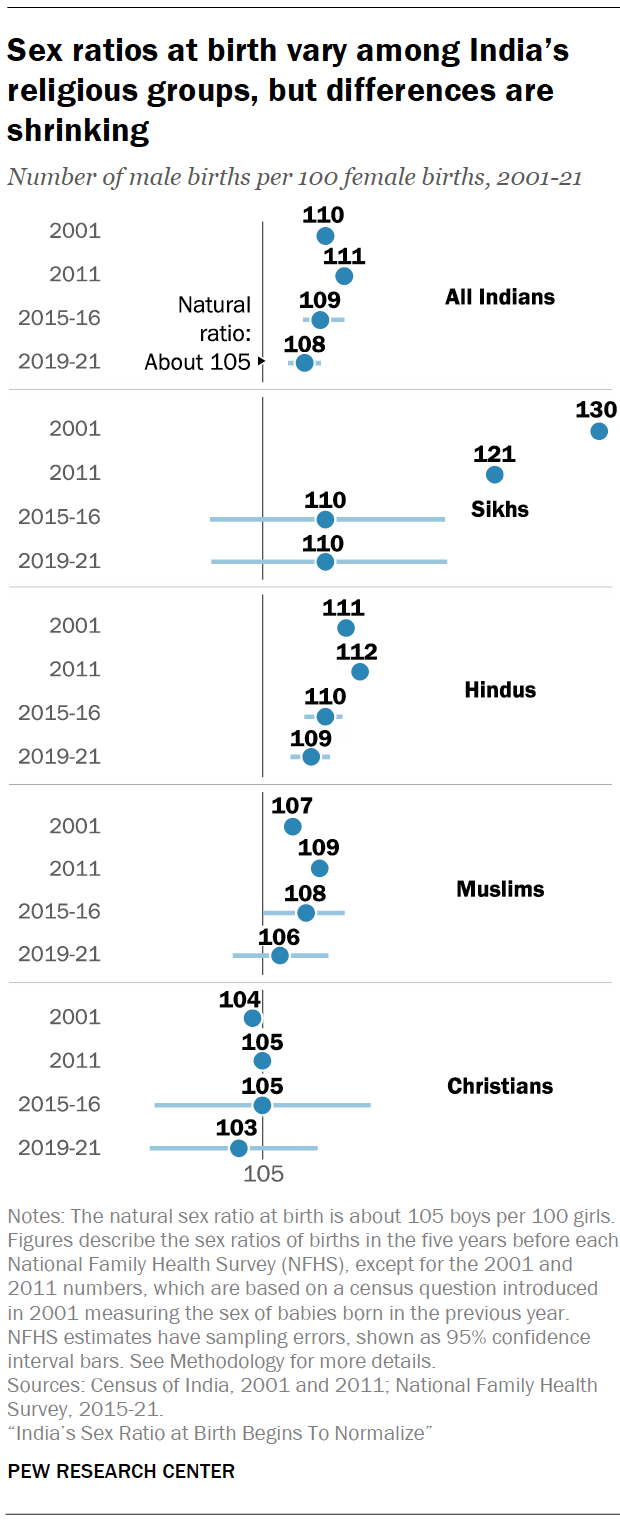
This is the clearest sign of journalistic mal-practice. We have numbers till 2021, and they have sharply declined since 2016. [2] [3] Rates of sex-selective abortion have clearly declined especially among those who can afford ultra sounds.

    > Female representation in higher education is rising, yet female labor-force participation, as of 2021, sits at a paltry twenty-three per cent, declining from twenty-eight per cent in 1990. A 2015 study published in The World Bank Economic Review showed that women were less likely to work when their husbands were educated and had high incomes, again underlining the paradoxical effects of affluence. India seems to value women less than when it outlawed dowry, sixty years ago.
I am not sure I agree with the conclusion. As India has moved from an agricultural economy [4] (where women were defacto employed) to physical migrant labor (defacto male employment), there is a natural lack of fresh jobs for low skilled women. While it is a scathing indictment of the one-sidedness of labor force changes in India, it isn't caused by sexism. The article makes it sound as if all trends are pointing downwards, but look at the numbers [5] and they've been sharply rising from 2016 - 2021. Hilariously, a lot of India's problems are due to labor force protections. Neighboring Bangladesh was able to vastly increase their female labor force participation by allowing exploitative textile factories to be built. This led to a massive rise in safe and non-physical jobs for women.

    > The Indian state of Punjab, where the majority of the world’s Sikhs live, has one of the most skewed sex ratios in the country
The decline in Sikh female infancide has been quite stark [6]. Long way to go, but an directionally excellent.

______________

I know that : "all stats for women are looking up in India since 2016" is not a narrative anyone wants to buy right now. But there is cause for genuine enthusiasm. There are also signs that the govt. might actually weaken some of the labor restrictions, and we might see some Bangladesh style rise in women-favored jobs, but the optics of "worse labor protections" makes it political kryptonite.

______________

[1] https://www.bbc.com/news/world-asia-india-57677253

[2] https://www.pewresearch.org/religion/2022/08/23/changes-in-s...

[3] https://www.pewresearch.org/religion/2022/08/23/indias-sex-r...

[4] https://en.wikipedia.org/wiki/File:Share_of_labour_force_emp...

[5] https://data.worldbank.org/indicator/SL.TLF.CACT.FE.ZS?locat...

[6] https://www.pewresearch.org/religion/wp-content/uploads/site...

Post reply on HN