Live data from Hacker News

IPCC climate crisis report delivers ‘final warning on 1.5C’

theguardian.com

101–110 of 456 posts

Re: IPCC climate crisis report delivers ‘final warning on 1.5C’

#101

Earlier quoted context omitted.

If climate models were predicting the temperature of your city on March 21, 2120 then your intuition here would be wise. But that is not at all what these models are predicting. They are predicting global average annual temperatures and other gross, planet-scale statistics. "Average annual global temperature in a given year" and "temperature in my city tomorrow" are fundamentally very different types of predictions.…

The point he is making is the disconnect between models and reality. Also when are people held accountable for their models being wrong and the output that comes from that. Climate models has a terrible track record and have failed to materialize over and over again. We have environmental crises all over the place which we should be focused on. The two are not the same thing and climate activism seems to not care abo…

But the models aren’t wrong. They’re surprisingly accurate. Some media reporting has been alarmist, choosing absolute worst cases and stating them as fact.

But in general, the changes we’ve seen so far are in line with predictions and there’s no reason to be more skeptical than normal of this science.

(As a side note, the resource extraction required to run a petrol engine is also not very green and often connected to human rights abuses. Not to downplay the issues in lithium sourcing, there are horrible conditions that need to be fixed, but the solution is not “oil”.)
Re: IPCC climate crisis report delivers ‘final warning on 1.5C’

#102
post #25

Let’s say if there is a magical wand that can will any policy the user wants to happen — so the magic can’t remove carbon, but it allows the bearer to pursue any mean within humanity technological abilities — what are the actual actions that could be taken to fight climate change? My impression is that even the big polluter like China (as an example) is already on full speed to build more nuclear plant or solar power…

Invest on renewable energy, until it is several times larger than our consumption; invest on energy storage and renewable chemical inputs; invest on carbon capture.

There's no hidden trick, all of that is completely obvious. Yet, government action could increase the rate of change several times.

Nobody is in full speed, everywhere things are mostly left to the market, and the market created a huge lot of completely artificial bottlenecks. It also is unable to do research and any kind of long-term investments, even when it's clear those are profitable; and it's always completely unwilling to do infrastructure investment.

Re: IPCC climate crisis report delivers ‘final warning on 1.5C’

#103

Earlier quoted context omitted.

What the fuck do you even mean with "nothing happens", when the climate has been changing noticeably for the past decade already?

[flagged]

I am not trying to communicate anything; just reacting with absolute bewilderment at somebody who is so far removed from reality, that he seemingly has not stepped outside in the past decade.

Re: IPCC climate crisis report delivers ‘final warning on 1.5C’

#104
post #18

Earlier quoted context omitted.

Overstating impact is detrimental to the cause. > decimated 1.5C will be bad, but it won’t directly kill 800+ million people in a short timeframe. People simply don’t respond to harm spread across 100 years the way they react to harm concentrated into a few large events.

So is understating the impact. This take is seriously dangerous. "1.5C is not so bad, chill people" When the fact is - we don't know the impact - if we go beyond 1.5. What we do know (because it's already very much measurable) is that much of the worlds glaciers will melt, causing drought. What we do know is that eventually the sea levels will rise and drown many extremely valuable coastal areas.

I'd argue we have no idea what will happen when the glaciers melt, given the lack of accurate climate change predictions to date. We have a lot of models that have historically proven very incomplete with no reason to believe they're any more complete now.

The oceans rising is more a problem, but it's not going to end human civilization and will happen slowly enough that adaptation is possible, albeit expensive. "Drowning" is hyperbole.

Uncertainty is just that, uncertainty. It will be positive for some areas and negative for others. Those of us who benefit from the status quo (myself included) can argue it would be unwise to mess up a good thing, but the simple fact is we have no idea. There will be winners as well as losers. It's quite possible that the midwest becomes wet enough that American farmers will become even more productive through double-cropping, for starters. Likewise the Russians look forward to their northern coastline thawing.

The sky isn't falling, it's shifting, and while we probably should minimize the shift as much as practical, we shouldn't plunge ourselves into an economic depression to do it.

Re: IPCC climate crisis report delivers ‘final warning on 1.5C’

#105

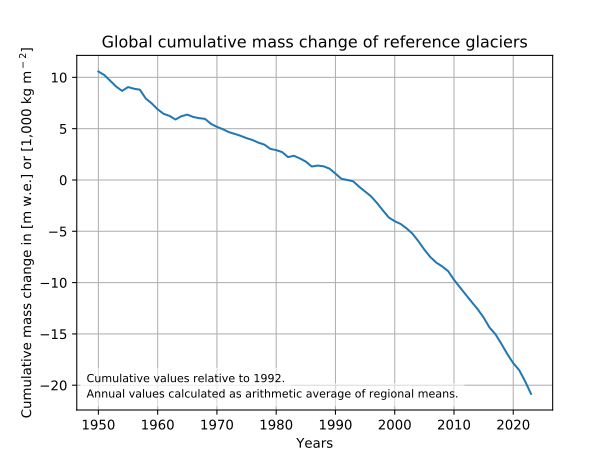
It was refreshing to see Greta delete her "were all doomed in five years tweet from 2018" last week. They also took down the signs in Glacier Park that predicted the glaciers would be gone by now near where I live.

Glaciers are disappearing globally.

http://wgms.ch/data/faq/_FAQ_RefGlac_Global_Cum_MB.svg

Re: IPCC climate crisis report delivers ‘final warning on 1.5C’

#106

Earlier quoted context omitted.

The point wasn't not only hitting that limit, but not hitting it before some date (end of century originally). The planet will continue warming up as long as we have an excess of greenhouse gases, even if we reach some kind of cooked up "net zero" of emissions. If we warm faster, feedback loops will have more effect earlier, tipping points may be reached in shorter time, biodiversity will drop a lot, and our ability…

Thanks for your answer, but to be clear, I understand all that. My question is what, specifically , the 1.5 degree budget signifies, and why it seems like there will be such a discontinuous amount of harmful effects if we blow past it. What is the significance of 1.5 vs 1 or 3? Also, I'm not some sort of "climate skeptic" - I totally understand there will be severe negative consequences for continuing to pump carbon…

Discontinuous effects, yes.

A stable climate functions more like a light switch than a dimmer switch. There is an "off", and once we go there getting back is really hard. It's almost like a one way switch.

As one example of a feedback loop, when polar ice melts, the area effectively turns from white (ice) to black (ocean). This area then absorbs more heat, driving more heating. So that's one feedback loop.

I think the feedback loops are kind of cool to study. Methane emissions in the tundra. Greenland melting causes more melting. Higher temps cause more water vapor that absorbs heat.

That doesn't give you specifics on where the line is. But wanted to give you an idea about the discontinuity, that there is a threshold vs dimmer switch.

P.S. I plugged your question into ChatGPT but the response was vague.

Re: IPCC climate crisis report delivers ‘final warning on 1.5C’

#107
post #68

Earlier quoted context omitted.

The predictions were not wrong. Society changed, people reacted to Greta and others, and that changed the situation, and thus the predictions. The Pandemia and pausing industries on a global scale did their own share. And as sad as it is, the war in Ukraine was finally a massive boost for changes in Europe's energy-infrastructure. People previously thought it would take decades, what now is finished in some years. Th…

Is that true? And assuming it is, the model was still wrong as an assumption of business as usual is part of that model. But I don't see how any of that could have prevented a glacier from melting by 2023 or the world from being "doomed" by 2018.

The model didn’t _assume_ business as usual. It explained the consequences of business as usual.

Re: IPCC climate crisis report delivers ‘final warning on 1.5C’

#108
post #59

Assume we hit 1.5C and "nothing happens" does this help the cause? While I'm very concerned about how unchecked climate change could impact future crop yields I also worry that having a hard line like this probably won't help convince anyone, and could counter intuitively act as a "I told you so" for climate denialists when the world doesn't fall apart as soon as we hit 1.5C. A lot of the more convincing arguments I…

> we're probably going to have to see some dire consequences of climate change before any serious action is taken.

Is it your position that there have been no serious consequences of climate change to date? That's not factual.

Re: IPCC climate crisis report delivers ‘final warning on 1.5C’

#109
post #8

For anyone interested in what 1.5C represents, I can't recommend enough the Climate Fresk [1] exercise. It's not just the droughts and floods, the heatwaves, the changes in birds, insects, crop yields, … Include permafrost melting and releasing greenhouse gasses, civil unrest in populated areas that won't be livable anymore, unstable food production, and quite a few other causes and consequences. It's a feedback loop…

Thanks! I wonder if there's a digital game or model version of this. Feedback loops can be pretty entertaining if presented well.

Re: IPCC climate crisis report delivers ‘final warning on 1.5C’

#110
post #93

Earlier quoted context omitted.

> ... the changes in ... crop yields... How would they even predict/model that? Have they modeled all the different plausible crops and agricultural techniques, which regional environmental conditions they're most suited for, and the transitions between them based on regional climate change effects? It's one thing to model a natural system, but seems quite a bit more complicated to model a system where human technolo…

Page 16 https://www.ipcc.ch/report/ar6/syr/ > Have they modeled all the different plausible crops and agricultural techniques, which regional environmental conditions they're most suited for, and the transitions between them based on regional climate change effects? Seems so. > It's one thing to model a natural system, but seems quite a bit more complicated to model a system where human technology and decision-making…

> Page 16

> https://www.ipcc.ch/report/ar6/syr/

>> Have they modeled all the different plausible crops and agricultural techniques, which regional environmental conditions they're most suited for, and the transitions between them based on regional climate change effects?

> Seems so.

I'm not seeing it. I'm assuming you mean page 16 of the "Summary for Policymakers," but all that has is a unreadable map of "Maize Yield" projections with the disclaimer:

> Projected regional impacts reflect biophysical responses to changing temperature, precipitation, solar radiation, humidity, wind, and CO2 enhancement of growth and water retention in currently cultivated areas. Models assume that irrigated areas are not water-limited. Models do not represent pests, diseases, future agro-technological changes and some extreme climate responses.

So it sounds like they are not accounting for things like changes between crops or changing which areas are cultivated, which could be pretty significant. For instance: their tiny map shows the cultivated area in Canada remaining unchanged, but if you're looking at total world agricultural yield of a future warmer planet, it seems like you would have account for more Canadian land becoming arable and agriculture spreading further north.

> "Extremely" is a big word. Agricultural yields depend on the weather. A population of 9-10 billion will not be sustained by vertical farms maintained in a synthetic climate.

Which is not the way I (or anyone reasonable) would think people would adapt. Instead of the software-engineer techno-fetishist fantasy of "vertical farms", I would think the adaptations would consist of things like:

1. Creating new farms in areas where the climate is currently too cold for productive agriculture,

2. Switching to different crops or different varieties that are hardier against heat and drought or otherwise yield more calories (per whatever limiting factor),

3. Switching to different irrigation techniques that may be more water-efficient,

4. etc.

Post reply on HN