Live data from Hacker News

The Remarkable Number 1/89 (2004)

www2.math.ou.edu

101–110 of 116 posts

Re: The Remarkable Number 1/89 (2004)

#101
post #69

On the decimal expansion part, 1⁄7 has always fascinated me, having something very similar going on. Doubling from 7, you get 14, 28, 56; and 1⁄7 is 0.1̅4̅2̅8̅5̅7̅, 2⁄7 is 0.2̅8̅5̅7̅1̅4̅, 3⁄7 is 0.4̅2̅8̅5̅7̅1̅, &c. (just changing which digit you start the recurring sequence with). https://en.wikipedia.org/wiki/142,857 talks about it a bit more; the doubling sequence thing is covered in the section 1⁄7 as an infinite…

Does this work or other bases too? Other than 10?

That you can find other special properties on various numbers is true in all bases, but 1/7 in base 10 is pretty special.

So the property it has is:

    1/n = n (2/b^2 + 4/b^4 + 8/b^6 + ...)
which by geometric series sums to

    1/n = n / (b²/2 — 1)

    n² = b²/2 – 1
So this works precisely because 7² = 49 = 50 – 1 = 100/2 — 1.

Calculating some of these out these appear to be the Newman-Shanks-Williams numbers [1], the next one is 41 in base 3364, where

    1/41 = {0}.{82}{164}{328}{656}{1312}{2625}...
notice the 5 finally coming from some overflow.

But, supposing that we just like the idea of starting with some digit d and then the next digit being k times that and the next digit being k times that, we get a more general set of numbers,

    d/b + dk/b² + dk²/b³ + ...
      = d/(b - k)
Given that, this becomes much more boring. So for example for doubling in base-100 we think about 1/98 (b=100, k=2) and we find

   1/98 = 0.01020408163265...
and factors of that 98 also may have similar patterns, so 7 has this strength because it is a factor of 98.

So for example we want to think about 1/7 in base-12, this suggests that maybe we should look for things that quintuple base 12, but that rapidly overflows base 12. So we do the same trick as 1/7 where we take pairs of digits, and maybe things quadruple base-144 (since 144 - 4 is 140 which is divisible by 7), and so we find that

    1/7 = 0.{20}{82}{41} repeating
and if you squint closely you can see starting with 20, quadrupling to 80, quadrupling to 320 but then getting a bit unwieldy. Of course even on single digits 12 - 2 = 10 which has 5 as a factor so you can expect to see a pattern in base-12 on

    1/5 = 0.{2}{4}{9}{7} [repeating]
which you can see a sort of "2, 4, 8, 16," pattern happening.

The other base that I really like is nonnary, if we met aliens we might find that they count in balanced nonnary with digits -4, -3, -2, -1, 0, 1, 2, 3, 4, (so like 7 is actually {1, -2}, 7 = 9 - 2), but it's harder to search for patterns in that because you really feel the cap of having only half the base to count up to before you carry.
Re: The Remarkable Number 1/89 (2004)

#102
post #33

"The successive ratios of the terms, i.e. 1/1, 2/1, 3/2, 5/3 ... tend to a number called the Golden Ratio by the Greeks." Fun fact: take any two numbers (e.g. chosen randomly), and use them as the seeds for a Fibonacci-like sequence by summing the last two terms to generate the next term. The ratio of any two consecutive terms in that series will tend towards the golden ratio.

If you read this and you’re curious, there’s a proof that is fairly easy to follow if you understand eigenvectors. Write the operation that takes the two last elements of the sequence and produces the following two, notice it’s linear, then analyze the eigenvalues of the associated matrix and relate the original operation to the power method.

You actually don't need eigenvectors for this proof. Sketch: Write x = lim a_n/a_{n-1} where a_n is the nth term of Fibonacci. Replace a_n with a_{n-1} + a_{n-2}, which will give you a quadratic equation in x. Solving this quadratic equation gives you the golden ratio.

Re: The Remarkable Number 1/89 (2004)

#103

On the decimal expansion part, 1⁄7 has always fascinated me, having something very similar going on. Doubling from 7, you get 14, 28, 56; and 1⁄7 is 0.1̅4̅2̅8̅5̅7̅, 2⁄7 is 0.2̅8̅5̅7̅1̅4̅, 3⁄7 is 0.4̅2̅8̅5̅7̅1̅, &c. (just changing which digit you start the recurring sequence with). https://en.wikipedia.org/wiki/142,857 talks about it a bit more; the doubling sequence thing is covered in the section 1⁄7 as an infinite…

Wow, it keeps going also with the further digits, e.g.

=14285712

+0000000224

=1428571424

+000000000448

=142857142848

+00000000000896

=14285714285696

+0000000000001792

=142857142857....

Re: The Remarkable Number 1/89 (2004)

#104

On the decimal expansion part, 1⁄7 has always fascinated me, having something very similar going on. Doubling from 7, you get 14, 28, 56; and 1⁄7 is 0.1̅4̅2̅8̅5̅7̅, 2⁄7 is 0.2̅8̅5̅7̅1̅4̅, 3⁄7 is 0.4̅2̅8̅5̅7̅1̅, &c. (just changing which digit you start the recurring sequence with). https://en.wikipedia.org/wiki/142,857 talks about it a bit more; the doubling sequence thing is covered in the section 1⁄7 as an infinite…

Cool thing is, this is not a special property of 1/7. 100 / 7 is 14, with a remainder of 2, therefore the series starts with 14, multiplies by 2, and divides with 100 in each iteration. For instance 10 / 7 is 1, with a remainder of 3, therefore 1/7 is also equal to 0.1+0.03+0.009 etc. And 1/8 is 0.1+0.02+0.004 etc.

Then how does 1/8 become 0.125?

If you do the calculation, with each step it goes towards 0.124999999999

Re: The Remarkable Number 1/89 (2004)

#105
Question (perhaps naive):

Given the decimal expansion of 1/89, is there any way to directly retrieve the Fibonacci sequence from it? (that is, not using any knowledge of the sequence itself)

I'm assuming it can't be done because different sets of fractions can sum to 1/89, but maybe I'm missing something.

Re: The Remarkable Number 1/89 (2004)

#106

Earlier quoted context omitted.

Cool thing is, this is not a special property of 1/7. 100 / 7 is 14, with a remainder of 2, therefore the series starts with 14, multiplies by 2, and divides with 100 in each iteration. For instance 10 / 7 is 1, with a remainder of 3, therefore 1/7 is also equal to 0.1+0.03+0.009 etc. And 1/8 is 0.1+0.02+0.004 etc.

Then how does 1/8 become 0.125? If you do the calculation, with each step it goes towards 0.124999999999

> with each step it goes towards 0.124999999999

Also known as .125.

https://en.wikipedia.org/wiki/0.999...

Re: The Remarkable Number 1/89 (2004)

#107

Earlier quoted context omitted.

I use CapsLock; lowest usefulness to size ratio possible.

Caps lock is much more useful as a home row ctrl key

I find it most useful as a Super key, so that I can attach all my custom keybindings and shortcuts to it.

Re: The Remarkable Number 1/89 (2004)

#108

On the decimal expansion part, 1⁄7 has always fascinated me, having something very similar going on. Doubling from 7, you get 14, 28, 56; and 1⁄7 is 0.1̅4̅2̅8̅5̅7̅, 2⁄7 is 0.2̅8̅5̅7̅1̅4̅, 3⁄7 is 0.4̅2̅8̅5̅7̅1̅, &c. (just changing which digit you start the recurring sequence with). https://en.wikipedia.org/wiki/142,857 talks about it a bit more; the doubling sequence thing is covered in the section 1⁄7 as an infinite…

I learned about 1/7 back in my youth, and it's just been one of those things that I enjoyed knowing as I went on in life.

Imagine my amusement when I ran across a Project Euler problem where those digits were the answer. I recall just looking at it and thinking I __know__ this one, there's no need to code anything. An easy point, but I didn't feel like I cheated on it.

Re: The Remarkable Number 1/89 (2004)

#110
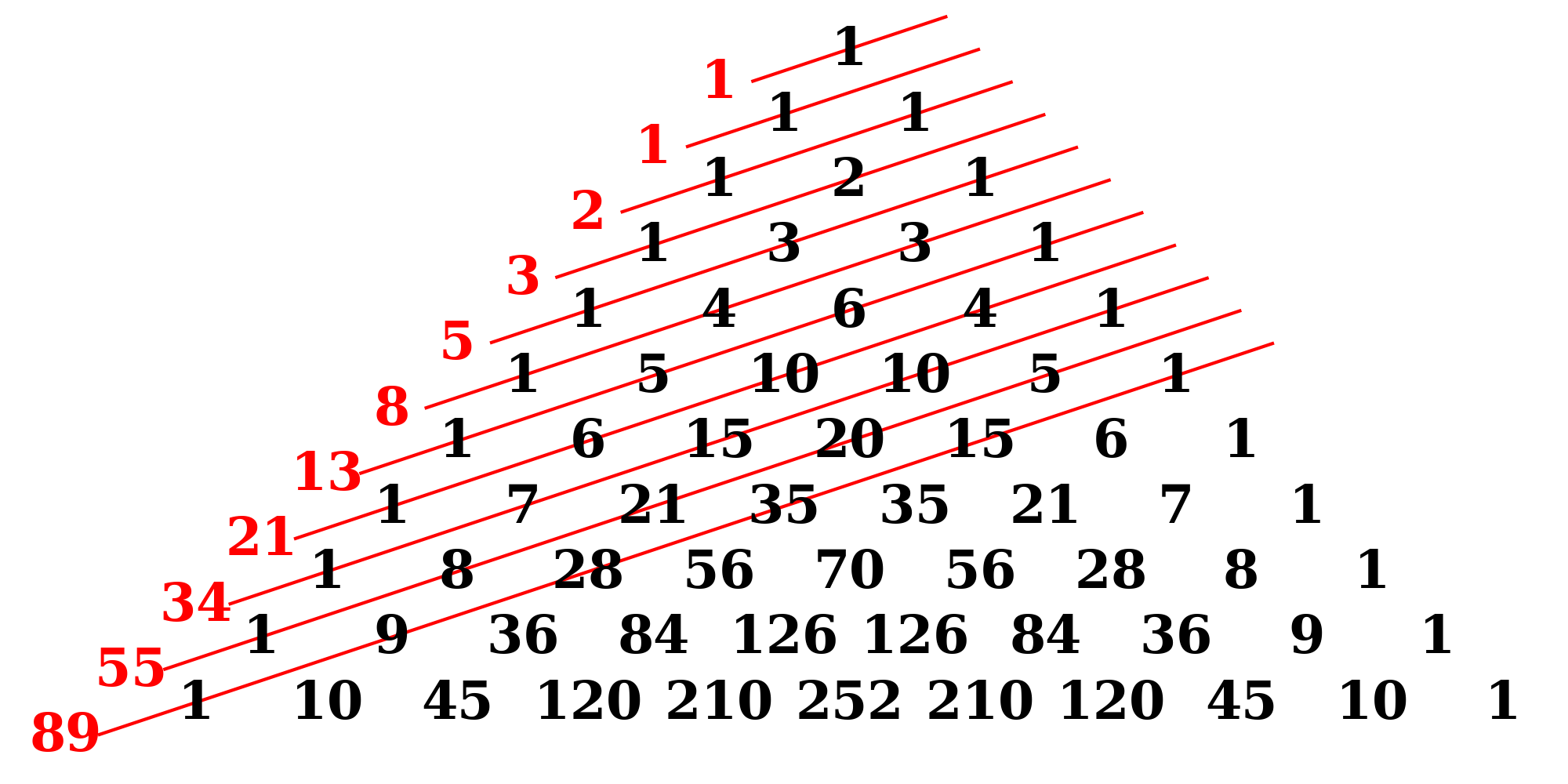
I noticed a while ago that the powers of 1001 encode the successive rows of pascal's triangle/the binomial coefficients. This is not so surprising, since we are effectively taking powers of the polynomial (1+x), but replacing x with 1000 (clearly it works the same if we use any other power of ten instead). I wonder if we can find a relationship to that here. We might start by looking at this relation:

  1/(1-x) = 1 + x + x^2 + x^3 + ...
Hopefully this will yield an operator x whose succesive powers are the fibonacci numbers. Take .01/(1-x) = 1/89, then x = 0.11. Actually, the powers of x, just like 1001 above, will yield rows of pascal's triangle. So the taylor expansion above tells us that F(k) = Σ(n=0..k-1) B(n, k), in other words that each fibonacci number is the sum of a diagonal of pascal's triangle (like here: https://cdn1.byjus.com/wp-content/uploads/2018/11/maths/2016...)

More generally, we can compute numbers with decimal expansions of the fibonacci numbers with 10^-2n / (1 - 10^-n - 10^-2n). Notice that this is just the z-transform of the recurrence relation of the fibonacci series, with 10^n replacing z:

  Z(f(n)) = Z(f(n-1) + f(n-2) + δ(n-2)) (δ is the kronecker delta)
     F(z) = z^-2 / (1 - z^-1 - z^-2)
The taylor expansion of this expression has coefficients equal to the terms of the fibonacci sequence - which makes sense, because that's the definition of the z-transform. We can, with a little rearranging, get an explicit formula for the fibonacci sequence from it too:

  Take φ± = (1 ± √5)/2
  Then F(z) = z^2/(z - φ+)/(z - φ-)
            = ( φ+ z/(z - φ+) - φ- z/(z - φ-) )/√5 (by partial fraction decomposition)
  Z^-1(F(z)) = f(n) = (φ+^(n+1) - φ-^(n+1))/√5
Post reply on HN