Live data from Hacker News

Low-Background Steel

en.wikipedia.org

101–110 of 114 posts

Re: Low-Background Steel

#101
post #48
post #8

The scene of the battle of Midway would also hold a hoard of nice steel (the Japanese lost a lot of ships including aircraft carriers). I understand that Scapa Flow has been heavily salvaged with only 7 out of 52 ships still down there.

The Battle of Midway was fought in spectacularly deep water, on the order of 17,000-18,000 feet deep. This would make salvaging difficult, if not impossible. Scapa Flow is shallow enough for divers. Once we run out of cheaply salvageable steel, we'll likely turn to steel smelting processes that do not introduce air into the steel. These processes require dramatically more energy and are thus more expensive, but will…

> Once we run out of cheaply salvageable steel, we'll likely turn to steel smelting processes that do not introduce air into the steel.

This would be exceptionally difficult, as oxygen is a basic requirement for steel making as we have ever known it. Steel is made from iron mixed with carbon and then heated to melt. Then oxygen is added which burns the excess carbon into carbon dioxide and reacts with all of the other reactive contaminants and brings them to the surface where they can be cupped off as slag. The melt is poured and cooled and you have steel. Early steel processes used air, blast into the furnace with high powered pumps. Modern steel is made with purified oxygen from cryogenic processes (and there are even designs floating around for steel mills which use the turboexpander from the oxygen processing to help generate electricity to drive the mill).

Without oxygen, you'd have to start with very, very clean iron ore (containing nothing but iron and whatever you wanted to alloy with the final steel), and add exactly the right amount of carbon (which is also exceptionally difficult, since carbon is light and the heat will want to make it sublime anyway). Odds are such a steel would still contain so much impurity as to require a second melt in a vacuum arc furnace, which also would dramatically drive up the cost.

While there might be a future making steel like this in space, I'm not counting it as very likely in the slightest to happen in this century.

It's much easier to use exceptionally clean oxygen - the mill could use an oxygen generation process (like a hydrogen peroxide chemical process plant being added to the mill), or by ultrafiltration of the process oxygen (which seems more realistic all told).
Re: Low-Background Steel

#102
It's been pointed out it's wrong but, as a sometime nuclear spectroscopist, I'm curious: why are people insisting that β-decay, i.e. ¹⁴C, is the issue?

Re: Low-Background Steel

#103
post #83

Earlier quoted context omitted.

Build large stone piles. https://en.wikipedia.org/wiki/Great_Pyramid_of_Giza

The problem with that is, judging by our own behavior, an unknown ancient structure makes humans investigate it, try to dig it up, etc. Placing a marker isn't the problem, the hard part is communicating "nothing interesting, only death here, do not enter" in a way that someone in 10.000 years will heed the warning.

The solution is to build them everywhere and put the bad stuff in one of them. If you build enough then the chances of them excavating the one with nuclear waste is pretty low.

Re: Low-Background Steel

#105
post #95
post #52

Earlier quoted context omitted.

They are using Oxygen, Oxygen can't become radioactive for longer than a few seconds anyway. All they need to do is filter for pure oxygen, nitrogen is fine as well. It's really just CO2 that's the problem.

So this is all kinds of wrong. When you make steel, you typically use 99+% pure oxygen - modern mills do air separation and reject nitrogen and argon (which makes steel brittle when it's dissolved in) and basically anything they can reasonably separate out but oxygen. But furthermore, it's not radioactive oxygen isotopes that get into the steel in the first place - they're scant to non-existent in nature, since all t…

How is the cobalt getting mixed with the stuff mined from the ground? I guess that's the part that confuses me.

Also, what's in the lead? I didn't think we wanted CO2 in lead but I'm really not sure what impurities it might have naturally.

Re: Low-Background Steel

#106
post #83

Earlier quoted context omitted.

Build large stone piles. https://en.wikipedia.org/wiki/Great_Pyramid_of_Giza

The problem with that is, judging by our own behavior, an unknown ancient structure makes humans investigate it, try to dig it up, etc. Placing a marker isn't the problem, the hard part is communicating "nothing interesting, only death here, do not enter" in a way that someone in 10.000 years will heed the warning.

https://en.wikipedia.org/wiki/Long-time_nuclear_waste_warnin...

Re: Low-Background Steel

#107
post #6

Earlier quoted context omitted.

Is there a particular trigger for this post? Is this a case of someone stumbling into the concept and wanting to share it with the world? Is there some trend in SV around low-background steel right now? Genuinely curious about the phenomenon of posts around topics that have a great deal of understanding and aren’t necessarily trending in the general news cycle.

Low background lead was recently mentioned on xkcd[0]. Maybe that circled back to HN? [0] https://xkcd.com/2321/

There was a recent post on the trinity test

Someone going on a binge from that, through discovering how Kodak found out about nukes from film and low background steel isnt a huge stretch either

Re: Low-Background Steel

#108
post #75

Earlier quoted context omitted.

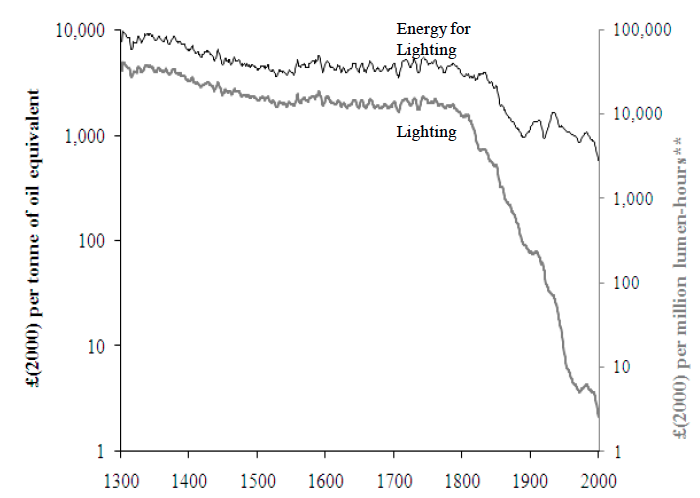
Now you are measuring electricity instead of the light you read by, and fuel instead of the vacation trip you take with it. You have worsened the problem I refer to.

Energy IS electricity, and to create a Lightbulp you NEED energy, it's exactly the same. For your vacation trip you NEED energie in form of food an fuel, the vehicle you travel in, is made by food and fuel...exacly the same. If the transport company accept your fuel (or workforce witch again is fulled by energie (your food)) as payment, you exchanged energie to energie, probably they dont and thats why you use a exch…

the fundamentally inescapable problem is your approach measures an input instead of output, and thus makes technology improvements look like an economic crash

consider the 'light' market:

https://ourworldindata.org/uploads/2013/12/Trends-in-the-Pri...

Re: Low-Background Steel

#109
post #105
post #95

Earlier quoted context omitted.

So this is all kinds of wrong. When you make steel, you typically use 99+% pure oxygen - modern mills do air separation and reject nitrogen and argon (which makes steel brittle when it's dissolved in) and basically anything they can reasonably separate out but oxygen. But furthermore, it's not radioactive oxygen isotopes that get into the steel in the first place - they're scant to non-existent in nature, since all t…

How is the cobalt getting mixed with the stuff mined from the ground? I guess that's the part that confuses me. Also, what's in the lead? I didn't think we wanted CO2 in lead but I'm really not sure what impurities it might have naturally.

> How is the cobalt getting mixed with the stuff mined from the ground?

So the term "fallout" is actually a pretty piece of propaganda. While a lot of it did or does indeed "fall out", there's still a lot of radioactivity in the air and on the surface from those nuclear tests in the form of fine particulate. It's in the fine dust all around you as 100nm and smaller particles, dancing around the air through Brownian motion. It's all over everything all of the time. It's in the water and the ocean. Nanograms here and there and everywhere. Not enough to really cause you health problems anymore, but plenty enough to increase the background radiation of the entire surface of the planet by a tiny amount.

How it gets into the steel is through the actual blasting of oxygen into the steel - hundreds of cubic meters of oxygen are used per ton of steel made, concentrating those tiny particulates into the steel they're going into and dissolving them throughout the melt, which is precisely why using ultrapure oxygen and vacuum processes could be used to make lower background steel today... if there was high enough demand to justify the absurd cost of that kind of handling. Fortunately though, there was plenty of steel made before the 1940s, and the demand is not all that high since it's usually used as a shielding material and not as large structural elements. As long as they don't remelt it, or do so in a high vacuum reformer, the metal can retain its low background nature.

Intermediate-lived gamma-emitting isotopes (cobalt-60, strontium-90, cesium-137, and so on) are the particular problem children of nuclear fallout in steel making. The cesium and strontium are largely removed by the same processes as steel is made in the first place - they're simply reactive enough to bond with the silicon and carbon and aluminum impurities being removed and will happily exclude the majority of themselves as part of the slag. So while they do contribute to the background, they're not the main problem. Cobalt, on the other hand, is right next to iron on the periodic table and its happy to stay stuck to the iron, even through rounds of recrystallization. Once the cobalt is in the steel, it's in there until it decays away to nickel over the next century or so. (This is also why it's much less of a problem now than it was even 20 years ago; the halflife of cobalt-60 is about 5 years, which means much of it from the nuclear testing is already gone - most of what remains is from nuclear reactor releases and neutron activation products.)

The more sensitive your instrument needs to be, the more radioactive contamination wrecks your instrument, which is already why physics experiments have to go to extreme lengths to keep everything clean of dust and debris, and are often located underground or underwater to avoid exposure to cosmic rays and atmospheric muons decaying. But the even higher sensitivity experiments like dark matter searches and measurements of cosmic background radiation have little choice but to reach for low background steels and lead as shielding material.

Re: Low-Background Steel

#110
post #79

Since tabacco gets its cancer making polonium from the air, I wonder if smoking got riskier because of the nuklear testing.

Do you have more information on this? Seems interesting!

Just search for the paper on the topic, written by the Phillip Morris Unbiased Research Group. it explains how frogs breathing air got more cancer then frogs trapped in airtight boxes and only allowed to breathe exhaled tobacco smoke, who mostly died for other reasons. seems legit...
Post reply on HN