Live data from Hacker News

Huawei Manages to Make Smartphones Without American Chips

wsj.com

101–110 of 208 posts

Re: Huawei Manages to Make Smartphones Without American Chips

#101
post #90

Earlier quoted context omitted.

> I really doubt that the EDA software is really that much of an investment these days If EDA tools were so simple, why don't the big IC design companies -- e.g., Intel, Apple, Samsung -- just build their own in-house tools instead of paying millions in license fees? > It's the lithography tech that's the real crown jewel, and it is being protected. Sure, but lithography tech is useless unless you have access to soli…

Millions is not that much. TCO of six engineers for a year gets you into millions. If it's a solved problem, it's probably worth just buying off the street.

I hope someone can correct me in this thread, but I recall hearing that a single-seat license can cost ~$50k per year. I would imagine that any company with a large number of ASIC engineers would love to reduce that overhead.

Regardless, none of what you said disagrees with the point that EDA tools are complex and should therefore be protected from Chinese influence.

Re: Huawei Manages to Make Smartphones Without American Chips

#102
post #72

Earlier quoted context omitted.

I'm just saying, from where I stand (and I'm first to recognize I'm not an expert here) it sure looks like my country is trying to make things harder for China, and is paying the price of making things harder for workers in my own country. Even if the Chinese worker is hurt more than the American worker, the American worker is still being hurt, and as far as I can tell, all involved would be better off if we traded i…

Is it really free when China had much greater tariffs on US goods than Chinese goods had come into the US? Is it really free when Chinese entities get to enjoy massive subsidies to dump products while foreign companies face nonmarket barriers? Fundamentally it's time to wake to the fact that the CCP views the very existence of Liberal Democracies as a threat to itself [1]. It will work to undermind or extinguish then…

>Is it really free when China had much greater tariffs on US goods than Chinese goods had come into the US? Is it really free when Chinese entities get to enjoy massive subsidies to dump products while foreign companies face nonmarket barriers?

so you are saying that a trade war is successful if there are fewer barriers at the end than at the beginning? That's a reasonable definition, but that would benefit both parties, so it still doesn't really show a "winner"

> And facing the CCP will have a cost.

But if you define a successful trade war as one where there are fewer barriers to trade at the end than at the beginning, that will benefit both parties.

I mean, one could argue that free trade (well, more trade) is going to make your society more free in general, is going to introduce more ideas and things like that, I suppose, and you could also argue that trading more with a country makes it less likely you will go to war with them, but these things aren't really about crushing your competitor.

Re: Huawei Manages to Make Smartphones Without American Chips

#103
post #102

Earlier quoted context omitted.

Is it really free when China had much greater tariffs on US goods than Chinese goods had come into the US? Is it really free when Chinese entities get to enjoy massive subsidies to dump products while foreign companies face nonmarket barriers? Fundamentally it's time to wake to the fact that the CCP views the very existence of Liberal Democracies as a threat to itself [1]. It will work to undermind or extinguish then…

>Is it really free when China had much greater tariffs on US goods than Chinese goods had come into the US? Is it really free when Chinese entities get to enjoy massive subsidies to dump products while foreign companies face nonmarket barriers? so you are saying that a trade war is successful if there are fewer barriers at the end than at the beginning? That's a reasonable definition, but that would benefit both part…

>I mean, one could argue that free trade (well, more trade) is going to make your society more free in general, is going to introduce more ideas and things like that, I suppose, and you could also argue that trading more with a country makes it less likely you will go to war with them, but these things aren't really about crushing your competitor.

One who would argue something like that in the face of the decidedly not free CCP run society that is modern China is fooling themselves. And their mode of operation is most certainly about crushing competitors.

Re: Huawei Manages to Make Smartphones Without American Chips

#104
post #13
post #4

I checked out a Huawei store - they're the same asthetic as an apple store with a ton more useful tech then an ipod, macbook and imac. The phones were impressive and very affordable. We're talking $200-300 for 6gb ram devices, 128gb storage, etc. Google, Apple are right to be worried.

Google and Apple are just milking it. Smart phones were introduced a decade ago. Flagship phones costed then around $500, now we got to the point that they costing $1,000+ like if mass producing wouldn't cut the cost down. On top of that making a battery be non removable and constantly over-volting the batteries to reduce their life. Ultimately phones become useless after 2 years, unless you replace batteries yoursel…

>Smart phones were introduced a decade ago. Flagship phones costed then around $500, now we got to the point that they costing $1,000+ like if mass producing wouldn't cut the cost down.

If making smartphones is really as easy as you make it out to be, and smartphone prices are rising, then why isn't that being captured in the global profit share? Considering that Androids are vastly more popular than iOS phones, there would be no reason why Apple's getting 62% of global profits.

[1] https://www.statista.com/statistics/780367/global-mobile-han...

Re: Huawei Manages to Make Smartphones Without American Chips

#105
post #72

Earlier quoted context omitted.

I'm just saying, from where I stand (and I'm first to recognize I'm not an expert here) it sure looks like my country is trying to make things harder for China, and is paying the price of making things harder for workers in my own country. Even if the Chinese worker is hurt more than the American worker, the American worker is still being hurt, and as far as I can tell, all involved would be better off if we traded i…

Is it really free when China had much greater tariffs on US goods than Chinese goods had come into the US? Is it really free when Chinese entities get to enjoy massive subsidies to dump products while foreign companies face nonmarket barriers? Fundamentally it's time to wake to the fact that the CCP views the very existence of Liberal Democracies as a threat to itself [1]. It will work to undermind or extinguish then…

Document 9 is for domestic policy, CPC recognizing Western Liberal values is a threat to Chinese system does not mean CPC is attempting to undermine those values elsewhere. Unlike USSR, CPC hasn't been exporting or competing on ideology.

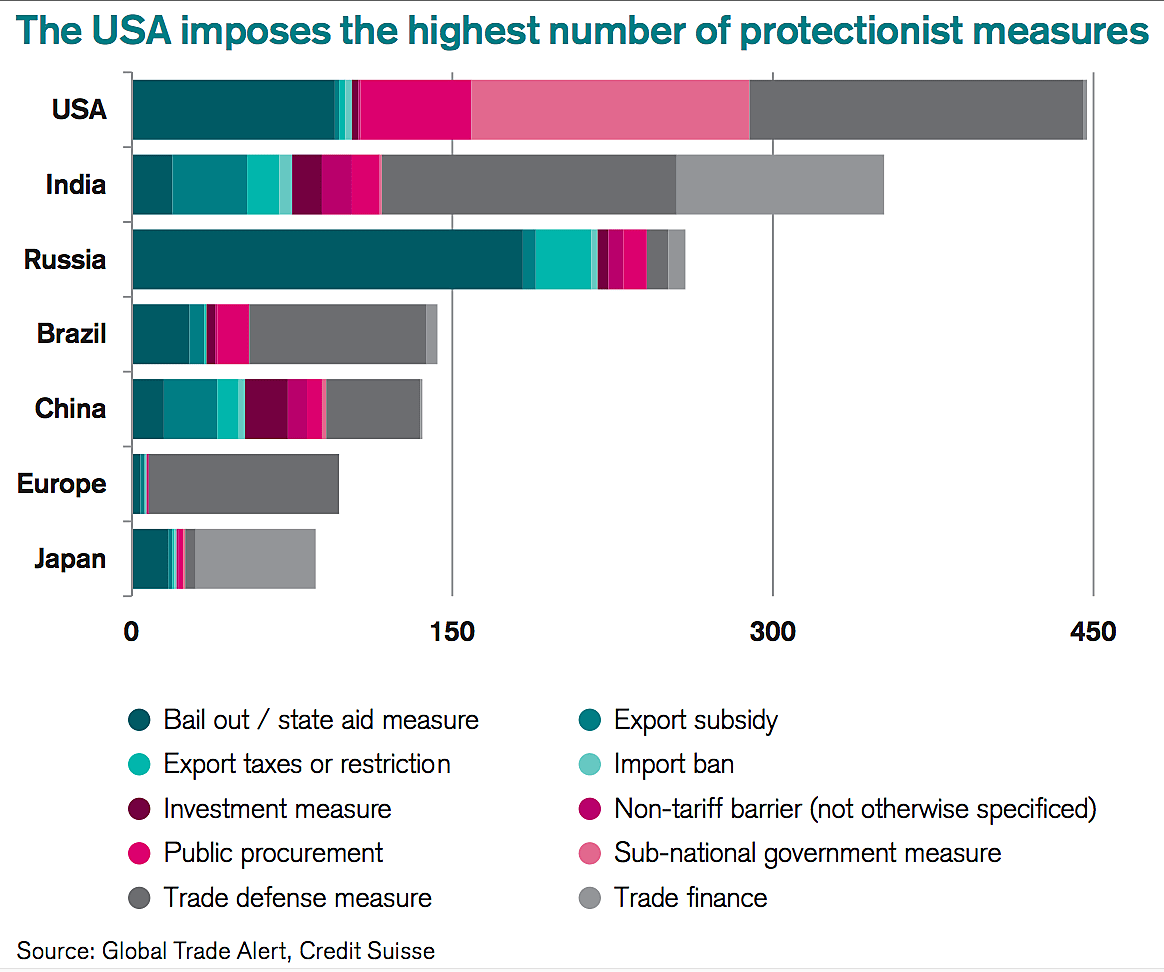
As for the free trade question, China has a higher mean tariff rate ~2% more, which is comparable to other developing countries. But viewing "free trade" in tariff lens doesn't present the whole picture. In terms of trade barriers US has more protectionist measures than China [1]. Go look up a list of WTO complaints to see who the largest free trade abuser is, a good visualizer [2]:

>China was involved in 63 disputes with 9 Economies from the time it acceded to the WTO in 2001 through 2018. China has been the complainant 20 times and the respondent 43 times.

VS

>United States was involved in 275 disputes with 42 Economies from the time it acceded to the WTO in 1995 through 2018. The United States has been the complainant 123 times and the respondent 152 times.

Or look up some US Chamber of Commerce surveys, Latest U.S. China Business Council's (USCBC) survey tldr was basically US companies overwhelmingly convinced Chinese companies receive (alleged) unfair state subsidies but they don't care because even with the tradewar, 97% of respondents said their China operations were profitable which is UP from 85% in 2015. Overall, business in China is good, select industries face more barriers than others (some technology, many financial services), industries with the loudest lobbying groups that skew the narrative.

[1] https://www.cato.org/sites/cato.org/files/styles/pubs_2x/pub...

[2] https://chinapower.csis.org/china-world-trade-organization-w...

[3] https://www.forbes.com/sites/kenrapoza/2019/08/30/us-compani...
Re: Huawei Manages to Make Smartphones Without American Chips

#106
post #72
post #66

Earlier quoted context omitted.

I would say that the "winner" is the one who got hurt less and can recover faster/better but it is all relative. While 2 sides are busy killing each other the third one might get the benefits

I'm just saying, from where I stand (and I'm first to recognize I'm not an expert here) it sure looks like my country is trying to make things harder for China, and is paying the price of making things harder for workers in my own country. Even if the Chinese worker is hurt more than the American worker, the American worker is still being hurt, and as far as I can tell, all involved would be better off if we traded i…

>> it sure looks like my country is trying to make things harder for China, and is paying the price of making things harder for workers in my own country.

Not sure if you've noticed, but manufacturing is starting to come back in the US. Industrial automation and skilled trades jobs are starting to be a thing again. These are solid middle class jobs that often dont require a degree. Its coming at the expense of some pain in other areas, but it might be an overall positive.

The path we were on was not sustainable. The US lost a LOT of capability over the last 20 years. Getting that back is critical and will not be painless.

Re: Huawei Manages to Make Smartphones Without American Chips

#107
post #101

Earlier quoted context omitted.

Millions is not that much. TCO of six engineers for a year gets you into millions. If it's a solved problem, it's probably worth just buying off the street.

I hope someone can correct me in this thread, but I recall hearing that a single-seat license can cost ~$50k per year. I would imagine that any company with a large number of ASIC engineers would love to reduce that overhead. Regardless, none of what you said disagrees with the point that EDA tools are complex and should therefore be protected from Chinese influence.

You always get screwed in niche B2B on a single seat license. There's no way the chip manufacturers are actually spending anywhere near that much.

And they really aren't that complex. China has more than enough capability to reproduce them.

I guess I'm not sure how to prove a negative here. What do you think is so special about EDA software that isn't fairly easy replicable? Other than the fab design rules, which if I'm making a litho vs EDA distinction in the first place aren't really a part of EDA.

Re: Huawei Manages to Make Smartphones Without American Chips

#108
post #97

Earlier quoted context omitted.

Xiaomi is even more impressive. A friend of mine from China showed me a video (2017 or 2018) of a man who ordered from a Xiaomi store. The video was of the man receiving the item he ordered 5 minutes after he ordered it! It was around midnight not sure of the day but 5 minutes to his door step from ordering it! I asked my friend how is that possible so he showed me an image of a map of Xiaomi warehouses. I can't reca…

>The video was of the man receiving the item he ordered 5 minutes after he ordered it! It was around midnight not sure of the day but 5 minutes to his door step from ordering it! Feels like a viral marketing stunt to me. There's zero reason why anyone would want a phone within 5 minutes (or even same day). In the off chance that they do, they could simply walk into a physical store and buy it there. There's no need t…

> Feels like a viral marketing stunt to me.

Possible. But he looked really pissed that there was a camera filming him.

I'm not sure if it was a phone he ordered.

Re: Huawei Manages to Make Smartphones Without American Chips

#109
post #73
post #48

Earlier quoted context omitted.

Another way of looking at things: Today’s phones are quite a bit more capable than the first generation of smartphones, and they only cost twice as much.

So tomorrow's smartphone will be 20 times faster and only cost 10 times as much?

No... that's pure hyperbole.

But 10x faster (or capable) and 2x the cost? That's not outrageous. BTW that's where we currently are.

Re: Huawei Manages to Make Smartphones Without American Chips

#110
post #72

Earlier quoted context omitted.

I'm just saying, from where I stand (and I'm first to recognize I'm not an expert here) it sure looks like my country is trying to make things harder for China, and is paying the price of making things harder for workers in my own country. Even if the Chinese worker is hurt more than the American worker, the American worker is still being hurt, and as far as I can tell, all involved would be better off if we traded i…

>> it sure looks like my country is trying to make things harder for China, and is paying the price of making things harder for workers in my own country. Not sure if you've noticed, but manufacturing is starting to come back in the US. Industrial automation and skilled trades jobs are starting to be a thing again. These are solid middle class jobs that often dont require a degree. Its coming at the expense of some p…

>Not sure if you've noticed, but manufacturing is starting to come back in the US. Industrial automation and skilled trades jobs are starting to be a thing again. These are solid middle class jobs that often dont require a degree. Its coming at the expense of some pain in other areas, but it might be an overall positive.

My understanding is that most of the really good paying manufacturing jobs aren't coming back; the manufacturing that is coming back is non-union and pays worse than a union job (and much worse, say, than the better IT jobs that don't require a degree.)

I personally think it's super weird that people (especially in the USA) seem to think that manufacturing jobs are inherently better than other jobs, when my impression is that most of the pay advantages are simply that it is a class of jobs that unionized while it was in high demand, preserving some of the benefits of being a high demand job through a time when demand had fallen.

Post reply on HN