Live data from Hacker News

European MPs vote to end summer time clock changes

bbc.com

101–110 of 121 posts

Re: European MPs vote to end summer time clock changes

#101
post #98

It's really a simple question. How should you approximate this curve? ....................*****..... .................***.....**... ................*..........**. *.............**.............* .**..........*................ ...**.....***................. .....*****.................... If you think it should be this, you want permanent standard time: .............................. .............................. .....…

There are two curves to account - sunrise and sunset. Daylight savings attempts to flatten one of those and not the other!

Yes, because DST correctly attempt to adjusts Sunrise towards our usual wake-up time (obviously it can't do miracles).

Re: European MPs vote to end summer time clock changes

#102
post #68
post #3

>The proposal would give each member state a choice from 2021: either to keep the current summer time system or scrap the twice-yearly clock changes So if you travelled vertically within a timezone, you could end up going back and forth by an hour repeatedly, depending on the state’s decision made here? Truly, a design made by committee.

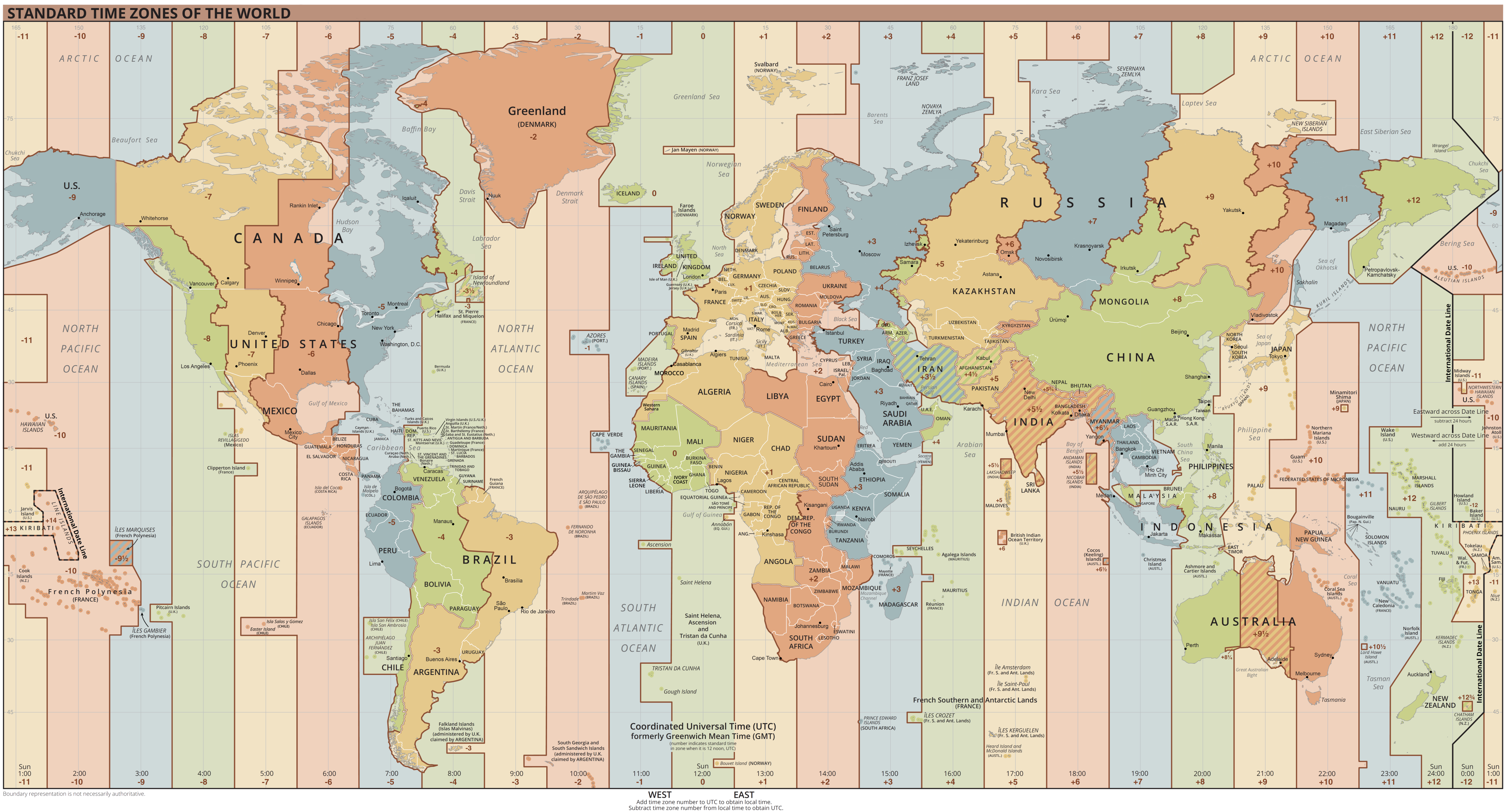
I once found a latitude with 4 different time zones. I think it goes through Pakistan. Time zones are always going to be weird.

If the Wikipedia map (https://upload.wikimedia.org/wikipedia/commons/8/88/World_Ti...) is accurate: - at the longitude of Kabul you have Afghanistan (+4.5), Pakistan (+5), India (+5.5), and Kazakhstan (+6). - at the longitude of Rangoon you have India (+5.5), Burma (+6.5), Indonesia (+7), China (+8) (and the open ocean at this longitude is theoretically +6)

Re: European MPs vote to end summer time clock changes

#104

Earlier quoted context omitted.

> Under the new legislation, governments opting to make summer time permanent would adjust their clocks for the last time on the last Sunday in March 2021. For those choosing permanent standard time - also called winter time - the final clock change would be on the last Sunday of October 2021. It's down to the member states to decide but I think most would prefer summer; save for maybe the Nordics, where the vast dif…

Even in the Nordics, eternal summer time would be preferrable for most people I think. It gives you more sunlight in the afternoon (if I'm not mistaken), when you actually have some free time to utilize that fact. Who cares if it's light or dark in the morning, nobody is outside enjoying the weather at that time anyway, we're just trying to get everyone to school/work.

Some people have tonwork outsides? Sun light also helps to wake up. So it's a trade off either way.

Re: European MPs vote to end summer time clock changes

#105
post #66

Mind that this is just a step in the legislative process not the final thing. Next step is the EU Council where relevant ministers of the individual member states have to find an agreement. Some governments aren't that enthusiastic ..

Do all of them actually have to agree or just some majority?

This is always so complicated and I do not know. Sometimes they need a simple majority representing so and so many citizens and so and so many different countries (i.e. so that big countries [De+Fr+UK] can't overrule small ones and the small ones can't overrule big ones) some hings have to be unanimous, sometimes a simple majority is enough ...

Re: European MPs vote to end summer time clock changes

#106
post #97

Earlier quoted context omitted.

Why even bother with a 24-hour clock, then? If we went to a 25-hour day, everyone could get another hour of sleep. We synchronize clocks to the sun because there is actual merit in matching the civil day to the solar day. The sun-earth relative positioning is the same for everyone on the planet. It sets a time standard without everyone having to agree on it. If someone chooses to go off the common standard, they may…

That is basically how the time zones were set. They were modified because it didn't work. We're still working on which modification is best. With the invention of cheap, ubiquitous, artificial lighting, it makes sense to set the clock at 13h for solar noon. Most people, if having to choose, would rather get up with artificial light and then do outdoor leisure activities with natural light.

Nothing "makes sense" about an arbitrary number. That's why it's arbitrary. It makes an equal amount of sense to say that mean local solar noon is 183615.

The system we have doesn't work because the problem is how to coordinate billions of humans. No solution will ever work, because you can't perfectly coordinate any number of humans greater than about 500. The mess we have now is just built upon centuries of kludges, each trying to improve on how civil time was defined beforehand.

Why are there 24 principal time zones? Because the clock has 24 hours. Why does the clock have 24 hours, with 60 minutes each? Because Sumerians counted on their fingerbones, and Babylonians liked base-60.

Machines, on the other hand, can coordinate perfectly fine on the number of milliseconds since 1Jan1970, at the center of the main telescope of the original Greenwich Observatory. The zone file is the only thing holding the stupid mess together. We could specify civil time to be any rule-based system whatsoever, and the computer clock would still allow us to coordinate with the rest of the world.

With the invention of cheap ubiquitous computing and piezocrystal-mediated clocks, it makes sense to throw out every unit other than the SI second, and stop trying to coordinate things that don't need to be coordinated. Schoolkids don't need to be in their homeroom seats at the same time the NYSE opens. The fast food chain stores don't all need to stop serving breakfast at exactly the same time. And companies don't need to have the same business hours as the local bank branch.

Most owls, as opposed to most larks, would rather get up after sunrise, rather than before it. Tired (literally) of larks setting the schedule for everyone just because they wake up first.
Re: European MPs vote to end summer time clock changes

#107
The consultations might have had a different result if there had been a practical multiple-choice test with questions that link the idea of DST to actual consequences. Like:

Would you like to go to work in the light or in the dark during winter time?

Would you like to have some daylight while having barbecue at 9pm in the summer.

...

(My concern is that people had no idea of the practical consequences beside sucks-to-have-to-get-up-one-hour-earlier and will be in for a rude awakening)

Re: European MPs vote to end summer time clock changes

#108

Earlier quoted context omitted.

Even in the Nordics, eternal summer time would be preferrable for most people I think. It gives you more sunlight in the afternoon (if I'm not mistaken), when you actually have some free time to utilize that fact. Who cares if it's light or dark in the morning, nobody is outside enjoying the weather at that time anyway, we're just trying to get everyone to school/work.

In my county (Östergötland), the sun starts rising at 3am around this time of year; so, the concept of it being light or dark in the morning (or afternoon/night) isn't really a concern (overall). In places like Kiruna, the sun will never set for about two weeks[0], during the summertime. It's the amount of actual daytime during the winter that would principally matter - in the overall scheme of things. [0] - https://…

FWIW I live a bit further north, at 63 degrees. In winter, at least december and january, we're in the state of "dark when you go to work, dark when you go home". However for the approx. two months between autumn equinox and end of november, and similar two months from end of january to spring equinox, having one more hour of daylight in the afternoon would be really really nice.

Re: European MPs vote to end summer time clock changes

#109

Earlier quoted context omitted.

Note that the article is incorrect. I just went thought the proposal and what member states can choose is between keeping summer ot winter time! quote: "Consequently, the Commission proposes to discontinue the seasonal time changes in the Union, while ensuring that Member States retain the competence to decide on their standard time, in particular whether they will move to the standard time corresponding to their sum…

The comment you replied to is correct based on what you said - if you start in a state in permanent summer time, travel south to a state in permanent winter time, keep travelling south to a state in permanent summer time, and so on, you will be going back and forth by an hour repeatedly. Hypothetically, if you start just north of Sittard and east of the German/Netherlands border (in Germany), and travel in a straight…

If Belgium and the Netherlands don't agree on a timezone, you could probably do that in the space of half a mile at https://en.wikipedia.org/wiki/Baarle-Nassau

Re: European MPs vote to end summer time clock changes

#110
post #76

Turkey removed DST in 2017 after 47 years, and it did not cause much trouble.

And Turkey is on winter time, not summer time. Istanbul is technically closer to being on its local summer time equivalent, but most of Turkey is practically on winter time. It seems the muslim world is again leading in its scientific understanding compared to the backwards west.

Yes, it must be that.
Post reply on HN