Live data from Hacker News

What I learned at work this year

gatesnotes.com

101–110 of 127 posts

Re: What I learned at work this year

#101
post #47
post #3

> [...] we are also going to be focusing more on improving the quality of life. I think this will be the thrust of many big breakthroughs of the future. For example, software will be able to notice when you’re feeling down, connect you with your friends, give you personalized tips for sleeping and eating better, and help you use your time more efficiently. Seems like a retrofitted use case that is more of an answer t…

I preface my statement below with a disclaimer that I live in a "developed" or "1st-world" country but have previously lived and experienced other less developed economies. Anyway, it feels to me Gates is fixing a real problem but with very 1st world solutions? > For example, software will be able to notice when you’re feeling down, connect you with your friends, give you personalized tips for sleeping and eating bet…

> software will be able to notice when you’re feeling down

This feels dystopian to me too, not least because in order for software to diagnose this problem you'll need to spend sufficient time generating relevant usage data... usage that will (if existing social media are anything to go by) be a net contributor to problems with self-esteem, fitness, sleep, etc.

I'm not going to pretend to know exactly what he means, or how it'll pan out, but the cynic in me is expecting a greater net benefit from just deleting your FB/Twitter/Insta account.
Re: What I learned at work this year

#102
post #98
post #95

Earlier quoted context omitted.

"The simple truth of natural nutrition" is scarcity and starvation. Obesity is a result of the ready availability of the kinds of foods (carbs and fat) that are "naturally" hard to get, so our body hoards them when it has access. We innovated ourselves into effectively unlimited food. All diets are unhealthy if access isn't limited. I like not going hungry on a regular basis. Most people do.

Most healthy people I know aren’t chronically hungry. You’ll be chronically hungry if your diet consists of simple carbs (white bread, soda, chips).

I mean hunger from a lack of available food, not from eating food that overstimulates your systems (the simple carbs). The solution to this is primarily education (so people make healthy choices), and availability of healthier alternatives.

That said, all of civilization is built on the ready availability of refined carbs brought about by agriculture. This isn't a modern phenomenon. The only modern thing is that suddenly our food production is outstripping population growth for the first time in ever.

Re: What I learned at work this year

#103
post #92

Earlier quoted context omitted.

A reversion that very few will undertake. Unless there is some kind of innovation that can affect that (social engineering? who knows) So in light of the harsh reality that obesity is essentially a given, what CAN be done?

I don't see why anything should be done. Obesity is your body telling you that you are doing food consumption wrong. If the human that is wearing a large body in life doesn't find the awareness to recognize that they must change their behavior, I don't believe society should try to innovate them a thinner body. Their currently large body is a gift from nature intended to signal that a course correction is needed. Thi…

I've tried losing weight and eating healthier and I can always stick to doing it for a while, but always gradually start eating worse and worse again. So I am aware, and have tried, and yet it feels like there's something bigger always pulling me back to eating poorly.

Is it addiction? Is it some biological process (the body wanting to retain its new equilibrium)? Is it the fact that my taste buds tend to prefer the flavors of unhealthy food a majority of the time?

Clearly the problem is bigger than obese people being aware of their obesity and trying (and failing) to change it. There are other forces at play, and I think, difficult ones to overcome.

Separately, why not still try to innovate or do something to reduce the burden obesity places on the healthcare system (regardless of how you feel about the individuals)?

Re: What I learned at work this year

#104
post #92

Earlier quoted context omitted.

A reversion that very few will undertake. Unless there is some kind of innovation that can affect that (social engineering? who knows) So in light of the harsh reality that obesity is essentially a given, what CAN be done?

I don't see why anything should be done. Obesity is your body telling you that you are doing food consumption wrong. If the human that is wearing a large body in life doesn't find the awareness to recognize that they must change their behavior, I don't believe society should try to innovate them a thinner body. Their currently large body is a gift from nature intended to signal that a course correction is needed. Thi…

> is a manifestation of a more fundamental internal issue (mental or emotional)

This is false.

Food deserts and lack of financial/nutritional education are a major cause of obesity. Many Americans don't have quick access to grocery stores and can only purchase fast food / junk food. They literally don't have time or the ability to change what they eat. Some Americans have grocery stores but literally do not know that healthy food CAN be cheaper. They see Whole Foods and rich people eating healthy and intuitively it makes sense that it seems more expensive. These are problems outside of individuals that exist on a national and global scale.

> Distance to store and prices were positively associated with obesity (phttps://www.sciencedirect.com/science/article/pii/S074937971...

Re: What I learned at work this year

#105
post #53
post #52

Earlier quoted context omitted.

I am sad to agree with you. We in tech love to believe - with our inflated egos due to recent successes improving the world - that every problem is solved through more tech. I think we need to watch tech fail to solve some problems and experience that failure first hand to really believe that some problems are rooted in culture and social norms, not in a lack of guidance or convenience from some app. I feel like we'v…

I guess what I'm saying is: if we need an app to remind us to call family, maybe there's a larger problem at hand. Book 4 of the Pendragon series (The Reality Bug) comes to mind. That was a formative book in my young adulthood.

People are lonely because corporate culture - including, but not limited to, work culture - is outrageously demanding and often insane, not because they need an app to remind them to phone grandma.

Everyone - who isn't financially independent - could benefit from shorter hours and more creative freedom and financial security. Apps that try to parent us are not a solution.

Re: What I learned at work this year

#106
post #71
post #67

> Nuclear is ideal for dealing with climate change, because it is the only carbon-free, scalable energy source that’s available 24 hours a day. The problems with today’s reactors, such as the risk of accidents, can be solved through innovation. So refreshing to see someone with his reach pushing for nuclear.

Though still missing the mark. Nuclear’s biggest issue is cost. If it was cheap enough companies would have built more and scaled them up and down to meet demand, instead France only got mostly Nuclear by exporting its excess and nobody else really got very close to full nuclear. The problem today is wind costs less. But, when you add a lot of wind during times of high wind your nuclear becomes useless. This ends up…

This is like punching someone in the face, and then accusing them of having a nose-bleeding problem.

Nuclear is expensive because the rampant fear-mongering generates massive amounts of litigation, construction delays, and outdated/unreasonable regulations.

If you look at the cost of reactors in China, Russia, Saudi Arabia, etc, they are one-tenth the US cost for the exact same reactor design.

Re: What I learned at work this year

#107
post #7
post #3

> [...] we are also going to be focusing more on improving the quality of life. I think this will be the thrust of many big breakthroughs of the future. For example, software will be able to notice when you’re feeling down, connect you with your friends, give you personalized tips for sleeping and eating better, and help you use your time more efficiently. Seems like a retrofitted use case that is more of an answer t…

Has Bill ever been good at predictions? No mention of smartphones or social media in The Road Ahead. Blindsided by how quickly the Internet developed, underestimated "bazaar" economies that enabled millions of people building both software and content. All the smart home stuff he was in love with has gone hardly anywhere. I think he's very smart and great at setting huge goals then hitting them, but I'm not sure he's…

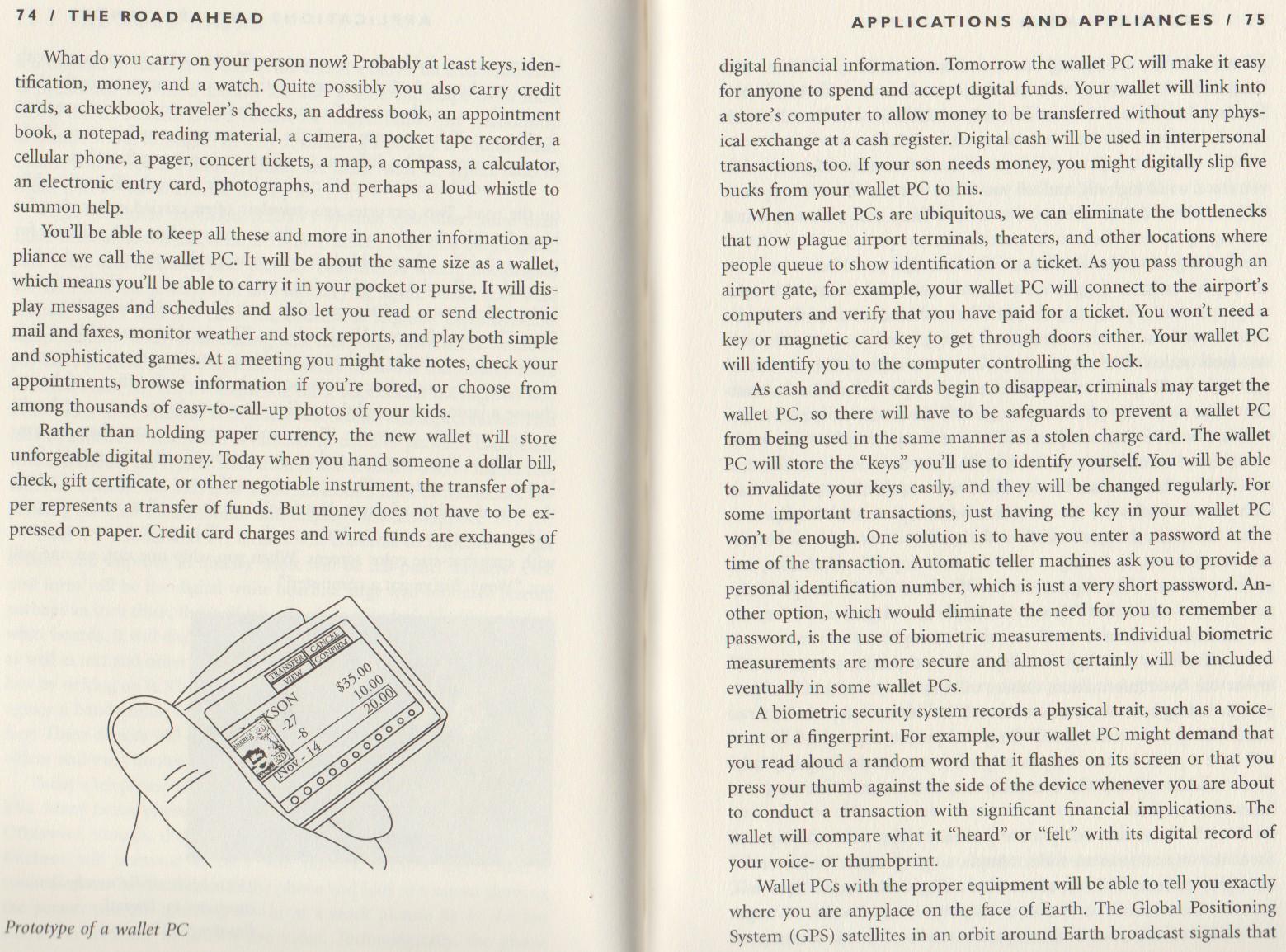
I think his vision of smartphones has held up well. From page 74 of my hardcover copy of The Road Ahead:

What do you carry on your person now? Probably at least keys, identification, money, and a watch. Quite possibly you also carry credit cards, a checkbook, traveler's checks, an address book, an appointment book, a notepad, reading material, a camera, a pocket tape recorder, a cellular phone, a pager, concert tickets, a map, a compass, a calculator, an electronic entry card, photographs, and perhaps a loud whistle to summon help.

You'll be able to keep all these and more in another information appliance we call the wallet PC.

https://pbs.twimg.com/media/A2o-6_WCYAAaNw5.jpg:large

Re: What I learned at work this year

#108
post #74

Earlier quoted context omitted.

The cost is a political problem. It's easier for the opponents of nuclear to find support for stricter and stricter safety laws for new reactors. Driving up the cost, making them economically nonviable. Meanwhile the older and far more dangerous reactors are rotting away and cannot be replaced (or are replaced with fossil fuels). It's been pointed out again, again and again. Coal plants pump out more radioactive wast…

I disagree; politics are a small factor, but up-front capital costs are by far the bigger issue. The most salient example is South Carolina, where it was up-front construction costs that axed the project. They poured billions into the plant multiple times and it never was completed. I'm all for advanced nuclear but it's never going to happen with such high start-up costs, especially outside of an authoritarian econom…

I always wondered how they came up with that north of 30% interest rate for the financing for the rest of the project that caused them to abandon it. Probably the banks just saying FYAD politely.

Re: What I learned at work this year

#109
Gates' resolution to learn and think more about the intersection between privacy and innovation is absolutely spot on. I've been thinking about better ways that we can approach chronic illnesses through health tracking, but absolutely terrified of the implication of that data falling into the wrong hands - and not even for nefarious purposes.

For example, I would not trust my health insurance company with information that may indicate I am predisposed to an illness or disease lest they brand me as a high risk, pre-existing condition patient, and deny or price me out of coverage forever. I'd rather do my own experimentation outside of the 'official' medical community than to risk my own data being used as a weapon against me.

Somewhat unrelated, I feel that the next underexplored area of medical science is that of the gut & intestines. Having a toilet that could do continual personalized analyses of your urine and stool is going to revolutionize medicine. However, as much as I believe that this is an opportunity to change the world for the better, I would never purchase such a device under the current privacy and security climate. I hope we can start to resolve these issues in 2019 and beyond so we can unlock these sorts of innovations to help people on a daily basis with chronic conditions.

Re: What I learned at work this year

#110
post #2

"[Warren Buffett] says his measure of success is, “Do the people you care about love you back?” I think that is about as good a metric as you will find." I love this.

This reminds me of the song 'what Sarah said' by death cab for cutie.

"That love is watching someone die

So who's gonna watch you die"

Post reply on HN