Live data from Hacker News

Big Banks Lock Horns with Personal-Finance Web Portals

on.wsj.com

101–108 of 108 posts

Re: Big Banks Lock Horns with Personal-Finance Web Portals

#101
post #99
post #3

If the banks cared they would provide either token-based API like oAuth or at the very least, a read-only password for users to give these sites that aren't fully credentialed. Customers will always want to extract their data.

It's amazing that we can grant revokable, read-only and audited access to our social accounts, but not our bank accounts. Even though the largest aggregators operate under some level of federal supervision (via FFIEC and the OCC), there is an obviously better way. TxPush ( http://txpush.org ) looks like an initiative in this direction. There will likely be an ongoing need for aggregators to maintain access to laggard…

> It's amazing that we can grant revokable, read-only and audited access to our social accounts, but not our bank accounts.

The UK is moving in this direction. The ODI/Fingleton report into Data Sharing and Open Data for Banks[1] recommended creating a open banking API standard and suggested using OAuth, using Twitter as an example (see p24 of the report). Work has begun on defining the roadmap towards creating an API standard[2].

1: https://www.gov.uk/government/publications/data-sharing-and-...

2: http://theodi.org/news/open-banking-working-group-uk-experts...
Re: Big Banks Lock Horns with Personal-Finance Web Portals

#102
post #87

I used Mint for a long time, but eventually decided I didn't like them having all my bank login information, including security questions. So I switched to a setup where I download OFX data directly from my banks using a Python script [1], and use Ledger [2] to track spending, balances, etc. A big bonus of this approach is that I have complete control over the data, so if an import get screwed up somehow I can fix it…

It absolutely blows my mind that people are happy to hand over their banking credentials to a third party. I would never in a billion years ever have believed it were possible for a firm to succeed predicated on that basis. I'm pretty sure that doing that in the UK instantly nullifies any protection you have against fraud etc.

Yeah but you technically also nullify your protection against fraud if you write your PIN on a sticky note or tell it to your partner. The question is whether a bank will use that as an argument, not whether they can.

E.g. Barclays:

"You must memorise your PIN or password ... Never give them to someone else or let someone else use them, or do anything that would let someone else use them, such as writing them down in a way that might be recognised by someone else, keeping the letter carrying a PIN, or giving someone else access to a device like a mobile phone on which the relevant details are stored."

"If you have either deliberately or with gross negligence: • failed to keep your card, PIN, password, PINsentry or mobile PINsentry generated codes, device or equivalent secure, or • failed to tell us as soon as possible that you have lost your card (especially if you think someone else might have been able to ind it) we will not refund any payments made before you tell us that it’s been lost or compromised."

Re: Big Banks Lock Horns with Personal-Finance Web Portals

#103
post #84

Earlier quoted context omitted.

The bigger they are the harder they fall

2008 proved you wrong for the one's that had what the parent referred to. Confess to crimes and crash economy results in $1 trillion bailout, no audits, some fines, and criminal immunity. Doesn't happen every day in industry.

Agreed but it is just postponing the inevitable. The bailout and bankruptcies made their closed-source hierarchical paper system even more highly centralized, while the superior electric medium is doing the exact opposite in becoming more decentralized, distributed, and open source.

http://www.frontporchrepublic.com/wp-content/uploads/2011/09...

Re: Big Banks Lock Horns with Personal-Finance Web Portals

#104
post #7
post #4

This seems like it would backfire. I suspect many people are more loyal to mint.com than to their banks.

Switching banks isn't easy, unfortunately. Note how banks have very successfully managed to create systems that do not have bank account number portability built in, they even engineered them in such a way that any future desire to implement such portability will meet with very substantial technical roadblocks.

It's also a regulation / regulatory capture issue. The UK has a switching regulation set up so that all you have to do is go into the new bank and tell them your account number at the old bank. All scheduled deposits and withdrawals switch over with no further effort on your behalf.

(Then again, they also don't have things like paper checks anymore.)

Re: Big Banks Lock Horns with Personal-Finance Web Portals

#105
post #3

If the banks cared they would provide either token-based API like oAuth or at the very least, a read-only password for users to give these sites that aren't fully credentialed. Customers will always want to extract their data.

The only way that is going to happen is if it is legally required to happen or if banks are financially incentivized to make it happen. It's absolutely true that offering data migration services decreases bank account stickiness, and that's something everyone is terrified of doing in the finance industry. Customer acquisition costs are so high, I doubt you'd believe me if I explained them to you.

>Customer acquisition costs are so high, I doubt you'd believe me if I explained them to you.

Of course we would believe you. When you use a metric like "customer acquisition costs", you can say pretty much whatever you like.

I'd rather hear something like, "We have such little deployed value at the retail level that no one wishes to contract with us unless we spend a lot of money over here (legalized entrapment codes and marketing)."

Re: Big Banks Lock Horns with Personal-Finance Web Portals

#106
post #103

Earlier quoted context omitted.

2008 proved you wrong for the one's that had what the parent referred to. Confess to crimes and crash economy results in $1 trillion bailout, no audits, some fines, and criminal immunity. Doesn't happen every day in industry.

Agreed but it is just postponing the inevitable. The bailout and bankruptcies made their closed-source hierarchical paper system even more highly centralized, while the superior electric medium is doing the exact opposite in becoming more decentralized, distributed, and open source. http://www.frontporchrepublic.com/wp-content/uploads/2011/09...

Their schemes have been working most of the time since creation of the Fed with usable currency and international uptake.

Using Bitcoin for its intended purpose is like gambling. Similarly for other, popular P2P. So, safe choice is better implementations of centralized model until stable alternatives exist in P2P space.

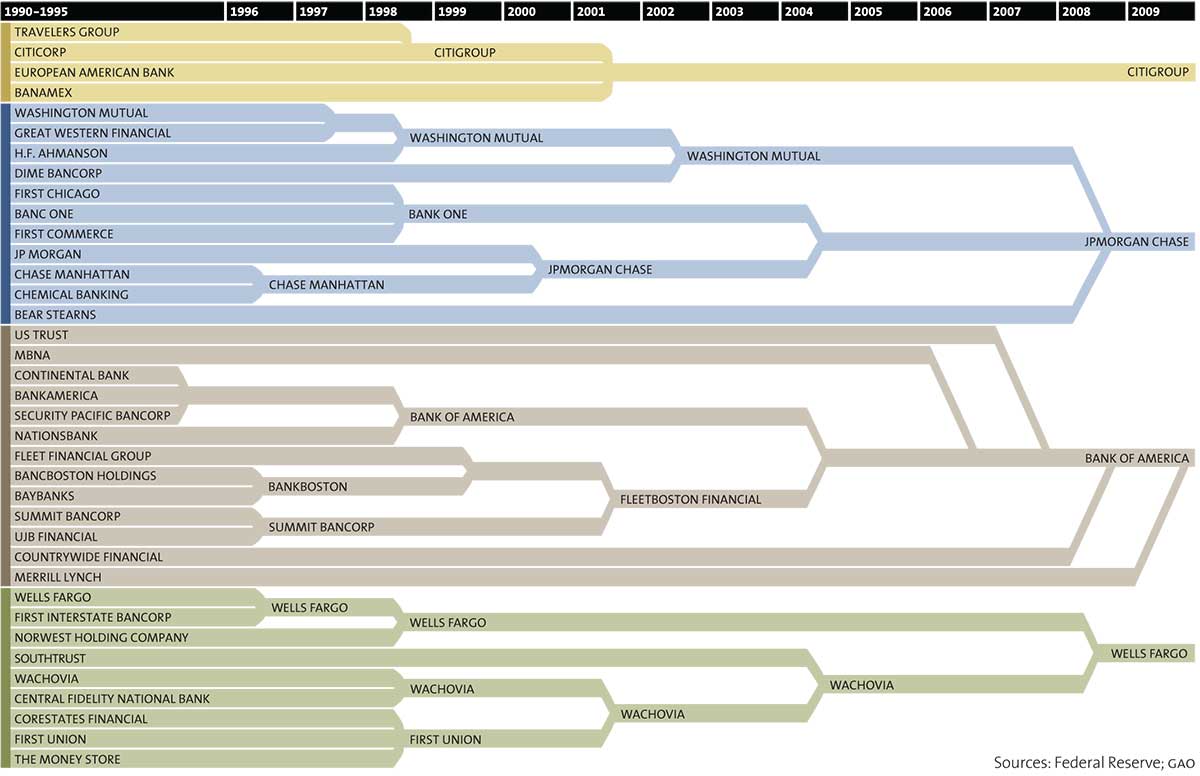
Note: Nice graphic but the best thing is looking at boards for interlock. Like Project Censored did in their nice Theory of Everything for global elites:

http://www.projectcensored.org/the-global-1-exposing-the-tra...

Now you know who they are. We've been able to figure ghe stuff out. Why still these problems? Cuz few give a shit or do anything. If that remains, we screwed in long-term. ;)

Re: Big Banks Lock Horns with Personal-Finance Web Portals

#107
post #97

Earlier quoted context omitted.

Yeah, but the advantage of OFX is that it is read-only and can use different credentials for authentication (depending on the bank.) Another advantage I forgot to mention is that I couldn't use my bank's 2FA with Mint.

Aahh, I've been moaning for ages that banks should implement a read-only interface for services like Mint; I had no idea that one already existed. I think this is the nail in Mint's coffin for me. Thanks! This does invite the question of why Mint isn't using (or even just offering) OFX read-only credentials... or do they?

Not all banks support OFX

Re: Big Banks Lock Horns with Personal-Finance Web Portals

#108

Earlier quoted context omitted.

The only way that is going to happen is if it is legally required to happen or if banks are financially incentivized to make it happen. It's absolutely true that offering data migration services decreases bank account stickiness, and that's something everyone is terrified of doing in the finance industry. Customer acquisition costs are so high, I doubt you'd believe me if I explained them to you.

>Customer acquisition costs are so high, I doubt you'd believe me if I explained them to you. Of course we would believe you. When you use a metric like "customer acquisition costs", you can say pretty much whatever you like. I'd rather hear something like, "We have such little deployed value at the retail level that no one wishes to contract with us unless we spend a lot of money over here (legalized entrapment code…

Banks actually don't have or need a ton of law to lock in customers. They use fees and consumer apathy pretty effectively.

But if you think that even pro consumer banks like Simple had better costs, think again.

Post reply on HN