Live data from Hacker News

China Turns to the Sea for Fresh Water

bloomberg.com

11–20 of 53 posts

Re: China Turns to the Sea for Fresh Water

#11
post #8
post #2

Israel (obv a different scale than china) has recently also experienced a big push toward desal. What's interesting is there's a moore's law type of effect at play here, desal keeps getting cheaper and cheaper to the point where it's actually a practical alternative to ground water, filtering etc. I think water will be another great Malthusian disappointment, ocean water is basically unlimited (correct me if I'm mist…

What will you do with the salts and various impurities?

Dump it on the roads in the North during the winter.

Or, more seriously, if it is salt that was extracted from the sea, there shouldn't be much harm in putting it back. The fresh water that was extracted will end up back in the sea also, so overall there should be no increase in salinity (except locally where the salt is dumped).

Re: China Turns to the Sea for Fresh Water

#12
post #8

Earlier quoted context omitted.

What will you do with the salts and various impurities?

Put it back in the ocean.

No...Most ocean life is ridiculously dependent on perfect salinity levels. We wouldn't be doing any favors by increasing these levels, no matter how small our impact may be.

Re: China Turns to the Sea for Fresh Water

#13
post #8
post #2

Israel (obv a different scale than china) has recently also experienced a big push toward desal. What's interesting is there's a moore's law type of effect at play here, desal keeps getting cheaper and cheaper to the point where it's actually a practical alternative to ground water, filtering etc. I think water will be another great Malthusian disappointment, ocean water is basically unlimited (correct me if I'm mist…

What will you do with the salts and various impurities?

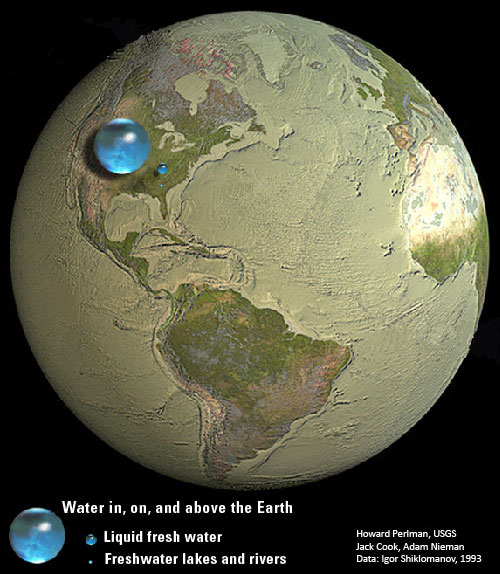
Considering drinking water is some tiny, tiny fraction of the world's water, it's probably not going to be a crazy idea to just dump the salt etc back in the oceans where it came from without causing any crazy imbalance, because we're talking about less than 1% of water.

About 2.5% of all the world's water is fresh water, and of that about 65% is in glaciers and icecaps. The roughly 0.8% of the world's water that remains, another 65% or so is permafrost and ice, only about 0.5% of the 65% of the 2.5% of the world's water is in river's for example.

See for example: http://water.usgs.gov/edu/pictures/watercyclekids/worlds-wat...

So the notion of taking a small fraction of the ocean, desalinating it, and dumping the rest back in the ocean (as will eventually the water itself, later on in the process) probably isn't a big deal.

But then it's just inference, I'm not intimate with the subject. Biggest hurdle for me was always that desal was crazily energy intensive. I can't imagine it's become orders of magnitude more efficient, and as energy costs didn't plummet on such a scale (orders of magnitude), I thought it'd still be. But it turns out the costs are dropping fast.

I mean, I can easily see desal working for drinking water & cooking (few litres a day) for everyone on earth, but things like agriculture are a whole different beast. A kilo of wheat for example averages over 1.000 litres of water, while meat can go all the way up to 20.000 litres. I can't imagine desal for the billions of farm animals we slaughter every year (yes, billions :-/) , each weighing tens if not hundreds of kilos, for example, or even just agricultural production.

I'd be happy to be enlightened!
Re: China Turns to the Sea for Fresh Water

#14
post #8

Earlier quoted context omitted.

What will you do with the salts and various impurities?

Considering drinking water is some tiny, tiny fraction of the world's water, it's probably not going to be a crazy idea to just dump the salt etc back in the oceans where it came from without causing any crazy imbalance, because we're talking about less than 1% of water. About 2.5% of all the world's water is fresh water, and of that about 65% is in glaciers and icecaps. The roughly 0.8% of the world's water that rem…

This is emphatically not true. The salinated impurities that are a byproduct of this process will kill everything in the zone that is is reintroduced to. Just because it is a small fraction of the ocean doesn't mean we can easily spread it across the entire ocean. Even then, we are doing an irreversible transformation of the ocean as a whole, and we need to be smart about the waste for the process to be sustainable.

I can think of several countries that did this incorrectly and killed large portions of their coastal ecology as a result.

Re: China Turns to the Sea for Fresh Water

#15

Earlier quoted context omitted.

Put it back in the ocean.

No...Most ocean life is ridiculously dependent on perfect salinity levels. We wouldn't be doing any favors by increasing these levels, no matter how small our impact may be.

won't the new fresh water get back to the ocean too?

Re: China Turns to the Sea for Fresh Water

#16
post #5

Why not look at something like nuclear? Since the need is both electricity and heat, a nuclear reactor seems ideal since you don't have to convert power back in to heat - you can just use it directly. With modern recycling techniques and reactor designs the chance of meltdown and wastes are limited, but that seems better than more coal. Not an expert on reactor design vs desal design by any means - would love an opin…

Many places with water shortage are sunny and hot. In my mind it is the perfect use case for solar thermal power plants. I just love how simple they are. If we build coal or nuclear power plants, we just ditch one problem for another.

It is also a great way to smoothen the varying production of renewal energy.

Re: China Turns to the Sea for Fresh Water

#17
post #7
post #3

Maybe they can export their excess freshwater in giant tankers to CA to solve their drought problem. They already produce most of the electronics we consume.

If that were reasonable then we would tank water in from Alaska. Or China would buy AK water. If you want to dream big, in the 1980s there were pipe dreams of bringing in water from the Copper or the Stikine through a large off-shore pipeline to California.

There have been serious proposals to ship Great Lakes water to Asia. This article mentions one:

http://www.wbez.org/frontandcenter/2011-06-21/great-lakes-fa...

There is now an agreement placing tight limits on what happens to the water:

http://en.wikipedia.org/wiki/Great_Lakes%E2%80%93Saint_Lawre...

Re: China Turns to the Sea for Fresh Water

#18
post #5

Why not look at something like nuclear? Since the need is both electricity and heat, a nuclear reactor seems ideal since you don't have to convert power back in to heat - you can just use it directly. With modern recycling techniques and reactor designs the chance of meltdown and wastes are limited, but that seems better than more coal. Not an expert on reactor design vs desal design by any means - would love an opin…

Many places with water shortage are sunny and hot. In my mind it is the perfect use case for solar thermal power plants. I just love how simple they are. If we build coal or nuclear power plants, we just ditch one problem for another. It is also a great way to smoothen the varying production of renewal energy.

That's an interesting idea as well. A molten salt reactor or something similar would have the same benefits as nuclear, you just trade reliability for cleanliness. I would imagine that a molten salt set up would be significantly cheaper to build as well, but I could be wrong on that.

Re: China Turns to the Sea for Fresh Water

#19

Earlier quoted context omitted.

Considering drinking water is some tiny, tiny fraction of the world's water, it's probably not going to be a crazy idea to just dump the salt etc back in the oceans where it came from without causing any crazy imbalance, because we're talking about less than 1% of water. About 2.5% of all the world's water is fresh water, and of that about 65% is in glaciers and icecaps. The roughly 0.8% of the world's water that rem…

This is emphatically not true. The salinated impurities that are a byproduct of this process will kill everything in the zone that is is reintroduced to. Just because it is a small fraction of the ocean doesn't mean we can easily spread it across the entire ocean. Even then, we are doing an irreversible transformation of the ocean as a whole, and we need to be smart about the waste for the process to be sustainable.…

Well, if you can think of them, can you type their names out and share them perhaps?

Or are you generally referring to pollution rather than disastrous desalination attempts?

Re: China Turns to the Sea for Fresh Water

#20

Earlier quoted context omitted.

Put it back in the ocean.

No...Most ocean life is ridiculously dependent on perfect salinity levels. We wouldn't be doing any favors by increasing these levels, no matter how small our impact may be.

The change in salinity would obviously be negligible averaged over the ocean, and would be massively, massively dwarfed by other human factors. Your extreme use of the precautionary principle would prohibit essentially all new constructions, if applied widely.

Much more interesting is the question of the impact to the nearby ecology in the immediate neighborhood of the discharge pipe. I'm not familiar with this, but I'd wager it can easily be mitigated.

EDIT: Thank you to CHY872, who provides a link below to a review of the environmental impact of the waste water from desalinization:

> In most other cases environmental effects appear to be limited to within 10s of meters of outfalls.

Post reply on HN