Live data from Hacker News

A Brief History of Web Design for Designers

blog.froont.com

11–20 of 28 posts

Re: A Brief History of Web Design for Designers

#11
post #7
post #5

You missed Web 2.0, around 2004, the rise of AJAX.

True. I also left out Frames. Web 2.0 for me was too much about aesthetics, but AJAX is very close to JS. Both deserve a spot in an extended version of the history though!

It's about design.

The post also states that Flash was "freedom", which it was only in a design sens.

Re: A Brief History of Web Design for Designers

#12
post #9

I always enjoy recaps of tech timelines. Thanks for putting that together. My wishlist of more web timelines with additional/different focus would include: 20 years of web advertising and tracking: this would outline the nuclear arms race between web authors and web browsers' user protections and google ranking algorithms. Stuff like cookies, the invisible 1 pixel image pingback, seo keyword spamming, etc 20 years of…

Open question: would VRML count as a failure?

Re: A Brief History of Web Design for Designers

#13
From 1989 to 2014 encompasses 25 years of progression. If you think about any other 25 year segment in history, I doubt you would have found such changes in print/media than there has been in the last 25 years. Consider that it took 25 years just for the printing press to move from Germany to England[1].

Imagine if it took 25 years for any technology trend today to go from the US to any other developed country in the world.

[1] http://en.wikipedia.org/wiki/Printing_press

Re: A Brief History of Web Design for Designers

#14
post #9

I always enjoy recaps of tech timelines. Thanks for putting that together. My wishlist of more web timelines with additional/different focus would include: 20 years of web advertising and tracking: this would outline the nuclear arms race between web authors and web browsers' user protections and google ranking algorithms. Stuff like cookies, the invisible 1 pixel image pingback, seo keyword spamming, etc 20 years of…

Open question: would VRML count as a failure?

The deep silence says Y E S...

Re: A Brief History of Web Design for Designers

#15
Neat start, but so many holes! JavaScript didn't take off for years, jQuery didn't come about 2006, and arguably the real start of the JavaScript "renaissance" was Prototype in 2005. CSS grid layouts got their start in around 2004, trying to finally replace tables for presentation. The larger CSS frameworks started in 2006 or so. Flash didn't even really take off until the Flash MX 2004 with the release of ActionScript 2. Even then ActionScript 1 didn't come out until 2000 with Flash 5 and Flash 4 before that had very little functionality with support for Actions, but people started using them right away in 1999.

Well, I guess my take isn't a brief history, but there is so much fun to learn in there on how we got to where we are!
Re: A Brief History of Web Design for Designers

#16
post #11
post #7

Earlier quoted context omitted.

True. I also left out Frames. Web 2.0 for me was too much about aesthetics, but AJAX is very close to JS. Both deserve a spot in an extended version of the history though!

It's about design. The post also states that Flash was "freedom", which it was only in a design sens.

It was a freedom in programming too, JavaScript was/is still buggy from browser to browser and with Flash using ActionScript you could code once and run confidently in any browser with the plugin.

Re: A Brief History of Web Design for Designers

#17
The amusing thing about web design trends is the dislike of tables, followed by the creation of CSS and JavaScript hacks to create columnar web design. Tables are now back, but they're called "layout tables".

What's been lost are the good page layout tools that didn't require manually writing HTML and CSS. Macromedia Dreamweaver once allowed laying out a page without even looking at HTML source. Now, you can't even buy Dreamweaver; it's rental-only.

Re: A Brief History of Web Design for Designers

#18
post #17

The amusing thing about web design trends is the dislike of tables, followed by the creation of CSS and JavaScript hacks to create columnar web design. Tables are now back, but they're called "layout tables". What's been lost are the good page layout tools that didn't require manually writing HTML and CSS. Macromedia Dreamweaver once allowed laying out a page without even looking at HTML source. Now, you can't even b…

Please point me to something about "layout tables" because I haven't hear of or seen a resurgence of layouts.

Re: A Brief History of Web Design for Designers

#19
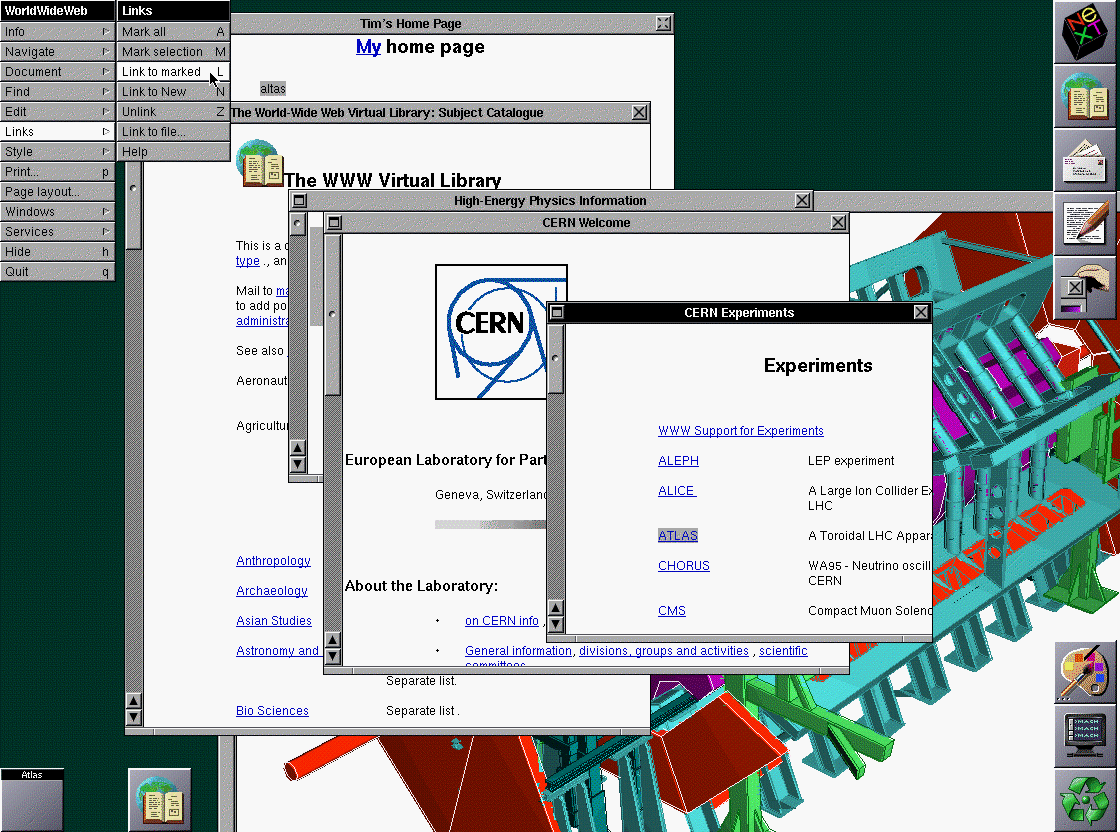
Well, the first web access in 1990 was graphical. http://www.w3.org/History/1994/WWW/Journals/CACM/screensnap2... Extracted from Tim Berners-Lee's (inventer the WWW) comments http://www.w3.org/People/Berners-Lee/WorldWideWeb.html.

The history is far deeper and richer than captured here.

Re: A Brief History of Web Design for Designers

#20
I would like to see an article that goes depper into the bright future of web design. The future no doubt is bouncy and full of smooth animated transitions. It makes web apps easier to use and gives people what they have been used to from their smartphone apps.

Google's Polymer, react and the famo.us javascript libraries seems to be only the beginning of a string of new libraries that pushes html rendering optimisation to new levels and makes it easier to do tweening and handle user events.

Post reply on HN