The guy next to me stole it. And some pens from my desk too.
If you see him, tell him to please return them. Thanks.
Who Stole the Four-Hour Workday?
11–20 of 99 posts
Re: Who Stole the Four-Hour Workday?
#12Maybe the stuff we want to buy has gotten increasingly expensive. College, phone and internet, all on a stagnating wage.
Can somebody explain why this was downvoted? It may be based on false assumptions, but at least commenting moves the conversation forward.
Re: Who Stole the Four-Hour Workday?
#13Universal basic income is the case that gives the rich, ruling class the maximum power over everyone else. Everyone gets dependent on government money, and it takes an act of Congress to increase the baseline pay.
Re: Who Stole the Four-Hour Workday?
#14People who don't work at all. That's the choice (maybe more like outcome) the society went with. For what might the first time in history, the rich are working more than the poor[1] and labour participation rates are dropping[2]. In many ways this is a superior alternative. Children don't work. They used to. People spend a lot more time in school at the beginning of their life when it has the potential to have the bi…
It's not that the current situation is really bad, but things seem to have stopped improving. Productivity keeps going up but wages don't.
Re: Who Stole the Four-Hour Workday?
#15Capitalism`s greatest strength is also its greatest weakness. The profit motive is so strong that it often ends up creating irrational scenarios such as the economic situation we have today. European countries seem to have struck a far better balance by harnessing the profit motive of capitalism while preventing disasters such as for-profit healthcare, for-profit education, for-profit government policies (for the ric…
Please explain how for-profit education is a disaster. By all measures, private schools in the US are superior to public schools, and the US's private universities are consistently rated best in the world. You also can't generalize about e.g. for-profit healthcare based on the American situation, because the regulatory environment is so extreme as to have to created a government-controlled crony-capitalistic oligopol…
I can only assume the parent is blaming the spiraling cost of education on Capitalism, when in fact it's the perpetually increasing federal loan guarantees spurring massive inflation that is the root of the cause.
The spiral in healthcare was also caused by the government taking over the industry in the late 1960s. No coincidence both industries began to skyrocket in cost at exactly the same time, shortly after Nixon ended the gold standard, and the Fed acquired free reign to generate immense inflation and aggressively tamper with interest rates (spurring the cheap consumer debt boom of the past 40 years).
Everyone recognizes that healthcare and education became very expensive recently. Nobody seems to ask what changed in the last few decades to cause that. They act like Capitalism didn't exist in 1960.
Re: Who Stole the Four-Hour Workday?
#16Four-hour workday is simple: do not marry and do not have a children.
Re: Who Stole the Four-Hour Workday?
#17Maybe the stuff we want to buy has gotten increasingly expensive. College, phone and internet, all on a stagnating wage.
Can somebody explain why this was downvoted? It may be based on false assumptions, but at least commenting moves the conversation forward.
Not really increasingly expensive. For example, a TV is actually a lot cheaper (not to mention better) than it used to be.
We have/want more stuff then people in the past. Houses are larger. Families have more cars, more clothes, more toys, etc. Plus things that didn't exist like cell phones and internet access.
Re: Who Stole the Four-Hour Workday?
#18Capitalism`s greatest strength is also its greatest weakness. The profit motive is so strong that it often ends up creating irrational scenarios such as the economic situation we have today. European countries seem to have struck a far better balance by harnessing the profit motive of capitalism while preventing disasters such as for-profit healthcare, for-profit education, for-profit government policies (for the ric…
When America was still Capitalistic, still had a functioning free market system, the results it produced in both education and healthcare put the European welfare state model to shame. If you go back 30, 40, 50 years America embarrassed most of Europe in both healthcare and education. For decades America had both the best healthcare system, and a very cost effective system. That reputation has only been lost in the last 20 years.
It's only the last two decades, with America's collapse into a second-rate welfare state in the French model, with the unemployment and debt to go with it, that a very select few European countries have caught up (most of which are tiny, homogenous and generally locked down on immigration; and the prime example, Norway, only got there due to half a barrel of oil per day per person).
Most of Europe consists of impoverished, backwards welfare states. It seems a lot of people like to pretend Spain doesn't have 36% real unemployment, that Portugal isn't as poor as it is, Greece isn't still watching its failed soft-socialism model erode as promises can't be kept, and they seem to like to pretend that eastern Europe doesn't exist at all. There are only a few countries in all of Europe in fact, that are good examples. Germany is the only large example that is working, both the UK and France are drowning in massive piles of debt, having stolen from the future to fake present prosperity. Denmark and the Netherlands are two of the most indebted nations on earth per capita, both having stolen from the future to fake today as well.
I hardly see any examples where the European welfare state model has actually worked. I'd love someone to show me where I'm wrong about stealing from the future to fake present prosperity via massive debt accumulation.
Re: Who Stole the Four-Hour Workday?
#19People who don't work at all. That's the choice (maybe more like outcome) the society went with. For what might the first time in history, the rich are working more than the poor[1] and labour participation rates are dropping[2]. In many ways this is a superior alternative. Children don't work. They used to. People spend a lot more time in school at the beginning of their life when it has the potential to have the bi…
It's not that the current situation is really bad, but things seem to have stopped improving. Productivity keeps going up but wages don't.
http://anticap.files.wordpress.com/2010/11/fig2_prodhhincome...
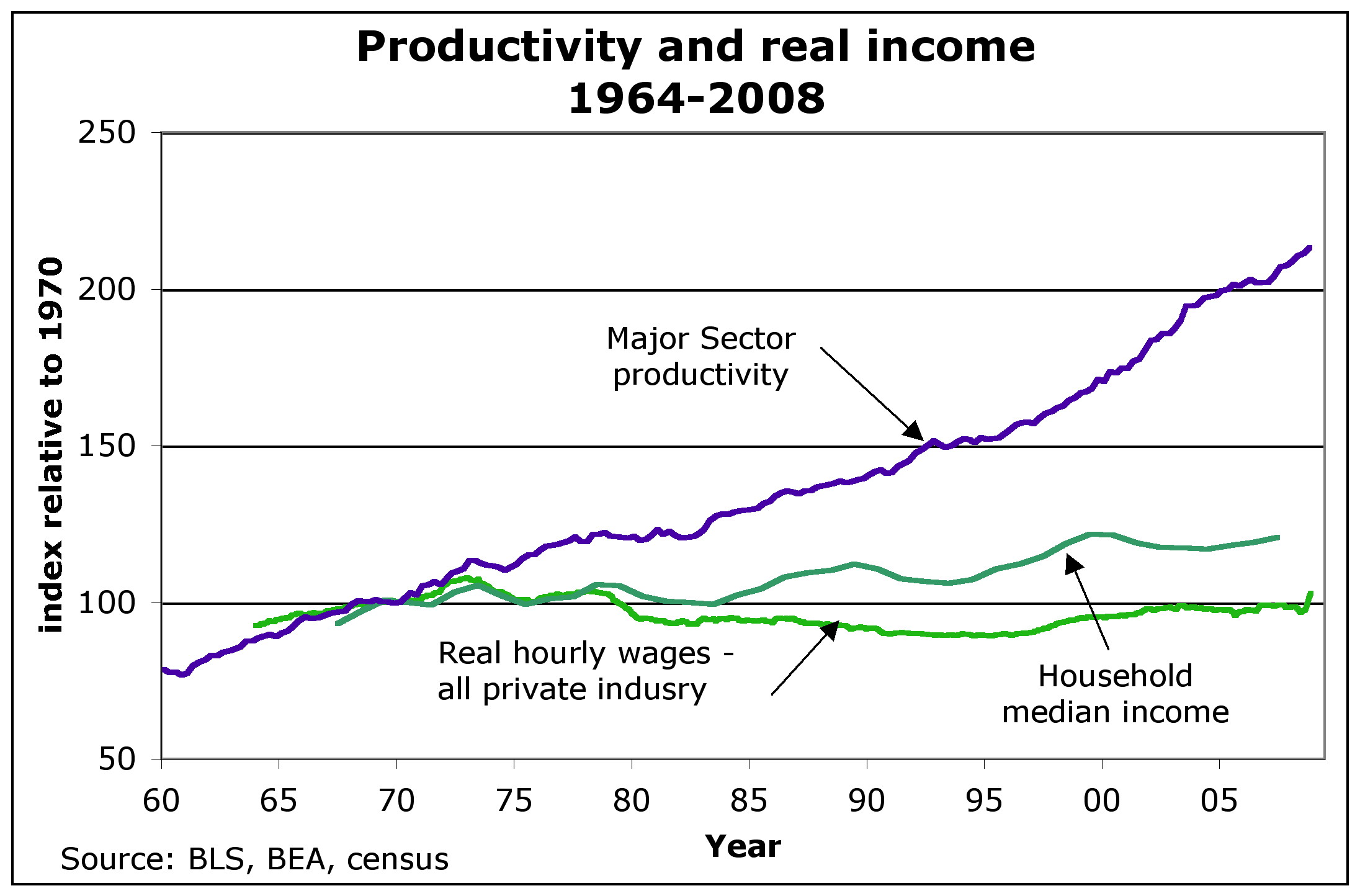
This is where the 4 hour work week went.
Disclaimer: I am an ardent supporter of work hours being reduced as productivity rises.
Re: Who Stole the Four-Hour Workday?
#20Capitalism`s greatest strength is also its greatest weakness. The profit motive is so strong that it often ends up creating irrational scenarios such as the economic situation we have today. European countries seem to have struck a far better balance by harnessing the profit motive of capitalism while preventing disasters such as for-profit healthcare, for-profit education, for-profit government policies (for the ric…
Please explain how for-profit education is a disaster. By all measures, private schools in the US are superior to public schools, and the US's private universities are consistently rated best in the world. You also can't generalize about e.g. for-profit healthcare based on the American situation, because the regulatory environment is so extreme as to have to created a government-controlled crony-capitalistic oligopol…
> the US's private universities are consistently rated best in the world.
By whom? In particular, are there any ratings of American versus European universities by people who have experience of both? I only have experience of the latter; from what I've heard from Americans talking about their university experience, it sounds markedly inferior.