Live data from Hacker News

Studies: Blood from young mice reverses aging in old mice

nytimes.com

11–20 of 54 posts

Re: Studies: Blood from young mice reverses aging in old mice

#11
You have to be very careful when you say "reverses aging." That is a very different thing from "reverses a couple of measurable aspects associated with aging." In the former case you are making an assertion that will immediately lead you to having to define the cause and mechanisms of aging and defend your point that it is, as a process, reversed - and the definition of aging is a contentious topic at the present time. But the press is lazy and in search of clicks, etc, etc.

The mainstream of the aging research community theorizes on the basis of mountainous evidence that aging is accumulated damage. What that damage consists of is pretty much settled, but there is a lot of argumentation over how it all hooks together, what is important, what is primary versus secondary, and how in detail it connects to visible pathologies of aging.

Outside that mainstream, the present day accepted heresy, in the sense that the minority population of heretics are engaged with rather than cast out of the cathedral, is that aging is an evolved genetic program. It is a selected adaptation and where there is damage that damage is a consequence of epigenetic changes, not the cause of them. There are factions within this heresy too, and a lot of argumentation. If you want to learn more, look for the hyperfunction theory of aging and related thoughts as representative of the field. [1]

The damage view of epigenetic and signaling changes in tissues that occur with aging is that these changes are reactions to damage. Altering them may lead to short term benefits and be worthy of use as treatments but that doesn't do anything about the underlying damage - which will grow and kill you. In the case of stem cell decline with aging, this process is thought to be a cancer suppression mechanism, and thus forcing all the dormant stem cells back to work is going to mean cancer everywhere. Equally it may turn out that evolution has produced an overcompensation and some of the benefits of doing this might be effectively free. The fastest way to find out is to conduct animal studies in something other than mice (which are little cancer factories and have telomere dynamics that are very dissimilar to that of humans).

In contrast the programmed aging view is that reversing signaling and epigenetic changes is exactly reversal of aging, and is thus a great thing to be doing and we should be making full steam ahead on this front. I think they are wrong, and that the balance of evidence clearly points in the other direction, but as I said this is a heresy with enough advocates that they are not just ignored.

(Bizarrely, most of that portion of the mainstream who work towards enhancing longevity and slowing aging actually spend their time on potential treatments that make much more sense as goals for programmed aging enthusiasts. Look at sirtuin or calorie restriction mimetic work - all about altering protein levels and signals. All too few researchers take the sensible approach of looking for means of damage repair. But that's a whole different topic. I blame regulation of medicine as a force steering research into marginal channels).

Anyway, on to the heterochronic parabiosis, which is what you call the linking of circulatory systems in two individuals, one old, one young. This has been used for some years as a way of studying what might be going on in old tissues, especially in connection with the decline in stem cell tissue maintenance activity that leads to organ dysfunction and death. The end goal is to figure out the differences and use that knowledge to produce the part of the complete map of the molecular biology of the progression of aging that covers tissue signaling - most researchers in the field have no declared interest in doing anything other than looking at what is going on.

Along the way, however, someone will produce prospective treatments based on identifying signals to stem cells involved in the choice between activity and quiescence. No-one is going to be shifting blood around as a basis for treatments between young and old when you can instead figure out what exactly it is in the blood that is causing changes - this is a change likely to occur in the stem cell transplant field also, in which much of the benefits seem to depend on the alteration of signals caused by the transplanted cells rather than any cell maintenance they are doing directly. Why sling cells around if you can just manufacture proteins that have the same beneficial effects?

One of the signals is apparently GDF11, which has been explored for a couple of years now. [2] It is interesting to see that it is more general than simply localized to heart tissue. Given the large number of quite different stem cell populations in the body it would be unexpected to find much in the way of commonality between the signaling systems that they use. Apparently there is some commonality after all. Though I wouldn't hold out for much more. In general I'm expecting the exploration of cell signaling to be every bit as complicated as the hunt-and-peck approach taken to finding ways to interfere with cancer: a lot of proteins, different in most tissues.
[1]: http://www.ncbi.nlm.nih.gov/pmc/articles/PMC3455862/

[2]: http://dx.doi.org/10.1016/j.cell.2013.04.015

Re: Studies: Blood from young mice reverses aging in old mice

#12
post #4

How long would effects like this last? I mean, let's say a bunch of children donated blood for the cause, and we used it to replace the blood of a senior citizen. I don't know how to phrase this properly, but how long does the blood maintain the youthful qualities? Do you constantly need new blood coming in from a young donor? Do you receive it once and you're good for a week? A year?

Most of the parabiotic procedures on mice had two organisms almost always connected to each other. Not sure if the case you described above is feasible in near future.

For eg, This one had them connected for 2 weeks : http://www.ncbi.nlm.nih.gov/pubmed/24145664

anyway, we need to wait for more research on similar methods.

Re: Studies: Blood from young mice reverses aging in old mice

#14
post #10
post #8

Earlier quoted context omitted.

It seems like it would be relatively easy to test out. People donate blood all the time. I'm sure the effects are known of how much blood you can replace at once without causing issues. Without a doubt some elderly people would volunteer. Why can't we start giving them new blood once a week from donors, and see the results on their health or illnesses? I'm all for testing, but this seems like one of those things you…

Should be done outside the normal blood donor system. There's not that much donor blood around, so it would be unethical to use it. Not a practical problem, but it would look and feel bad. Anyway, yes, why not try this on humans? Sounds perfectly reasonable.

Because of cancer.

As mentioned in the article:

"Waking up stem cells might lead to their multiplying uncontrollably."

Re: Studies: Blood from young mice reverses aging in old mice

#16
post #10
post #8

Earlier quoted context omitted.

It seems like it would be relatively easy to test out. People donate blood all the time. I'm sure the effects are known of how much blood you can replace at once without causing issues. Without a doubt some elderly people would volunteer. Why can't we start giving them new blood once a week from donors, and see the results on their health or illnesses? I'm all for testing, but this seems like one of those things you…

Should be done outside the normal blood donor system. There's not that much donor blood around, so it would be unethical to use it. Not a practical problem, but it would look and feel bad. Anyway, yes, why not try this on humans? Sounds perfectly reasonable.

Well, many people seem to be suggesting (including the researchers themselves) that there is a possibility of the older person dying of insta-cancer after receiving the blood because their cancerous stem cells would immediately be told to start multiplying. That's why I think it's a good idea to test this in animals first.

Re: Studies: Blood from young mice reverses aging in old mice

#17
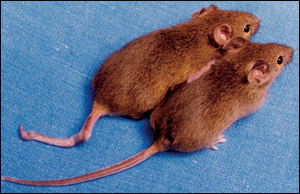
Details of the procedure: "To do so, they joined rats in pairs by stitching together the skin on their flanks. After this procedure, called parabiosis, blood vessels grew and joined the rats’ circulatory systems. "

So the old and new rats were basically sewn together.

If you want to see what this looks like, here's a picture: http://www.viewzone.com/regen.miceduo.png

Re: Studies: Blood from young mice reverses aging in old mice

#18
post #8

Earlier quoted context omitted.

Only one way to find out...

It seems like it would be relatively easy to test out. People donate blood all the time. I'm sure the effects are known of how much blood you can replace at once without causing issues. Without a doubt some elderly people would volunteer. Why can't we start giving them new blood once a week from donors, and see the results on their health or illnesses? I'm all for testing, but this seems like one of those things you…

Did you read all the way to the end? Where they ended on "this will probably cause cancer" ... ?

Re: Studies: Blood from young mice reverses aging in old mice

#19
post #13
post #7

[deleted]

Scientists do a lot of grotesque things to mice, rats and insects all the time. We have to test stuff on someone, and humans are not really acceptable, even with consent.

I agree with you.. but.. going to argue the other way anyway ;)

Isn't a consenting subject better than a forced subject? The mice had no say, but a human does..

Re: Studies: Blood from young mice reverses aging in old mice

#20
post #7

[deleted]

The parent shouldn't be downvoted, as it is exactly true. Hypocritical even in its two sentences, but true. It is fashionable to look away, and necessary for our own health and progress in medicine to do these things, but that doesn't make it anything other than what it is.

However, what happens within the scientific community is a drop in the ocean of what happens on farms and in the wild.

If you feel strongly about animal suffering, then the following are logical things to advocate and aid:

1) Veganism, now that we are at a point in our mastery of agriculture at which this is a viable choice if everyone made it.

2) Tissue engineered meat and other animal products, made without any form of suffering.

3) Simulational approaches to animal research. Ultimately animals will be sacrificed only for calibration, at rates far lower than is presently the case.

4) The removal of all natural wildlife, to be replaced by managed systems in which there is no death or violence, only the simulation of it.

Obviously these, especially (4), are long term projects. They are not impossible, but will require progressively greater levels of technology in the order in which they are presented. If you think they are valuable, you should help these causes.

The Hedonistic Imperative is an interesting set of ideas to look into with regards to (4). [1]

[1]: http://hedweb.org/

Post reply on HN