Live data from Hacker News

The engineer who fixed his own heart

bbc.co.uk

11–20 of 43 posts

Re: The engineer who fixed his own heart

#11
post #7

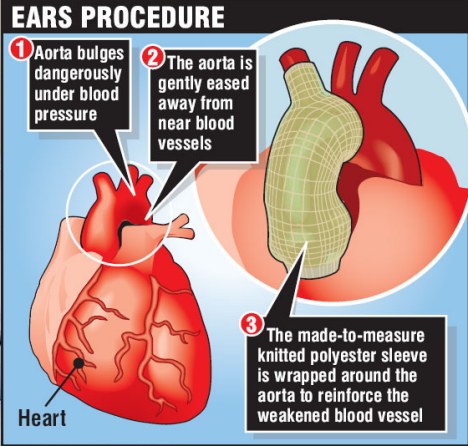
Aorta wrapping was actually pioneered in the 1950's, before the graft replacements that the article mentions, but generally the wrapping had a poor result and was abandonded as a technique. (see http://www.ncbi.nlm.nih.gov/pmc/articles/PMC1802172/pdf/anns... ) Generally the trend in vascular surgery these days is to less invasive procedures such as a stent graft.

And I think the journal article about this particular process is from 2009 ( http://icvts.oxfordjournals.org/content/10/3/360.short ).

So, hey, points to the BBC for writing an article about something that continues to be interesting instead of something that's "brand new".

Re: The engineer who fixed his own heart

#12
post #9

Marfan syndrome makes you tall and lanky, so they actually have to watch for it carefully in highschool basketball teams. The build it gives them makes them a natural at the sport, but the stress of the game combined with the heart weakness caused by Marfan Syndrome can be lethal. I suspect a lot of kids who lost their basketball dreams in a heart-attack will be lining up for this procedure.

My favourite artist has Marfan Syndrome, Bradford Cox of Deerhunter: http://www.miscmusic.net/wp-content/uploads/2011/09/138.jpg

Re: The engineer who fixed his own heart

#14
post #11
post #7

Aorta wrapping was actually pioneered in the 1950's, before the graft replacements that the article mentions, but generally the wrapping had a poor result and was abandonded as a technique. (see http://www.ncbi.nlm.nih.gov/pmc/articles/PMC1802172/pdf/anns... ) Generally the trend in vascular surgery these days is to less invasive procedures such as a stent graft.

And I think the journal article about this particular process is from 2009 ( http://icvts.oxfordjournals.org/content/10/3/360.short ). So, hey, points to the BBC for writing an article about something that continues to be interesting instead of something that's "brand new".

I find it fascinating that such an old procedure has been revisited sucessfully (not completely unheard of in medicine either). Perhaps better materials (now a polymer mesh) than used previously (cellophane wrap!).

Re: The engineer who fixed his own heart

#17
post #10

Tal provided one of my favourite Ted talks on this subject: http://www.ted.com/talks/tal_golesworthy_how_i_repaired_my_o...

[deleted]

I think your brother is probably rolling his eyes when he agrees that yes it would be great if we had a cheap and effective universal mass screening tool for cancer. I mean, why would -any- doctor not want that. Why would any cancer researcher not want that. Oh, but it would mean they would lose their funding you say. But in exchange, you get ever-lasting fame. Oh, and you don't have to worry about having probes shoved up your ass, or have bits of your breast cut out for inspection when you get to "that age".

I think your supposition ignores a lot of the latent difficulties in the subject area. You could very well rephrase that as "why not try to create a drug that just kills all cancer with minimal side effects as it seems crazy to have to cut someone open and cut it out by hand".

The answer to "why haven't we done more" is "because it's hard and we're working on it". Why isn't automatic machine translation any better? Why are natural language interfaces so crappy? Why does my speech to text program make mistakes? Why are we still using steel and concrete? Why don't have we have a room-temperature superconducting power grid? Why do we still have to get our meat from animals on a farm? Why don't we just make a cure for HIV? Why don't we just make a cure for the common cold? Why don't we just have a malaria vaccine (they really are working on this one! It's HARD!)?.

The answer to all of these questions is "because it's hard and we're working on it".

Re: The engineer who fixed his own heart

#18

i'm wondering whether the fact that it is in UK is important, ie. wrt. who paid for the [experimental] surgery. As we all know, while coming up with idea is great, an actual implementation faces the issues of resources/money.

UK or not is probably not too important. The surgeon mentioned (Tom Treasure) is at University College London (his surgery is likely based at Guy's Hospital, as mentioned in the OP). This was most likely the beneficiary of a grant for medical innovations, funded by either the NHS or one of the non-profits such as the Wellcome Trust or the British Heart Foundation.

[1] http://www.ucl.ac.uk/operational-research/the_team/TomTreasu...

Re: The engineer who fixed his own heart

#19

i'm wondering whether the fact that it is in UK is important, ie. wrt. who paid for the [experimental] surgery. As we all know, while coming up with idea is great, an actual implementation faces the issues of resources/money.

Having single-payer healthcare is important for this to happen, yes.
Post reply on HN