Live data from Hacker News

Porting my 3D points renderer on a ZX Spectrum 48K

github.com

11–15 of 15 posts

Re: Porting my 3D points renderer on a ZX Spectrum 48K

#11
post #8

> Then again, maybe you, kind reader, can try this out on your Speccy - and tell me if it works? It does, here is 'Statue' loading and running on Belarusian 'Bajt' ZX Spectrum clone: https://youtube.com/shorts/0LaItots33Q?feature=share

Oh wow! I never expected to see this in a real Speccy until I fix the one I have back home (I'm an expat).

Thank you so much! :-)
Re: Porting my 3D points renderer on a ZX Spectrum 48K

#12
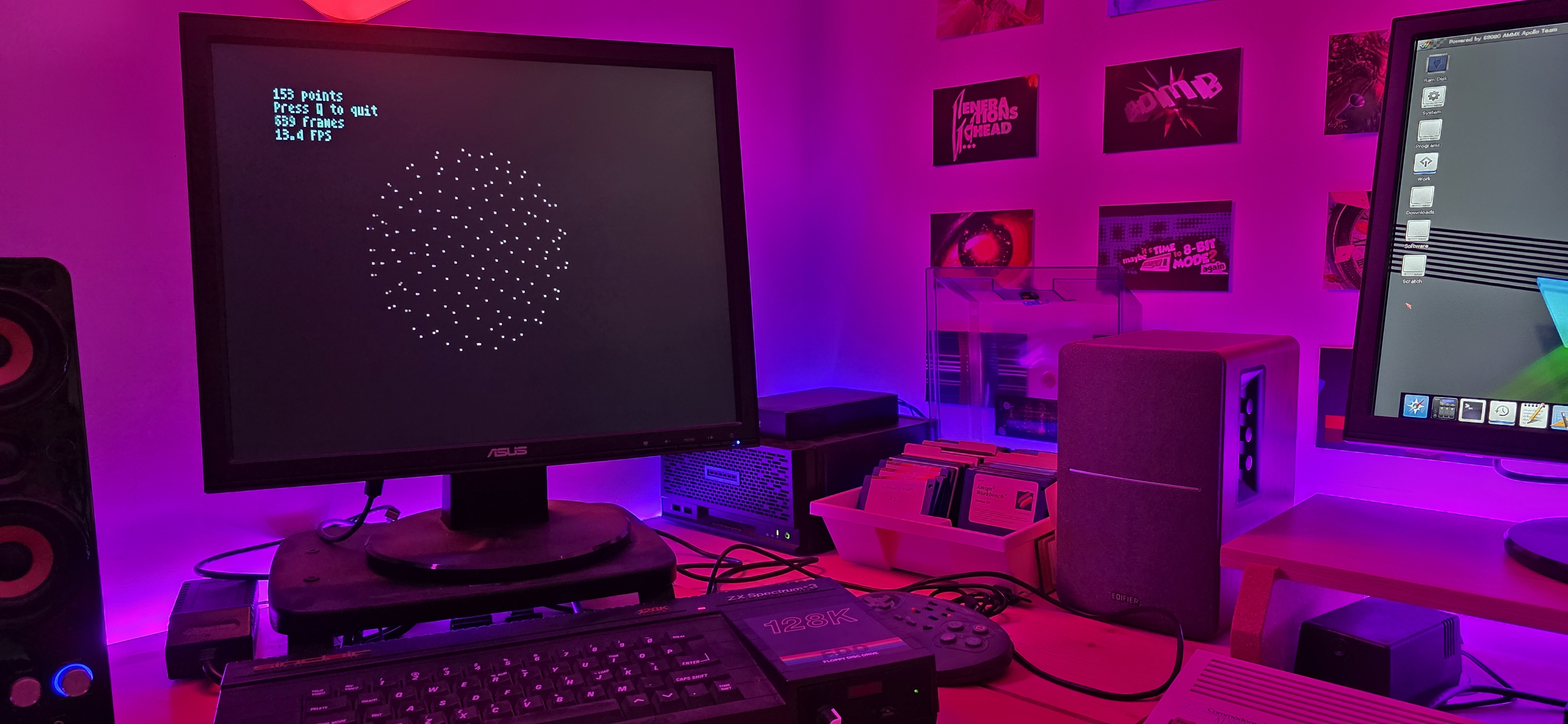
It does indeed work! You can see it running here on my +3 in my "retro cave" :)

https://share.markround.com/sphere.jpg

I have also uploaded it to my TNFS site[1], which you can also access through an emulated Speccy in a browser (or a real Spectrum if you have a Spectranet/Spectranext card fitted):

https://jsspeccy.markround.com

Press option 4 on the main menu when it loads for recent uploads.

It's really cool and very, very smooth. I wasn't quite sure what to categorise it as on my site, so I filed it under "demos" as I think it's a very impressive bit of code :)

Thanks for sharing!

-Mark

[1]=More details at https://tnfs.markround.com or on my "DevOps for the Sinclair Spectrum" series of articles which are linked from both sites.

Re: Porting my 3D points renderer on a ZX Spectrum 48K

#13

It does indeed work! You can see it running here on my +3 in my "retro cave" :) https://share.markround.com/sphere.jpg I have also uploaded it to my TNFS site[1], which you can also access through an emulated Speccy in a browser (or a real Spectrum if you have a Spectranet/Spectranext card fitted): https://jsspeccy.markround.com Press option 4 on the main menu when it loads for recent uploads. It's really cool and ve…

Thanks, Mark - for both setups!

It's very nice seeing it put to use in actual Spectrum machines - love it :-)

Re: Porting my 3D points renderer on a ZX Spectrum 48K

#15
post #4

If you want to write faster Z80 code, pretend it's a Game Boy, and use the IX/IY registers sparingly. You can use 256-byte aligned tables. Then you put your index into the low byte of the register pair, and which table into the high byte of the register pair. You don't even need to completely use the table if you don't need all 256 entries, you can treat the rest of a table as free space to put other variables in the…

So basically an 8080
Post reply on HN