I find it funny how people are so concerned that AI cannot innovate, that AI coding agents only give the most bland solutions to any problem etc. when the next step in OpenAI's 5 stages to AGI is literally called "Innovators".
It's marketing.
Designing AI for Disruptive Science
11–20 of 51 posts
Re: Designing AI for Disruptive Science
#12The article presumes that the models we have today describing everything could still be subject to a major paradigm shift. Maybe they could be, but it seems pretty unlikely. The edges of a lot of scientific understanding are now past practical applicability. The edges are essentially models of things impossible to test. In fact, relativity was only recently fully backed up with experimental data.
I think also what's practically applicable changes constantly. Perhaps we're truly at the End of Science, but empirically we've been wrong every other time we've said that. My money is that there's more race to run.
Re: Designing AI for Disruptive Science
#13I find it funny how people are so concerned that AI cannot innovate, that AI coding agents only give the most bland solutions to any problem etc. when the next step in OpenAI's 5 stages to AGI is literally called "Innovators".
My two step plan is to go to sleep and then wake up the next day and be a billionaire. Surely because that's my stated next step that means when I wake up tomorrow I'll be rich.
Re: Designing AI for Disruptive Science
#14The article presumes that the models we have today describing everything could still be subject to a major paradigm shift. Maybe they could be, but it seems pretty unlikely. The edges of a lot of scientific understanding are now past practical applicability. The edges are essentially models of things impossible to test. In fact, relativity was only recently fully backed up with experimental data.
I'm also a little skeptical about the practical value of the bleeding edge of both experimental and theoretical physics. Interesting? Sure.
Re: Designing AI for Disruptive Science
#15Re: Designing AI for Disruptive Science
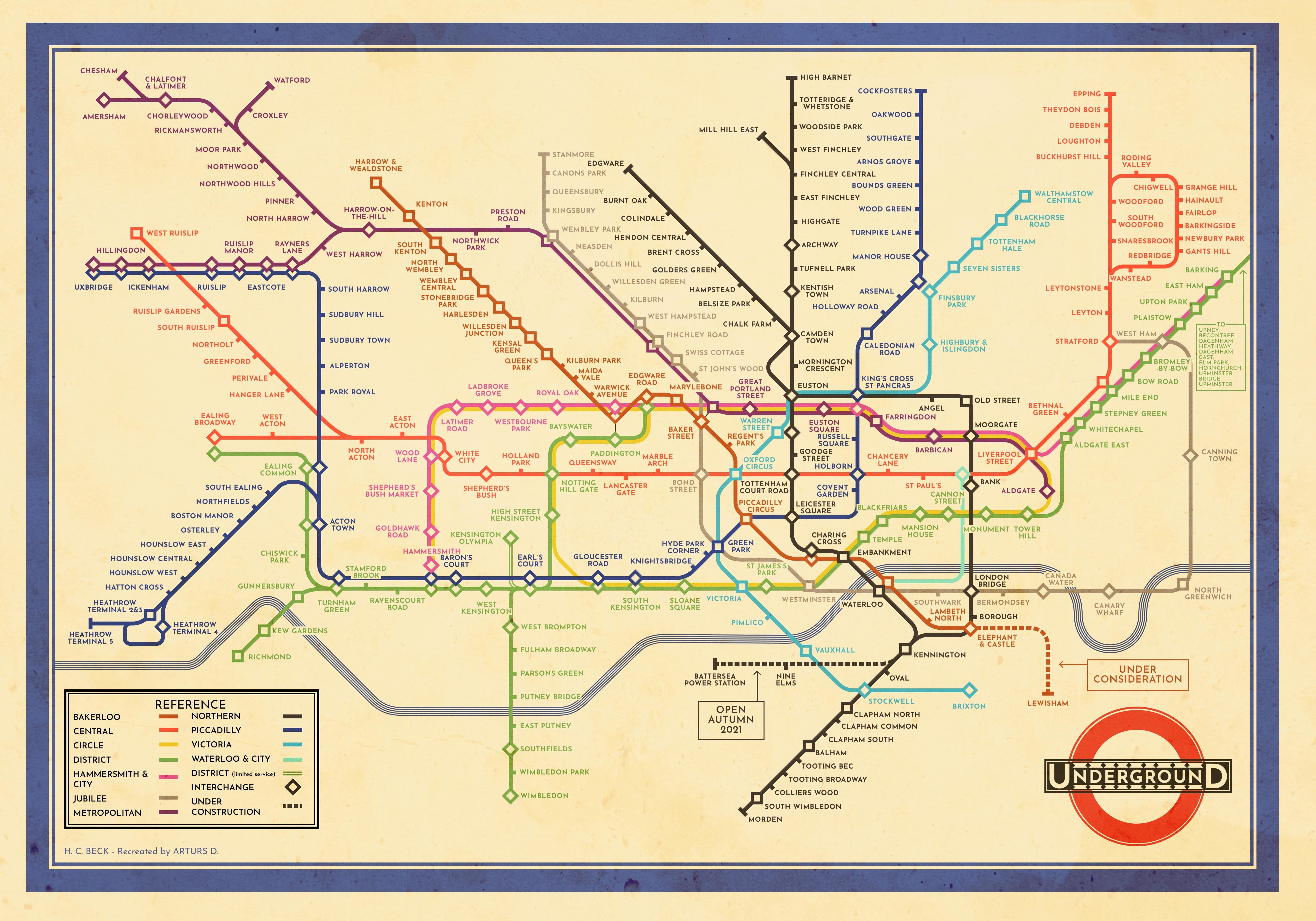
#16which contains Heathrow Terminals 1, 2, 3, 4 & 5 on the Picadilly line. For about 15 seconds I imagined a world where Heathrow has had 5 terminals since 1933, then I read the map itself: "Recreated by Arthurs D". Phew.
Awesome example of improving information conveyance through abstractions though!
Re: Designing AI for Disruptive Science
#17Worsen. LLMs discard/loses and mixes data on their statistical "compression" to create their vectorial database model. Across the time, successive feed back will be homologous to create a jpg image sourcing a jpg image that was created from another jpg image, through this "gaussian" loop.
Those faster (but worst) results will degrade real valuable data and science at a speed/rate that will statistically discard good done science on a regular basis, systematically.
IMHO.
Re: Designing AI for Disruptive Science
#18The article presumes that the models we have today describing everything could still be subject to a major paradigm shift. Maybe they could be, but it seems pretty unlikely. The edges of a lot of scientific understanding are now past practical applicability. The edges are essentially models of things impossible to test. In fact, relativity was only recently fully backed up with experimental data.
I don't think paradigm shifts have to be 'better' in some march-toward-progress sense, they can be lateral or even regressive in that way and still lead to longer-horizon improvements. I think also what's practically applicable changes constantly. Perhaps we're truly at the End of Science, but empirically we've been wrong every other time we've said that. My money is that there's more race to run.
But they do. Paradigm shifts happen because the new paradigm explains the unexplained and importantly also covers the old model. If prior data is unexplained with a paradigm shift, the shift will never be adopted.
> Perhaps we're truly at the End of Science
Who said that? Just because the core of our current models seem pretty rock steady doesn't mean there's not more science. It simply means that we can mostly just expect refining rather than radical discovery.
There will be sub-paradigm shifts, but there's likely not going to be major "relativity" moments from here on out.
Re: Designing AI for Disruptive Science
#19The article presumes that the models we have today describing everything could still be subject to a major paradigm shift. Maybe they could be, but it seems pretty unlikely. The edges of a lot of scientific understanding are now past practical applicability. The edges are essentially models of things impossible to test. In fact, relativity was only recently fully backed up with experimental data.
Alternatively: there's plenty of mainstream, accepted science that's plain, flat out, provably wrong. Yet, it is against good taste (job security, people's feelings, status quo bias, etc.) to point this out.
Hence, it can actually be tricky to catch wind of, or get a grasp on, such issues to begin with, much less pursue such issues toward meaningful, published, recognized change in understanding (that is to say: paradigm shift).
I'd name some examples, but you wouldn't believe me.
With respect to the article, it seems the current LLMs can (though, obviously, do not necessarily have to) return text that appears to reason (pretty reasonably!) about paradigm shifts, when given the context required and nudged quite forcefully toward particular directions. But, as the article seems to indicate, the LLMs seem to not tend toward finding, investigating, and reporting on paradigm shifts all on their own very much. (But maybe part of that is intrinsic to how they are programmed and/or their context?)
Re: Designing AI for Disruptive Science
#20The article presumes that the models we have today describing everything could still be subject to a major paradigm shift. Maybe they could be, but it seems pretty unlikely. The edges of a lot of scientific understanding are now past practical applicability. The edges are essentially models of things impossible to test. In fact, relativity was only recently fully backed up with experimental data.
Physics is a bit of a special case. This certainly doesn't apply to, say, biology, medicine, cognition, not to mention any of the social sciences—i.e. most research. I'm also a little skeptical about the practical value of the bleeding edge of both experimental and theoretical physics. Interesting? Sure.
And the closer you get to physics, the less likely any sort of major paradigm shift will be discovered (though the article focuses pretty heavily on physics which is why I do as well).
But even in those fields, there are core parts that aren't likely to ever see any sort of paradigm shift. For example, in biology, I doubt we'll see a shift from evolution as it'll be impossible for a new model to also explain what evolution does.
I agree that at the edges you'll possibly see more paradigm shifts and discovery, but those are all going to be working from things that will not see paradigm shifts. For example, biology can't escape things like single celled organisms made up from atoms and chemical compounds.
But ultimately, what I disagree with in the article is the notion that discovery won't ultimately be a process of hypernormalization. In medicine, we are unlikely to see a new paradigm that isn't germ theory. When it comes to the research, it'll mostly be focused on finding new compounds and delivery mechanisms for treatment rather than finding a new paradigm for how to treat a disease.
The softer sciences are the only place where you might find new paradigms, but that's simply because the data itself is so squishy and poor anyways that it's easy to shift around. There it's less a question of the science and more of the utility of the model (regardless of whether or not it aligns with reality).