Live data from Hacker News

Measuring the impact of zoning on housing in a city

blog.jonathannolan.net

11–20 of 78 posts

Re: Measuring the impact of zoning on housing in a city

#11
post #8
post #6

Earlier quoted context omitted.

I have personally been involved in a few planning and “traffic engineering” issues where I live. And although this comment is heavy on the sarcasm it is very reflective of my experience. As a whole planning departments seem unable to defend decisions with relevant data and instead rely on indefensibly old manuals and standards. Some of which themselves use indefensible statistics- particularly traffic manuals (lets p…

I am not actually intending to be sarcastic at all - I think the entire industry is morally bankrupt. I am a real estate developer (re-developer actually - specializing in heritage buildings and other complicated adaptive reuse projects), so I deal with planners, committees, official plans, zoning by-laws and the building code daily. It is painful to see indefensible requirements being thrust on projects - even those…

> by taxing / fining people for having a second home.

I don't see the issue with this? The profits in Canadian real estate are not on the back of some new found resource. It's entirely an effective wealth redistribution from have-nots to haves.

If you have property, the vast amount of value in it is strictly from the fact that it is artificially scarce. To get into the "haves" you have to pay an artificial tax in the form of a grossly inflated price.
Re: Measuring the impact of zoning on housing in a city

#12
> Giving up some aesthetic control means creating a city much more like Tokyo where building heights differ markedly even on lots next door to each other.

I've lived a ridiculous number of major USA cities and I'll never forget what Houston, which is the only one I can think of that had no zoning, looked like.

https://www.chron.com/news/houston-texas/houston/article/Wei...

Re: Measuring the impact of zoning on housing in a city

#13
post #5

I personally tried to build more housing, I tried to buy 5 acres and build 5 homes on them. 5 acres could have easily held 5 large homes with big yards. The city zoning board denied me, saying that that 5-acre plot had been zoned for ONE house and an ADU of no larger than 300 sqft. That was when I realized why housing is so expensive.

In this case, it may not have just been that 5 acres was enough "room" for five houses. It gets into questions of building infrastructure for those houses -- sewers, water rights, etc. One development of 5 houses might not move the needle on that, but it then opens the door to neighbors doing the same thing, which could very much require major investment in infrastructure for the area.

Re: Measuring the impact of zoning on housing in a city

#14
post #12

> Giving up some aesthetic control means creating a city much more like Tokyo where building heights differ markedly even on lots next door to each other. I've lived a ridiculous number of major USA cities and I'll never forget what Houston, which is the only one I can think of that had no zoning, looked like. https://www.chron.com/news/houston-texas/houston/article/Wei...

Here is a good article on Tokyo zoning: https://urbankchoze.blogspot.com/2014/04/japanese-zoning.htm...

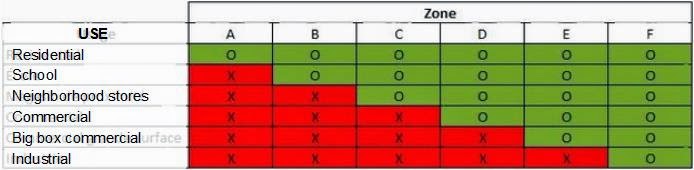
You'll notice that the model is additive instead of exclusionary. Basically if a block is zoned light commercial, you can put stores, apartments, or single family homes on it. Here is a nice chart https://1.bp.blogspot.com/-Lweabho82d0/U0HCJsQ3tbI/AAAAAAAAA...

Tokyo does zoning right, and the simplest first step to solve housing problems that plague major American cities is to just adopt a model of zoning that is proven to work.

Re: Measuring the impact of zoning on housing in a city

#15
post #4

> Planners do important work moulding how our cities grow. Lost me at the first sentence. Let me fix it: “Planners follow the flavour of the day while committing the same sins over and over, their failures recognizable only in retrospect once replaced with a new (also faulty) paradigm based on centralized planning. Despite their repeated failures, as an industry or field of study they show no contrition and continue…

What's your preferred solution? Laissez-faire development?

I think some of the discussion in this book - written by a former planner - is pretty sensible around what we should be doing:

https://islandpress.org/books/arbitrary-lines#desc

By getting planners out of some of the unnecessary minutiae of their jobs, they can, well, actually plan for things. Ensure that we have good street grids, land set aside for parks and schools that are harder to retrofit into a pure 'anything goes' system, and also try to do some planning to keep genuinely noxious uses away from where people live, rather than "keeping apartments away from the 'nice' neighborhoods".

Re: Measuring the impact of zoning on housing in a city

#16
post #8

Earlier quoted context omitted.

I am not actually intending to be sarcastic at all - I think the entire industry is morally bankrupt. I am a real estate developer (re-developer actually - specializing in heritage buildings and other complicated adaptive reuse projects), so I deal with planners, committees, official plans, zoning by-laws and the building code daily. It is painful to see indefensible requirements being thrust on projects - even those…

> by taxing / fining people for having a second home. I don't see the issue with this? The profits in Canadian real estate are not on the back of some new found resource. It's entirely an effective wealth redistribution from have-nots to haves. If you have property, the vast amount of value in it is strictly from the fact that it is artificially scarce. To get into the "haves" you have to pay an artificial tax in the…

The grossly inflated price comes from where though? I'd put it to you that a ban on usury where real estate was concerned would crush land values over night. Easy money (cheap loans) allow speculation, and speculation is one of the primary drivers of land value.

Re: Measuring the impact of zoning on housing in a city

#17
post #14
post #12

> Giving up some aesthetic control means creating a city much more like Tokyo where building heights differ markedly even on lots next door to each other. I've lived a ridiculous number of major USA cities and I'll never forget what Houston, which is the only one I can think of that had no zoning, looked like. https://www.chron.com/news/houston-texas/houston/article/Wei...

Here is a good article on Tokyo zoning: https://urbankchoze.blogspot.com/2014/04/japanese-zoning.htm... You'll notice that the model is additive instead of exclusionary. Basically if a block is zoned light commercial, you can put stores, apartments, or single family homes on it. Here is a nice chart https://1.bp.blogspot.com/-Lweabho82d0/U0HCJsQ3tbI/AAAAAAAAA... Tokyo does zoning right, and the simplest first step to…

> 1- Zoning is a *national law*, not a municipal by-law

A national zoning law is very interesting.

My biggest complaint about every city in TX I lived in (Houston, Austin, SATX, Dallas) was the lack of MDUs (among other things) causing them all to be painfully sparse. I lived in the densest neighborhoods I could find, usually Uptown or with Austin right off Guad by UT and 5th/Comal and my life now living in Denver which has a HUGE amount of MDUs/Duplexes/etc everywhere is so drastically different even though Denver has nowhere near the population of those. I haven't driven my car in months and nearly everyone I know lives in a 1-10 block radius.

What was my previous mountain view from my 4 story townhouse is now an 11 story office building directly behind me that glares down at my patio, though, so there's that. I think it's coming with 400-1000 car parking spots (underground garage).

We've been trying to get this (currently) low-traffic, low-mph throughfare street to completely ban car traffic and be turned into pedestrian/restaurant walking only, which it was during COVID and was wonderful, so that's probably dead in the water now.

Re: Measuring the impact of zoning on housing in a city

#18
post #5

I personally tried to build more housing, I tried to buy 5 acres and build 5 homes on them. 5 acres could have easily held 5 large homes with big yards. The city zoning board denied me, saying that that 5-acre plot had been zoned for ONE house and an ADU of no larger than 300 sqft. That was when I realized why housing is so expensive.

I've looked at something similar. The path is to split the plot first via your county (or whatever) and then build.

Correct, but the zoning board people outright told me they would deny the request to split the lot because it had already been zoned as “single family”.

Re: Measuring the impact of zoning on housing in a city

#19
post #8

Earlier quoted context omitted.

I am not actually intending to be sarcastic at all - I think the entire industry is morally bankrupt. I am a real estate developer (re-developer actually - specializing in heritage buildings and other complicated adaptive reuse projects), so I deal with planners, committees, official plans, zoning by-laws and the building code daily. It is painful to see indefensible requirements being thrust on projects - even those…

What is your opinion on the recent SCOTUS decisions declaring that forcing developers to pay for community improvements qualifies as a taking? Do you see this having a material effect on housing development?

Do you have a link to a summary? I missed it, if it ever made the front page news.

IANAdeveloper… if a developer is otherwise within code/zoning, SCOTUS is probably correct. If they’re asking for zoning changes, there should be room for negotiation on nearby improvements.

Re: Measuring the impact of zoning on housing in a city

#20
post #4

> Planners do important work moulding how our cities grow. Lost me at the first sentence. Let me fix it: “Planners follow the flavour of the day while committing the same sins over and over, their failures recognizable only in retrospect once replaced with a new (also faulty) paradigm based on centralized planning. Despite their repeated failures, as an industry or field of study they show no contrition and continue…

In my experience, local planners usually try to do what’s right/best/useful. And then end up hamstrung by state law or state DOT. I’m in Fairfax County, VA FWIW.

I’ve seen them be quite proactive with plans near the Metro extension. But then VDOT does dumb shit like failing to build out multi-modal transit to meet the vision of the local planners.

Post reply on HN