Live data from Hacker News

Manipulating App Store Reviews with Dark Patterns

90percentofeverything.com

11–20 of 24 posts

Re: Manipulating App Store Reviews with Dark Patterns

#11
post #4

I agree with the overall premise of the article, in that these examples are in fact exploiting UI design patterns to funnel users into not being able to painlessly leave negative reviews. But i want to offer a different perspective for consideration other than "this is evil". As a developer of apps, you provide software that tries to fulfill a specific need of some subset of users (in other words, it's not merely an…

I don't think it is unethical to make more of an effort to persuade happy users to leave a review. In fact, I find the "send love" option quite brilliant.

What I do find a bit appalling is outright tricking the user to think they are leaving a review to help other users make an educated decision on whether to download/purchase this app using a faux review form that leads nowhere, as in the last example. This is deceptive and in in a way it's almost comparable to phishing. I think that "posing as an official Apple feedback channel with the intention to censor bad reviews" would be a pretty natural addition to Apple's Terms & Conditions.

Re: Manipulating App Store Reviews with Dark Patterns

#12
post #4

I agree with the overall premise of the article, in that these examples are in fact exploiting UI design patterns to funnel users into not being able to painlessly leave negative reviews. But i want to offer a different perspective for consideration other than "this is evil". As a developer of apps, you provide software that tries to fulfill a specific need of some subset of users (in other words, it's not merely an…

I'm also not convinced this is unethical. I think the Appsfire example could be unethical, IF it tried to trick users into thinking they were leaving a review in the App Store, when in fact that were not.

However, after reading the blog post, I installed the Appsfire app to see how it worked. In the interface, the link that brings up the feedback page is labeled Send Us Feedback. I think that's clear enough that it's sending feedback to the developer.

In some cases, negative feedback can be resolved if the developer knows about it. The important thing to the user is that their voice is heard.

So I don't think Appsfire is tricking people. Subsequently asking people who like the app to review it doesn't seem unethical to me. For example, I often get e-mails from people telling me they love my app, and I suggest to them they leave a review in the App Store. I don't think that's unethical.

Re: Manipulating App Store Reviews with Dark Patterns

#13
I have seen too many "it has this bug" in the App Store reviews to think this is a bad thing to do. If my software has an issue I depend on the user to report what they are seeing. It is much more difficult for me if I have to scan the reviews for one-sentence "bug reports" from people I cannot follow up with.

The fact is that the review page is just not about that. I want those reports to get to me so I can fix them issue and I will probably need to have a conversation with the user.

So I like that this feature can possibly catch those issues. Also I don't see it as very deceptive try and catch a good review either. Why can't I? People can freely rate our app and if they want to leave a negative one they know how to do it.

If it is too difficult to do it traditionally than I'm glad they don't do it. They are probably just as lazy about using my app. So I doubt whatever issue they have with it is even real.

Re: Manipulating App Store Reviews with Dark Patterns

#14
post #10

If you haven't used Appirater, the article doesn't make it clear that one way to use it is to only nag users for a review after they've hit a "significant event" like completing all the levels or improving their score or whatever.

I did exactly this in one of my android app. When the user successfully finishes the games, he will be given an option to either rate the game on Google play or retry the game again. If he fails to complete the game, he will just be allowed to retry/quit.

Re: Manipulating App Store Reviews with Dark Patterns

#15
I'm sure this method works great, but the funny thing is you don't even have to go nearly this far. We use a custom bit of code that presents a dialog almost exactly like the one in the first picture. (We even localized it along with the app.)

The dialog is only set to show when the customer has used the app past the period of time where most people who aren't going to stick around will have abandoned it[1]. Thus, we simply only show the "please review the app" request to people who have already decided they like the app.

The difference between this method and the one presented in the article is this-- every user of our app, who becomes a "regular" user, gets asked to leave a review. The "dark method" only asked those who decide they want to give feedback of some kind to give a review.

So, of course, those who are still grudgingly using our app past the %80 cutoff will be asked to leave reviews and they leave some medium or negative reviews.

But here's the big secret of the appstore that I've never seen anyone mention-- reviews boost sales, even bad ones. Getting a sufficient quantity of reviews over some period, with a sufficiently high net positive value for those reviews, causes Apple to feature your app more in cross-selling opportunities (like the iTunes receipt or the "customers of this app also bought..." box).

So, I'd stick with our current method where every long term user of the app is asked to leave a review, over only asking those who have decided to leave feedback.

The app whose had this feature the longest is currently at 4.5 stars and is getting regular reviews. Another app that was a MVP that failed (but is still a good highly rated app) doesn't have this feature (cause its an MVP) and gets far fewer reviews as a percentage of its user base.

[1] This is part of the reason app prices are so cheap. People use the app store as a place to impulse buy small items. So they want apps to be cheap because often they aren't going to use them long, or they are just trying them out.

Re: Manipulating App Store Reviews with Dark Patterns

#17
Hi there. This is ouriel co-founder of appsfire

Thanks for the comments and interesting conversation. Here is a comment i just posted to the author of the post. I hope it brings some light on the situation.

====================================

i wanted to follow up on your note regarding app booster.

First off App booster is a dialog system between the developer and the user. It includes a among other elements a simple feedback system which is not a review UI. It is a way for users to simply and directly contact the developers. Like thousands of apps we had at the beginning a simple email feedback system, but we realized that all it was creating was poor quality feedback - mostly blank emails. Many developers were in the same situation. So we decided to create our own app specific, mobile feedback system.

The idea behind this feedback system was, unlike the app store, to allow the developer to have a chance to respond before the user posts a bad review. Many times bad reviews are published for the wrong reasons and are wrongly attributed to the developer who has no chance to answer in the app store (eg users complaining of an app performing poorly, when the problem was the wifi connection or poor 3G connection..). We had to create a system that allow the developer to have a chance to answer first. If we were suggesting the user to drop a negative review in the app store, then we would simply kill that possibility.

When a positive feedback is sent, it is mostly likely one that does not need an answer and it felt right to entice the user to visit the app store to publish a review there. Note that unlike other methods you are describing in your post this is not forced to all users by a popup, It is natively integrated in the flow of a user already satisfied in the app. Jumping from there to the app store is not incentivized or rewarded in anyway (your post does not mention those methods used by many apps who will ask for a like on Facebook or pay users to review apps which are clearly manipulative methods). The review comes in context in a full optin way, with no tricks.

When using App booster, Users know they are not submitting a review to the App store and they send "Feedback" to the developer because this is the app messaging system. I am not sure why you would consider it differently and i would suggest an edit to your post. You seem to indicate we may try to confuse user with that approach?

We don't agree with your interpretation this is manipulation. As a matter of fact we believe this is the right thing to do. It just makes things right for the developer and the user. No one is forcing any one and a real dialog can take place. The real problem is that the review system is broken in the app store. It is being gamed, it is being manipulated, but you should look in a different direction: look at services paying or rewarding users creating massive pattern of ratings in a matter of hours.

For the record we created for our quality index (App score) a system that detects abnormal rating patterns. We know a little about that. http://blog.appsfire.com/introducing-the-appsfire-app-score-...

App booster is an user friendly, developer friendly way to re-establish what the app store has never offered: a direct dialog channel with the user and a smart feedback system to treat efficiently bad and good feedback.

Let me know if you have more questions

PS: We actually showed our system to some people at Apple who actually reacted very positively to the initiative.
Re: Manipulating App Store Reviews with Dark Patterns

#19
post #2

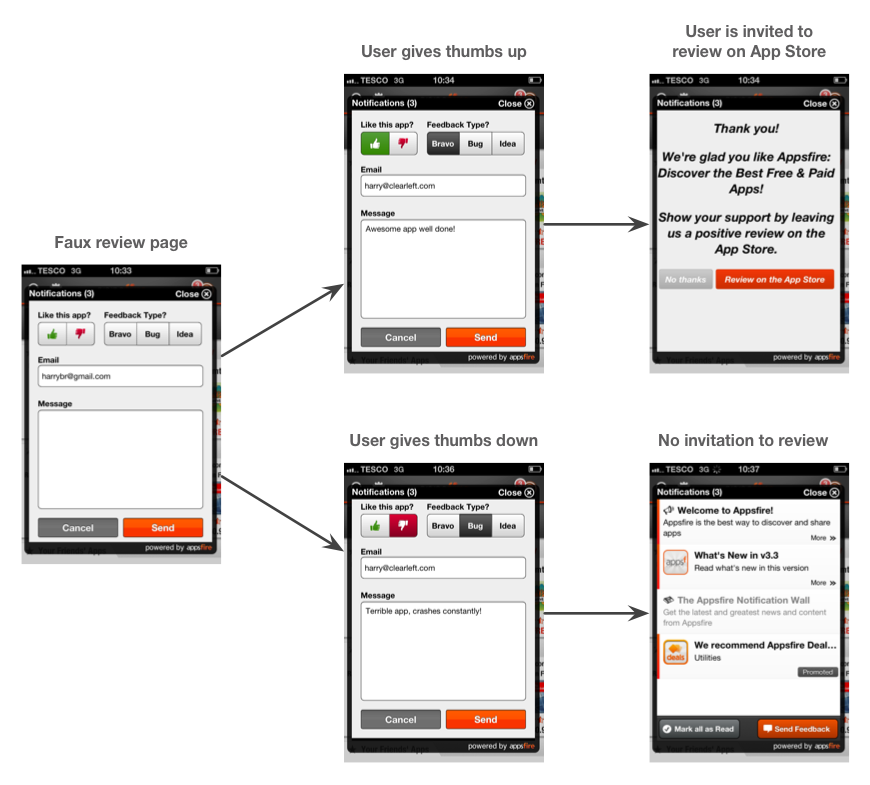
If the user taps the green thumbs up icon and submits the form, they are invited to leave an App Store review. If they tap the red thumbs down icon, what happens? Nothing. They are given no easy way to post-up their negative review. I don't think this is unethical. I don't know anyone who encourages unhappy customers to write reviews, on or off the app store.

"If you can find a subtle way to segment your users by their sentiment towards your app, you can then ask one of those segments to write reviews and not the other, thus skewing the ratings." It skews the ratings in your favor, deceiving future users about the actual quality of the app.

Not necessarily. Anyone who has had an app on the store knows that there are lots of reviews that are simply inaccurate. If unhappy users would contact the devs first, many "problems" can be easily solved.

For example, many people don't understand lots of apple's UI decisions that we take for granted. I had a user contact me and ask if our app did X. It does, I told him that, and he bought the app. Then I got an angry email saying it doesn't do that. (the thing was persisting data when "closing" the app with fast app switching.)

Well he thought all his apps were running constantly in the background draining battery so he force closed everything when he quit them. Obviously my app can't do the fast app switching persistant data if he force closes it. In no way does my app deserve an angry 1 star review when a simple email explanation can fix the problem.

Re: Manipulating App Store Reviews with Dark Patterns

#20
post #17

Hi there. This is ouriel co-founder of appsfire Thanks for the comments and interesting conversation. Here is a comment i just posted to the author of the post. I hope it brings some light on the situation. ==================================== i wanted to follow up on your note regarding app booster. First off App booster is a dialog system between the developer and the user. It includes a among other elements a simp…

Article author here.

It's true that Apple's App Store design encourages users to vent into reviews because it does not provide a straightforward way to contact the developers or raise a support ticket. This is bad and it really needs fixing.

However, your approach is not neutral. Let's just take a look at the logic (diagram from article):

http://www.90percentofeverything.com/wp-content/uploads/2012...

After a user submits positive feedback, they are invited to leave a review. After a user submits negative feedback, they are not invited to do so - only a highly motivated user would then bother to leave the app, find the entry in the App Store and write a review there. What's more, it's hard to say whether some users will even understand the difference between your internal feedback UI and the Apple App Store review UI. i.e. they might think that your feedback form posts into the App Store reviews area.

For the record, the article does not claim "this is evil" (as kgtm stated earlier). It simply states that the appsfire interface fits the definition of a dark pattern. Whether you think it's ethical or not, you have to agree that the UI is somewhat manipulative.

Post reply on HN