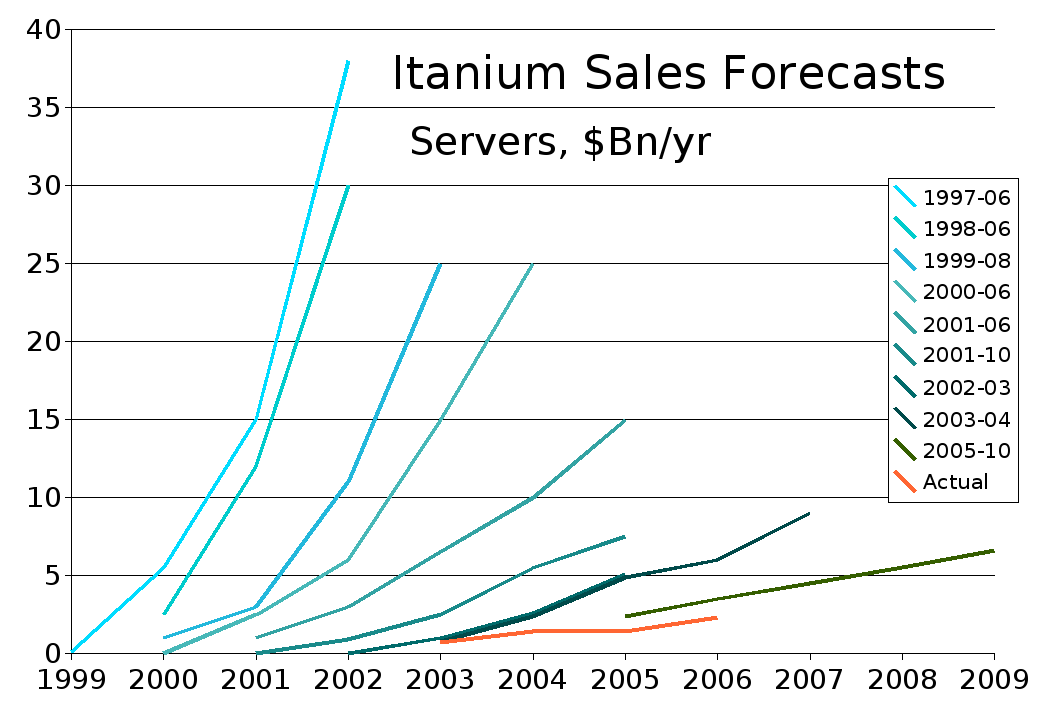
The Itanium sales forecasts never fail to make me laugh. Aged like the finest wine:
https://upload.wikimedia.org/wikipedia/commons/8/88/Itanium_...
11–20 of 220 posts
https://upload.wikimedia.org/wikipedia/commons/8/88/Itanium_...
The latest 9700 models from 2017 are still in support until 2025!
Earlier quoted context omitted.
2009 summary https://www.pcmag.com/article2/0,2817,2339629,00.asp > The failure of this chip to do anything more than exist as a niche processor sealed the fate of Intel—and perhaps the entire industry, since from 1997 to 2001 everyone waited for the messiah of chips to take us all to the next level. > It did that all right. It took us to the next level. But we didn't know that the next level was below us, not above.…
This piece sounds like a lot of misrepresentation and exaggeration.
The DEC Alpha architecture was planned for 25 years and it certainly was not technical barriers that killed the Alpha 21464.
It's funny thinking back to the hype cycle of Itanium back in the heady days where performance was doubling every year, desktop was king and this was the future . Turns out it was more like IBM's MCA / PS2 rather than the future. Compatibility and ubiquity wins. As nearly always.
Linus Torvalds in 2003: https://yarchive.net/comp/linux/x86.html
>Itanium 2 doesn't hold a candle to a P4 on any real-world benchmarks.
The Itanium sales forecasts never fail to make me laugh. Aged like the finest wine: https://upload.wikimedia.org/wikipedia/commons/8/88/Itanium_...
Statistics and modeling are complicated, granted. But when your model diverges from reality 5 years in a row, perhaps you should just extrapolate the current line next time around.
(In the case of the Itanic, that would have been the line at 0. Still a better forecast than what they did!)
The Itanium sales forecasts never fail to make me laugh. Aged like the finest wine: https://upload.wikimedia.org/wikipedia/commons/8/88/Itanium_...
On the one hand, I am not surprised -- at my workplace, we only ever had one Itanium system, an SGI Altix 3000-series computer. It was kind of niche even when we bought it, and core-for-core, the Itanium CPUs were slower than their competitors. What the SGI was really good at was MPI parallelism. I don't know how much of that was the CPU and how much was the overall system design of the Altix, which featured a pretty…
there's an altix 3000 on ebay that I'm kinda tempted by https://www.ebay.com/itm/174917876903
it only runs like one specific version of suse or red hat
Earlier quoted context omitted.
This piece sounds like a lot of misrepresentation and exaggeration.
Whether the DEC Alpha development stopped because of Merced (as it was called then) or because of the 1997 legal mess https://www.wired.com/1997/10/intel-dec-settle-alpha-chip-di... is quite hard to say. The DEC Alpha architecture was planned for 25 years and it certainly was not technical barriers that killed the Alpha 21464.