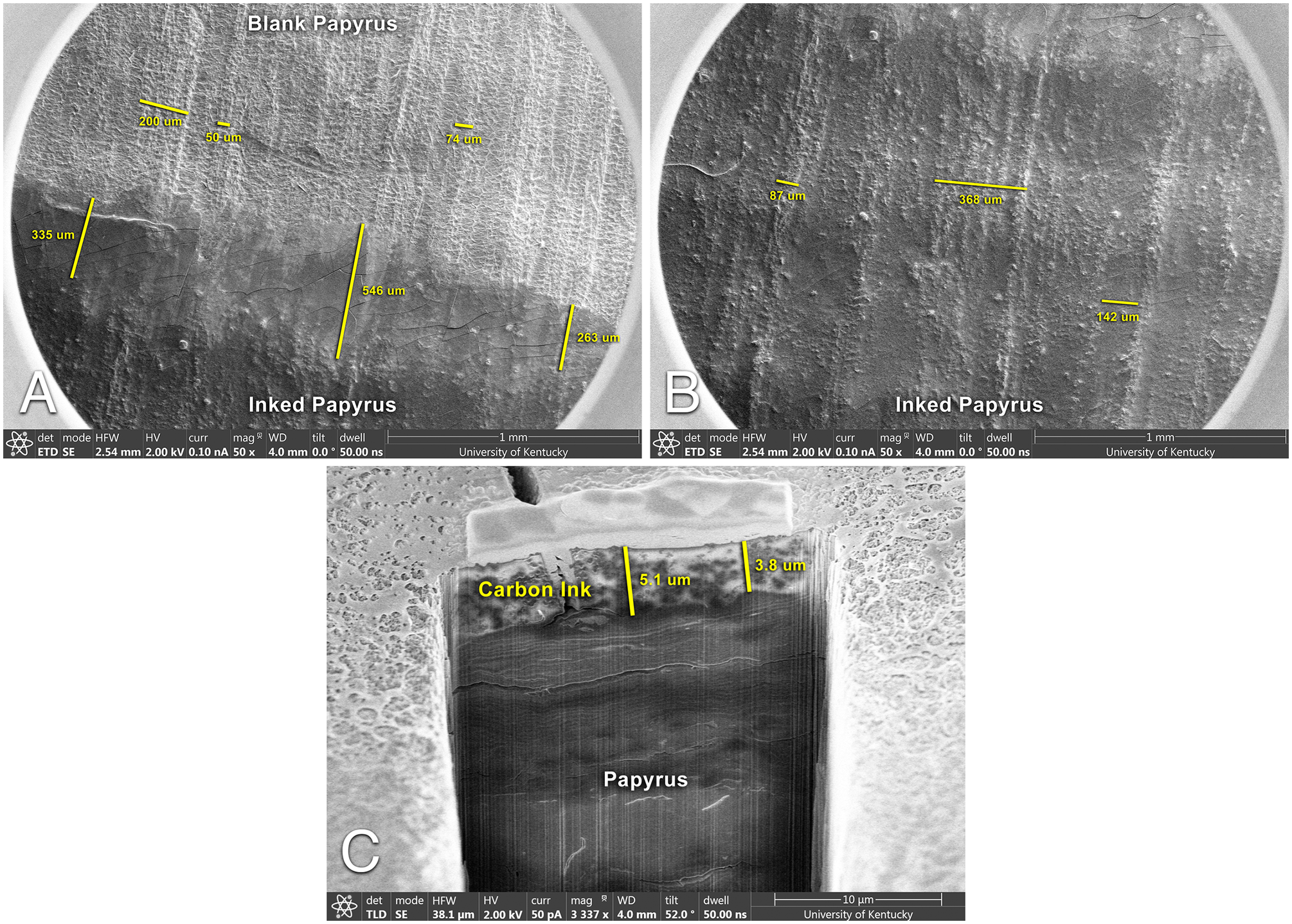
The lettering was found by looking for 'crackle' texture on papyrus segments from the CT scans which obviously were in the shape of Greek letters, and annotating those as training data. Unfortunately such crackle texture isn't visible, at least by eye, on most of the papyrus. Probably it's only that visible where the ink was very thick. You can easily see the difference in texture in this electron microscope image [1] (far higher resolution than the CT scans) but especially on the very edge of the inked area (the narrow strip in the left image; I think the whole right image is inked) where the ink was pushed to. I'm surprised the crackle was discovered only after the Kaggle Ink Detection contest. Looking at the CT-scanned fragments with infrared ground truths, which were used in the Kaggle contest, Casey Handmer wrote [2]:
> The ongoing apparent failure of deep-learning based ink detection based on the fragments indicated to me that direct inspection of the actual data would be more fruitful, as it has been here.
> ...
> I found similar “cracked mud” and “flake” textures corresponding to known character ink, but only for perhaps 10% of the known characters. It’s been a long day, I can probably find more on closer inspection, but that does make one wonder about automated ink detection and what that is seeing.
These new images are much better than I hoped for, but still only in one small area, so I'm still pessimistic about more than an odd sentence being readable.
[1] https://scrollprize.org/img/tutorials/sem.png
[2] https://caseyhandmer.wordpress.com/2023/08/05/reading-ancien...