Fun fact: Solar cells and the LEDs are the same element. If you wire up a solar cell like an LED, it glows dimly in infrared. QA uses this to diagnose dysfunctional wafers.
In the solar world they call it a blocking diode.
11–20 of 92 posts
Fun fact: Solar cells and the LEDs are the same element. If you wire up a solar cell like an LED, it glows dimly in infrared. QA uses this to diagnose dysfunctional wafers.
In the solar world they call it a blocking diode.
Earlier quoted context omitted.
Transistors! E.g. EPROM (memory type chip) is typically deleted by shining a uv light on the actual silicon die, through a uv transparent quartz window in the final packaged chip. edit: fixed EEPROM -> EPROM
That's not an EEPROM. That's an EPROM. The first E in EEPROM is ELECTRONIC - i.e. you use a voltage (or a control word) to indicate that you would like to erase the device. Also, EPROMs are extremely vintage. They were replaced by EEPROMs - the first of which came out in 1977. That's an... extremely vintage example.
And thanks for the info, I don't have direct experience dealing with EPROM and I had conflated EEPROM and EPROM together in my mind, but a quick google search quickly reveals my inadequate knowledge, which has now been updated, even if only good enough for trivia.
Earlier quoted context omitted.
Steve Mould had a video[1] about this a couple of years ago where he shows a small solar panel lighting up. [1]: https://www.youtube.com/watch?v=6WGKz2sUa0w
Is it possible to have a light / emw battery ?
Earlier quoted context omitted.
Transistors! E.g. EPROM (memory type chip) is typically deleted by shining a uv light on the actual silicon die, through a uv transparent quartz window in the final packaged chip. edit: fixed EEPROM -> EPROM
I read somewhere that some people used EPROMs and decaped Ram chips as digitizers for early computers.
Yeah I remember a friend of mine back around '90 wanted to try it out. I can't remember if it was using DRAM or EPROM memory though. I want to say it was called 'ramra' or 'ramera'.
Earlier quoted context omitted.
Steve Mould had a video[1] about this a couple of years ago where he shows a small solar panel lighting up. [1]: https://www.youtube.com/watch?v=6WGKz2sUa0w
Is it possible to have a light / emw battery ?
MEMS. Micro-electromagnetic systems. The most common MEMS I can think of is the comb sensor, used for accelerometers in all of your cell phones.
https://www.memsjournal.com/2010/12/motion-sensing-in-the-ip...
The MEMS sensor for an accelerometer is quite simple. Take the nearest comb and smack it against a desk: you'll notice that the comb vibrates in one direction. Now hook up two combs and interleave their teeth together so that they're barely touching. When they touch, an electrical signal is sent through them to sense when they touch.
Add differently sized teeth, the larger the spacing the more acceleration is needed before they activate. (EDIT: Looks like the iPhone MEMS uses capacitance... similar concept though, the capacitance changes based off of how far away these teeth are from each other and you can measure that using college-level electronics)
Finally, have these teeth rotated in all directions, so that you can sense all the directions in one little device.
--------
MEMS are about using the physical properties of object, but just making these small physical objects really, really, really tiny thanks to the magic of photolithography.
You can see this literal comb structure by looking at any accelerometer under a microscope: https://memsjournal.typepad.com/.a/6a00d8345225f869e20148c70...
------
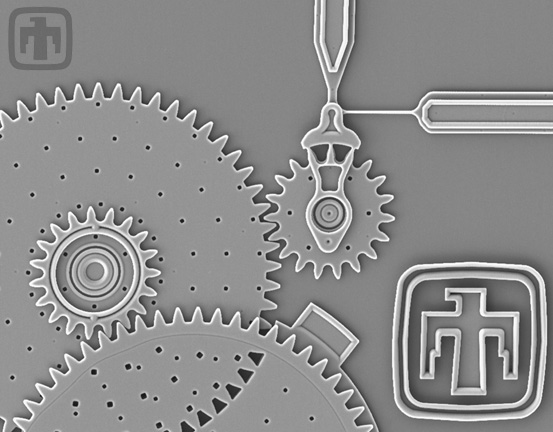
If the accelerometer is too difficult for you to understand, the "beginner MEMS" is gears.
https://www.sandia.gov/app/uploads/sites/145/2021/11/1-1.jpg
You can make any shape you want with modern chip-making tools. The "shape" most people want is a transistor (gate, drain, source). But in many ways, a teeny-tiny gear is simpler to think about.
The practical applications of micro-scale MEMS (gears, combs, springs, etc. etc. ) is somehow harder to think about than computers, so there aren't very many practical MEMS around. But still, practical MEMS help remind us that all of these chip-making tools exist in the real, physical world. Albeit at a very small scale.
Earlier quoted context omitted.
Transistors! E.g. EPROM (memory type chip) is typically deleted by shining a uv light on the actual silicon die, through a uv transparent quartz window in the final packaged chip. edit: fixed EEPROM -> EPROM
That's not an EEPROM. That's an EPROM. The first E in EEPROM is ELECTRONIC - i.e. you use a voltage (or a control word) to indicate that you would like to erase the device. Also, EPROMs are extremely vintage. They were replaced by EEPROMs - the first of which came out in 1977. That's an... extremely vintage example.
IIRC, EPROMs were still cheaper than EEPROMs for many years. EPROMs probably were sold in commercial quantities well into the 80s, and maybe used in the 90s.
EPROMs were erased by just throwing them into a UV-bin and blasting them with UV light. In contrast, EEPROMs needed transistors inside to handle the erasing cycle.
Finally, EPROM's last stand was as a low-cost one-time-programmable ROM (aka: PROM). All you had to do was make the same chip except without the expensive "window" (that'd normally receive UV-light for erasure).
Earlier quoted context omitted.
That's not an EEPROM. That's an EPROM. The first E in EEPROM is ELECTRONIC - i.e. you use a voltage (or a control word) to indicate that you would like to erase the device. Also, EPROMs are extremely vintage. They were replaced by EEPROMs - the first of which came out in 1977. That's an... extremely vintage example.
> Also, EPROMs are extremely vintage. They were replaced by EEPROMs - the first of which came out in 1977. That's an... extremely vintage example. IIRC, EPROMs were still cheaper than EEPROMs for many years. EPROMs probably were sold in commercial quantities well into the 80s, and maybe used in the 90s. EPROMs were erased by just throwing them into a UV-bin and blasting them with UV light. In contrast, EEPROMs needed…
Good overview, but he's missing one of the coolest applications of semiconductor / photolithography. MEMS. Micro-electromagnetic systems. The most common MEMS I can think of is the comb sensor, used for accelerometers in all of your cell phones. https://www.memsjournal.com/2010/12/motion-sensing-in-the-ip... The MEMS sensor for an accelerometer is quite simple. Take the nearest comb and smack it against a desk: you'l…
Fun fact: Solar cells and the LEDs are the same element. If you wire up a solar cell like an LED, it glows dimly in infrared. QA uses this to diagnose dysfunctional wafers.