“Artificial pancreas” = “Full Self Driving”? It offers guidance on insulin injection amounts. It doesn’t make insulin and doesn’t do any of the many other critical functions of the pancreas.
Yeah sadly that is what the marketing term means. Personally my bar would be fully automatic and insulin and glucagon at a a minimum.
Wearable device senses blood glucose and administers insulin accordingly
11–20 of 28 posts
Re: Wearable device senses blood glucose and administers insulin accordingly
#12Earlier quoted context omitted.
Insulin from animals have not been used for human injections in like 4 decades. We use synthetic insulin-like proteins these days. And they are produced typically by modified e-coli. This product does not produce insulin, like other insulin pumps it contains a reservoir of it.
Lol I had heard it was made by bacteria but not that that was e. coli :) It's weird to know that something we inject to save lives comes from poop :P And a bacteria that can actually cause severe illness itself! I wonder why they picked that specific bacteria? Maybe because it's one of the first known to man and as a result we know so much about it?
Anyway this was like mid 70s so there probably were no options.
Edit: I don't know anything about the benefits or issues with using e-coli specifically.
Re: Wearable device senses blood glucose and administers insulin accordingly
#13Earlier quoted context omitted.
Yeah sadly that is what the marketing term means. Personally my bar would be fully automatic and insulin and glucagon at a a minimum.
Interesting, I didn't know that Type 1 diabetes involved impaired glucagon regulation as well - the beta cells only really produce insulin and amylin, but from reading the wiki briefly there are knock-on effects in other areas. Cool stuff, hopefully the technology continues to improve and produce something resembling a true artificial pancreas soon, or maybe beta cell regeneration therapies.
Re: Wearable device senses blood glucose and administers insulin accordingly
#14They do, however, use a sensor that measures blood glucose (fairly accurately) and a controller that estimates how much insulin to give (very crudely).
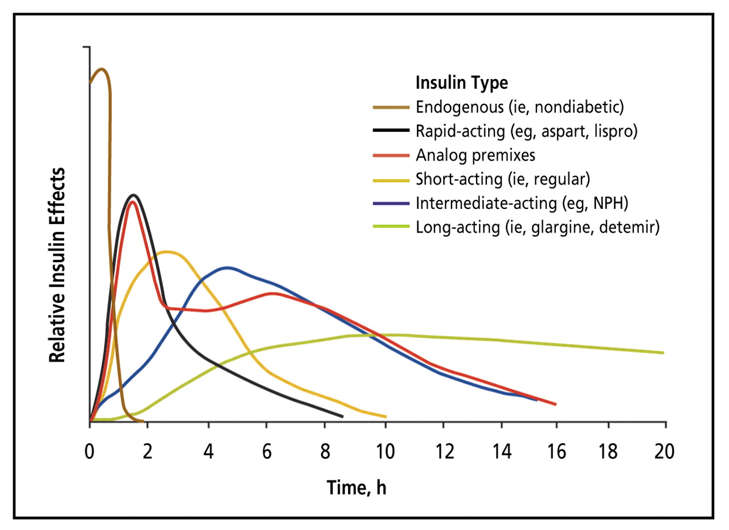
Maybe this seems unintuitive, but the bottleneck of these systems is not the hardware or the control algorithm, but rather the time it takes for the insulin to start "working" once injected.
In a normal situation, the pancreas secretes insulin directly into the hepatic portal vein and reaches peak concentration within minutes. When you inject insulin, depending on how good ($$$) it is, it can take anywhere from 2-4 hours to peak [1]. In technical terms, you have a closed loop controller with a very slow actuator, which severely limits how tight the control can be.
There is ongoing work to make faster insulins. But personally, I think the "cure" for type 1 diabetes will come from restoring the insulin-producing capabilities of pancreatic islets, or synthetically adding such capabilities to other highly vascularized tissues.
Also worth checking out is Tidepool, an organization trying to take an open source closed loop controller through FDA submission. https://www.tidepool.org/automated-insulin-dosing
[1] https://images.squarespace-cdn.com/content/v1/5b7c64af620b85...
Re: Wearable device senses blood glucose and administers insulin accordingly
#15It doesn't make insulin. Not a replacement for the pancreas yet. Insulin is a fantastically complicated molecule and costly to life to make. Cells in the pancreas have to be doubly sensitive to glucose. They have to make insulin from sensing glucose, and they are more easily damaged by glucose. https://en.wikipedia.org/wiki/Insulin_(medication) For now it takes the sacrifice of many animals to satisfy a diabetic. Wha…
Okay. Then why does it cost a fortune to get in the USA? Its just as simple as brewing wine is it? Well. I have my doubts.
Genetically modifying yeast to produce insulin is a little more difficult than brewing wine. Seriously, what are you on about? They haven't harvested insulin from animals since 1998. That's the last you could get it. They started using it in 1978... all that was a 2 minute Google search.
Re: Wearable device senses blood glucose and administers insulin accordingly
#16Re: Wearable device senses blood glucose and administers insulin accordingly
#17So what this article is talking about is, basically, taking the thing DIYers are already doing, and making a more foolproof, FDA-approval-grade version. And I'm sure they're massively better in terms of how fiddly they are to set up and get working, but the end result is actually worse; they wind up not including features like autotune (which auto-adjusts basals and carb ratio based on historical data), because there's less risk of liability if they make doctors do the tuning, even if the doctor is only looking at the patient's data once every six months and is doing a poor by-eye approximation of what the algorithm does.
Re: Wearable device senses blood glucose and administers insulin accordingly
#18Earlier quoted context omitted.
Insulin from animals have not been used for human injections in like 4 decades. We use synthetic insulin-like proteins these days. And they are produced typically by modified e-coli. This product does not produce insulin, like other insulin pumps it contains a reservoir of it.
Lol I had heard it was made by bacteria but not that that was e. coli :) It's weird to know that something we inject to save lives comes from poop :P And a bacteria that can actually cause severe illness itself! I wonder why they picked that specific bacteria? Maybe because it's one of the first known to man and as a result we know so much about it?
Bacteria have a neat feature where, in addition to their "main" chromosomal DNA, they also have small circular "loops" of DNA called plasmids that can be copied independently. In 1973, Cohen and Boyer demonstrated that one could "cut" a piece of DNA from one source, insert it into an E. coli plasmid, and then coax the cells into producing the protein coded for by the edited gene. This trick lets you generate "heterologous proteins" by purifying them from the cells or can change how the cell behaves.
E coli. can't make every kind of proteins, but they can make a lot of them. It's also cheap and easy to grow, so it's often the "default" approach.
Re: Wearable device senses blood glucose and administers insulin accordingly
#19Earlier quoted context omitted.
Yeah sadly that is what the marketing term means. Personally my bar would be fully automatic and insulin and glucagon at a a minimum.
Interesting, I didn't know that Type 1 diabetes involved impaired glucagon regulation as well - the beta cells only really produce insulin and amylin, but from reading the wiki briefly there are knock-on effects in other areas. Cool stuff, hopefully the technology continues to improve and produce something resembling a true artificial pancreas soon, or maybe beta cell regeneration therapies.
Re: Wearable device senses blood glucose and administers insulin accordingly
#20I'm a type 1 diabetic. None of the examples mentioned truly replace the endocrine functions of the pancreas lost in the disease progression. They do, however, use a sensor that measures blood glucose (fairly accurately) and a controller that estimates how much insulin to give (very crudely). Maybe this seems unintuitive, but the bottleneck of these systems is not the hardware or the control algorithm, but rather the…