Live data from Hacker News

A Chemical Hunger – Part V: Livestock Antibiotics

slimemoldtimemold.com

11–20 of 54 posts

Re: A Chemical Hunger – Part V: Livestock Antibiotics

#11
post #2

So livestock antibiotic use is correlated with obesity? I'm reminded of: https://www.tylervigen.com/spurious-correlations

Antibiotics are used in livestock for the specific purpose of causing weight gain in the livestock. The question is to what extent this causes weight gain in humans.

Re: A Chemical Hunger – Part V: Livestock Antibiotics

#12
I had never heard of slime mold time mold dot com until today, so I read back through the author's theories and I'm not convinced there's anything here.

His initial premise, that the cause of obesity is a mystery, doesn't seem to be that well-researched. Most importantly, he does not really poke holes in the basic premise that the cause is linked to increased availability of food in general coupled with more people living sedentary lifestyles. He even mentions that average daily caloric intake has gone up c. 400 kcal since the turn of the 20th century. Which, for someone with a maintenance-level diet, would cause a 35-45 lb. annual weight gain.

The antibiotic theory here doesn't seem to address the possibility of wealth and industrialization as a confounding variable. In fact, he doesn't seem to seriously address confounding variables anywhere in his analysis.

I don't assert that antibiotics in the food supply should not be considered harmful, but his vague hand-waving in the direction of a culprit for some great unknown mystery seems thin at best. I'd love to hear some competing takes.

Re: A Chemical Hunger – Part V: Livestock Antibiotics

#13
I think this author is not being very scientific. E.g. in part 2 he dismisses carbs as a cause of obesity, and he begins by citing a trial involving 16 people.

"A study from 2003 examined low-fat diets in 16 overweight people. Naturally, this low-fat diet was high in carbohydrates. When patients started the low-fat diet and were told to eat as much as they wanted, they actually ate 291 calories less per day."

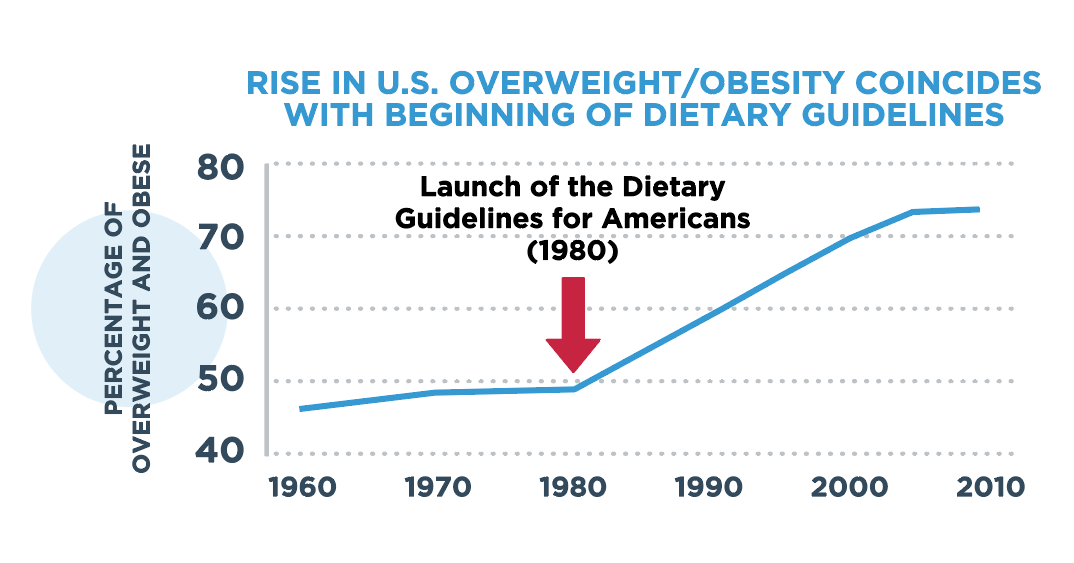
I think it is important to note that obesity skyrockets from 1980 on. The exact year the USDA began mandating a high carb diet. https://images.squarespace-cdn.com/content/v1/5a4d5666bff200...

I recommend listening to Garry Taub instead. He is a physicist. Nutrition scientists are literally not allowed to deviate from the official dietary fat causes obesity/lipid hypothesis. So it requires outsiders to get at the truth here.

Why We Get Fat: https://youtu.be/qKuDamgGkZQ

Big Fat Fiasco: https://youtu.be/exi7O1li_wA

Big Fat Nutrition Policy: https://youtu.be/hzQAHITIUhg

Edit: Carbs are sugar strung together. They are quickly chopped up and metabolized, raising your blood sugar level. To maintain homeostasis the liver responds with a squirt of Insulin. Insulin signals to your fat cells to start storing the excess sugar, which would otherwise poison you by hyperglycemia. In a normal high fat/ low carb diet, you feel full after eating, and your blood sugar returns to normal. At this point your fat cells can release those sugars back to the blood stream (to prevent hypOglycemia). But with a low fat diet your body doesn't get enough vitamins and minerals (most of which are fat soluble and removed, or made indigestiable without fat) so you stay hungry. You are forced to eat more of this high sugar food, which keeps your blood sugar high and prevents your fat cells from completing the second part of the fat/glucose cycle. So your fat cells swell and divide, making you bigger, and the bigger you are, the more nutrients your body demands. The obesity epidemic began in 1980 when the USDA began dictating a high carb diet.

There are dozens of trials involving 10s of thousands of people going back 70 years that show a clear trend of carbs causing obesity in the West. I say West because it also clear that there is a genetic component involved in the carbs/fat cycle or insuline response. Which may explain why one isolated community can consume a lot of carbs from root veg and stay lean.

Re: A Chemical Hunger – Part V: Livestock Antibiotics

#14

I had never heard of slime mold time mold dot com until today, so I read back through the author's theories and I'm not convinced there's anything here. His initial premise, that the cause of obesity is a mystery, doesn't seem to be that well-researched. Most importantly, he does not really poke holes in the basic premise that the cause is linked to increased availability of food in general coupled with more people l…

I agree with you on the first point, however, the sedentary lifestyle hypothesis is also out. It's part of the same f Fat Lazy Slob theory that always blames the people for their lifestyle choices. What do they tell you to do build up an appetite? Exercise. Exercise makes you hungry, and if you try to cure that hunger with low nutrient carbs then you will end up obese and malnourished.

Re: A Chemical Hunger – Part V: Livestock Antibiotics

#15

I think this author is not being very scientific. E.g. in part 2 he dismisses carbs as a cause of obesity, and he begins by citing a trial involving 16 people. "A study from 2003 examined low-fat diets in 16 overweight people. Naturally, this low-fat diet was high in carbohydrates. When patients started the low-fat diet and were told to eat as much as they wanted, they actually ate 291 calories less per day." I think…

> E.g. in part 2 he dismisses carbs as a cause of obesity, and he begins by citing a trial involving 16 people.

The author starts with that, but they continue with other arguments as well. Particularly, they bring evidence of entire cultures consuming a diet made almost exclusively of carbs who have near 0% obesity - quite powerful proof that carbs themselves are not a direct cause of obesity.

Re: A Chemical Hunger – Part V: Livestock Antibiotics

#16

I had never heard of slime mold time mold dot com until today, so I read back through the author's theories and I'm not convinced there's anything here. His initial premise, that the cause of obesity is a mystery, doesn't seem to be that well-researched. Most importantly, he does not really poke holes in the basic premise that the cause is linked to increased availability of food in general coupled with more people l…

> He even mentions that average daily caloric intake has gone up c. 400 kcal since the turn of the 20th century. Which, for someone with a maintenance-level diet, would cause a 35-45 lb. annual weight gain.

That's one data point, but they also show that caloric intake has been decreasing since 2010 and yet obesity is still increasing. They also mention that the 400 Cal figure is based on consumption in the 1960s-70s vs today, but that there are reasons to believe that at the turn of the century consumption would have been higher than that. Also, observing that people are eating more just begs the question: why are they eating more today than they need, when they weren't dong this in the past?

> Most importantly, he does not really poke holes in the basic premise that the cause is linked to increased availability of food in general coupled with more people living sedentary lifestyles.

Except that people are exercising on average more today than in 2010 or 1990, and more than office workers in 1950, and still obesity is going up. Similarly for availability of food. Also, none of your observations address the bizarre correlation between obesity and altitude for example.

> The antibiotic theory here doesn't seem to address the possibility of wealth and industrialization as a confounding variable. In fact, he doesn't seem to seriously address confounding variables anywhere in his analysis.

Industrialization and wealth are not direct causes of obesity - people don't eat money or factories. If people in countries A and B are eating the same amount and composition on average, but country A is wealthy and industrial and country B is poor and rural, and country A has higher average BMI than country B, then you should exactly start looking at some environmental causes for the difference.

Edit to add:

> Which, for someone with a maintenance-level diet, would cause a 35-45 lb. annual weight gain.

This is nonsense - there is no way to predict weight gain based on calorie intake - variance between people is too huge on this metric - individual BMR alone varies between 1000 kcal/day up to 2500 kcal/day.
Re: A Chemical Hunger – Part V: Livestock Antibiotics

#17

I think this author is not being very scientific. E.g. in part 2 he dismisses carbs as a cause of obesity, and he begins by citing a trial involving 16 people. "A study from 2003 examined low-fat diets in 16 overweight people. Naturally, this low-fat diet was high in carbohydrates. When patients started the low-fat diet and were told to eat as much as they wanted, they actually ate 291 calories less per day." I think…

> E.g. in part 2 he dismisses carbs as a cause of obesity, and he begins by citing a trial involving 16 people. The author starts with that, but they continue with other arguments as well. Particularly, they bring evidence of entire cultures consuming a diet made almost exclusively of carbs who have near 0% obesity - quite powerful proof that carbs themselves are not a direct cause of obesity.

we also should be careful extrapolating a universally optimal diet from what seems to work best for one genetically homogeneous group. There of been studies that indicate that Indian and farther eastern Asian populations have a sequence that allows better utilization of bean and pea protein.

Re: A Chemical Hunger – Part V: Livestock Antibiotics

#18

Earlier quoted context omitted.

> E.g. in part 2 he dismisses carbs as a cause of obesity, and he begins by citing a trial involving 16 people. The author starts with that, but they continue with other arguments as well. Particularly, they bring evidence of entire cultures consuming a diet made almost exclusively of carbs who have near 0% obesity - quite powerful proof that carbs themselves are not a direct cause of obesity.

we also should be careful extrapolating a universally optimal diet from what seems to work best for one genetically homogeneous group. There of been studies that indicate that Indian and farther eastern Asian populations have a sequence that allows better utilization of bean and pea protein.

Sure, but still people from these places tend to get fat at similar rates to locals when moving to other countries, after some time.

Re: A Chemical Hunger – Part V: Livestock Antibiotics

#19

Earlier quoted context omitted.

we also should be careful extrapolating a universally optimal diet from what seems to work best for one genetically homogeneous group. There of been studies that indicate that Indian and farther eastern Asian populations have a sequence that allows better utilization of bean and pea protein.

Sure, but still people from these places tend to get fat at similar rates to locals when moving to other countries, after some time.

That does seem interesting. To be aure we should introduce antibiotics into their food supply... I know for myself, eating potatoes doesn't lead to weight gain like grain flours. My hypothesis is either fiber level or the presence of water in the potatoes as opposed to dry starches. I think a chemical source is also likely. It could also be a chemical we aren't getting anymore instead of one we are only now exposed to.

Re: A Chemical Hunger – Part V: Livestock Antibiotics

#20
How does his theory explain why the UK has the most overweight people in Europe but still relatively low antibiotics use? And, yes, Swedes and Norwegians (who are from countries which banned antibiotics use a long time ago) are lean for Europeans but internationally we are still pretty fat. I am all for banning casual antibiotics use in animals (which my country has done a long time ago) but I do not buy this theory since it does not match the evidence very well.

https://ourworldindata.org/grapher/antibiotic-use-in-livesto...

Post reply on HN