Earlier quoted context omitted.
There certainly is some conceptual overlap in defining an experience/decision making process as a directional graph. However, to my limited knowledge of this, BPMN doesn't quite differentiate between its activities in terms of "does this need user interaction" vs "process this thing". In our case, we have pane nodes for the "need user interaction" activity and processor nodes for the "process this thing" activity.
> BPMN doesn't quite differentiate between its activities in terms of "does this need user interaction" vs "process this thing". User interaction is a distinct BPMN Activity Type, so BPMN can make this distinction quite unambiguously. Concrete BPMN implementations, IIRC, use varying amounts of the spec and have varying degrees to which Activity types are functionally rather than merely visual distinguished, so a part…
A New Architecture for Plaid Link: Server-Driven UI with Directed Graphs
11–20 of 27 posts
Re: A New Architecture for Plaid Link: Server-Driven UI with Directed Graphs
#12Hi folks — author/engineer here. Happy to answer any questions about this system!
1. How you implemented this on the backend? Did you consider using something like Temporal, AWS Simple Workflow, or AWS Step Functions?
2. Interested in how you're avoiding (waiting) on network calls on each action. You mentioned it was coming in next post.
3. How are you managing multiple workflows? Does a common child graph make sense for a common workflow?
Re: A New Architecture for Plaid Link: Server-Driven UI with Directed Graphs
#13Re: A New Architecture for Plaid Link: Server-Driven UI with Directed Graphs
#14Hi folks — author/engineer here. Happy to answer any questions about this system!
Would be interested in: 1. How you implemented this on the backend? Did you consider using something like Temporal, AWS Simple Workflow, or AWS Step Functions? 2. Interested in how you're avoiding (waiting) on network calls on each action. You mentioned it was coming in next post. 3. How are you managing multiple workflows? Does a common child graph make sense for a common workflow?
Given this already a major change in our clientserver interaction model and that we didn't want to _fully_ rewrite the entire world, we didn't consider additional major changes to our existing backend services strategy (Go services + RPC) as part of this project. We had a bunch of backend logic and common code we wanted to reuse across Flex Link and the legacy endpoints, which gives us a stepwise mechanism for future refactors once the old APIs are turned down.
Once this rolls out to 100%, the new API boundaries do allow us to refactor the backend into something more like you suggest — leveraging step functions, lambdas etc if desired.
> 2. Interested in how you're avoiding (waiting) on network calls on each action. You mentioned it was coming in next post.
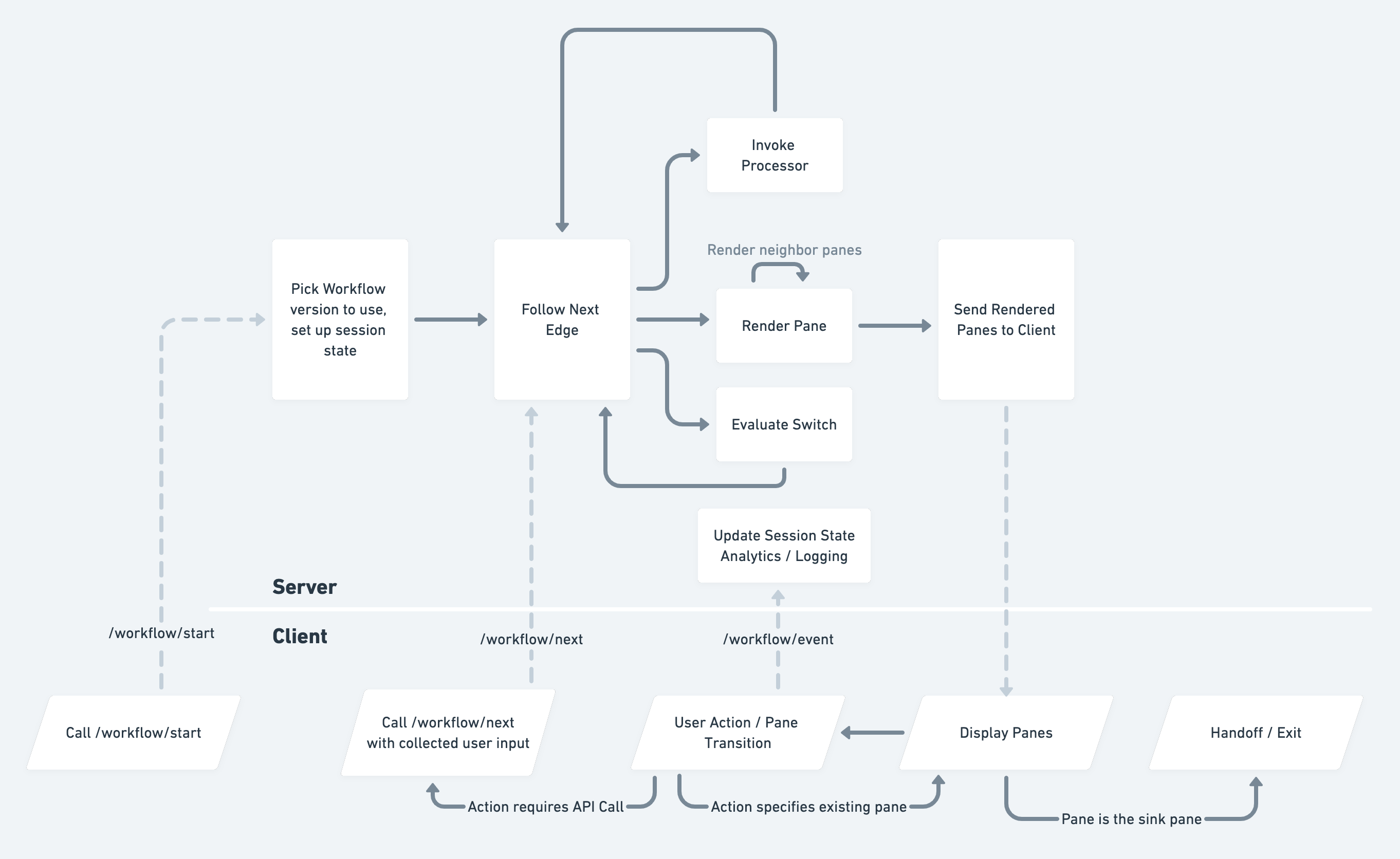
Yes! Full details of that would take a dedicated post. However, if you look at the "Client Rendering Loop" diagram in the post ( https://images.ctfassets.net/zucqsg1ttqqy/5kp6LibAllW1YW69jT... ) you'll see there is a "render neighbor panes" loop in the flow. At the point where we've walked the graph and encountered a pane, we can do a quick breadth-first-search to render out neighboring panes (that don't have a processor in between) and serve those all to the SDK. We all them "additional panes". The response includes a map from "action" to "additional pane" so the SDK can know whether to hit the API or use an already-provided additional pane. (this is in the diagram as well)
The nice part is, clients don't _have_ to implement this functionality. They can always hit the server each time they want the next pane. But as a performance optimization they can leverage the additional panes to render many things locally.
> 3. How are you managing multiple workflows? Does a common child graph make sense for a common workflow?
We use the expanded semantic versioning in the post for teams to have their own versioned workflow namespace. On the `workflow/start` call, we have a dispatcher that can pick which workflow to serve based on the provided configuration, SDK version, platform, experiments, etc.
We don't yet support subgraphs for common chunks of a workflow but it is definitely in our roadmap and would allow teams to share common pieces of the graph.
Re: A New Architecture for Plaid Link: Server-Driven UI with Directed Graphs
#15Earlier quoted context omitted.
Would be interested in: 1. How you implemented this on the backend? Did you consider using something like Temporal, AWS Simple Workflow, or AWS Step Functions? 2. Interested in how you're avoiding (waiting) on network calls on each action. You mentioned it was coming in next post. 3. How are you managing multiple workflows? Does a common child graph make sense for a common workflow?
> 1. How you implemented this on the backend? Did you consider using something like Temporal, AWS Simple Workflow, or AWS Step Functions? Given this already a major change in our client server interaction model and that we didn't want to _fully_ rewrite the entire world, we didn't consider additional major changes to our existing backend services strategy (Go services + RPC) as part of this project. We had a bunch of…
How is session state kept? Is /event required (as data would be sent in /next?).
Also as I understand, Processors won't be involved until they are needed. E.g. if we have 2 panes but only the result of the first was required to be processed, would the processor be invoked after just the first pane was complete?
Re: A New Architecture for Plaid Link: Server-Driven UI with Directed Graphs
#16Ooo Plaid.. so advanced, so intuitive, much tech! So how come going to production with you is a three month process involving endless spreadsheets and email exchanges? not at all as presented on website. You've left your onboarding / compliance team behind while focusing on the cool stuff.
Can you send me an email: jgreze plaid.com -- I'll see what I can do to help. For the vast majority of cases onboarding should be self-serve until you hit a certain level of scale, so I'd love to understand what's happening here and what we can do better. (VPEng at Plaid)
Re: A New Architecture for Plaid Link: Server-Driven UI with Directed Graphs
#17Hi folks — author/engineer here. Happy to answer any questions about this system!
Re: A New Architecture for Plaid Link: Server-Driven UI with Directed Graphs
#18Ooo Plaid.. so advanced, so intuitive, much tech! So how come going to production with you is a three month process involving endless spreadsheets and email exchanges? not at all as presented on website. You've left your onboarding / compliance team behind while focusing on the cool stuff.
Our team will be gearing up for this soon, any additional details you can share?
Security - policies, architecture, breach procedures, external review, GDPR compliance, hosting structure, cryptography.
Compliance - proove registration with different compliance bodies, proof of insurance (professional indemnity AND cyber), AML measures, KYC measures, proof of purchase of monitoring systems..
Identity - provide information on ALL directors and shareholdeing structure, provide proof of address and identity of 2 of them, name a company signatory and provide proof of identity and address for him as well.
And more and more... took us 2 months just to compile all the information in endless back-and-forth email conversations.
Re: A New Architecture for Plaid Link: Server-Driven UI with Directed Graphs
#19Earlier quoted context omitted.
> 1. How you implemented this on the backend? Did you consider using something like Temporal, AWS Simple Workflow, or AWS Step Functions? Given this already a major change in our client server interaction model and that we didn't want to _fully_ rewrite the entire world, we didn't consider additional major changes to our existing backend services strategy (Go services + RPC) as part of this project. We had a bunch of…
Thanks for the answers. How is session state kept? Is /event required (as data would be sent in /next?). Also as I understand, Processors won't be involved until they are needed. E.g. if we have 2 panes but only the result of the first was required to be processed, would the processor be invoked after just the first pane was complete?
> How is session state kept?
It's kept as encrypted blobs in redis that times out after some amount of inactivity (to clean up stale sessions)
> Is /event required (as data would be sent in /next?).
Nope! Not necessarily required — although there are some features (client side event tracking, location-in-graph updates on the backend) that benefit from it. We've hooked it up but no feature currently _depends_ on it being called.
> Also as I understand, Processors won't be involved until they are needed. E.g. if we have 2 panes but only the result of the first was required to be processed, would the processor be invoked after just the first pane was complete?
This is true — processors are only invoked as needed. In other words, they are only invoked if the user is traversing an edge that touches a processor. When a processor is invoked depends completely on its location within the graph. The diagram I linked to above in this thread has a stage for "invoke processor" that's only triggered if the backend walks an edge and sees a processor.
There is actually no strict correlation between a pane and a processor. Each can have any pieces of session state they want as input or output. In other words a processor declares "I want Foo ID as my input" not "I want the output of Bar Pane as my input". This helps composability.
Re: A New Architecture for Plaid Link: Server-Driven UI with Directed Graphs
#20Earlier quoted context omitted.
Can you send me an email: jgreze plaid.com -- I'll see what I can do to help. For the vast majority of cases onboarding should be self-serve until you hit a certain level of scale, so I'd love to understand what's happening here and what we can do better. (VPEng at Plaid)
That is absolutely not true. only thing that's self-registration is development access which is limited to 100 customer connections. Going to production requires submitting a ticket which is picked up a person that transmits requirements from compliance team.
You have my email, and if you reach out I can see what I can do to help. Best.