Live data from Hacker News

Stock Market Returns Are Anything but Average

awealthofcommonsense.com

11–20 of 433 posts

Re: Stock Market Returns Are Anything but Average

#11
The author falls for the "past equals future" fallacy.

    The only way to truly take the randomness
    out of the stock market is to have a
    multi-decade time horizon.
He says so after looking at the data of a few decades. That makes no sense. It is like looking at 3 people and saying "People come in groups no larger than 3".

The whole article is based on that premise. He has something like 90 data points and assumes the next 90 data points will be alike.

Is it possible the next 10 years will have a negative return? This is a very interesting question. But I doubt we can answer it by looking at historical returns. We need to look at the actual situation. What would have to happen in the world so we see negative returns? War? A natural desaster? Who says war and natural desasters cannot throw us back 100 years? 1000? 10000?
Re: Stock Market Returns Are Anything but Average

#12
post #5
post #2

I mean, just look at last year, when the S&P 500 index plunged over 30%, then proceeded to nearly double from then until now, in the midst of a global pandemic that froze big chunks of the world economy. Stock market returns make no sense.

Instead of seeing as high returns, you can also look at it as money losing value due to excessive printing of last year.

Except measuring the value of money as something other than the ability to provide consumption (the ability to buy things you consume, rather than investments) doesn't make sense, regardless of how fashionable it is on this site to throw around the term "asset inflation".

Re: Stock Market Returns Are Anything but Average

#13
post #2

I mean, just look at last year, when the S&P 500 index plunged over 30%, then proceeded to nearly double from then until now, in the midst of a global pandemic that froze big chunks of the world economy. Stock market returns make no sense.

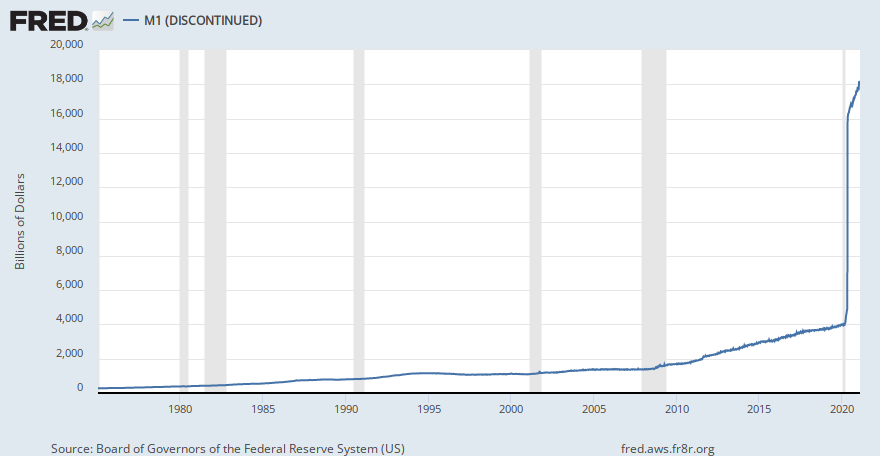
More like the value of the dollar has roughly halved due to record money-printing and this is reflected in capital assets firsts.

https://fred.stlouisfed.org/graph/fredgraph.png?width=880&he...

MMT apologists are the modern day petit bourgeois. Trust the experts!

Re: Stock Market Returns Are Anything but Average

#14

The author falls for the "past equals future" fallacy. The only way to truly take the randomness out of the stock market is to have a multi-decade time horizon. He says so after looking at the data of a few decades. That makes no sense. It is like looking at 3 people and saying "People come in groups no larger than 3". The whole article is based on that premise. He has something like 90 data points and assumes the ne…

I mean yes, past performance doesn't guarantee future results. But it does waggle its eyebrows suggestively at it, when you have a phenomenon that's gone unchallenged for probably a hundred years now. It isn't guaranteed. But nobody's lost their shirt betting it'll continue yet.

People always bring up Japan in these discussions, of course. The Nikkei 225 peaked on 29 December 1989, still only at half that value over 30 years later.

Re: Stock Market Returns Are Anything but Average

#15
post #6

There are all sorts of interesting facts you can pull out of this, like how if you missed the top 10 best days in the market from 1999-2019, your return was cut in half. If you missed the top 20 best days, you actually lost money: https://www.fool.com/investing/2019/04/11/what-happens-when-... Basically never mistake annualized return over a long period of time for your expected return in a given year (or day, etc).…

> It's likely to be a "picking up pennies in front of a steamroller" type trade.

What does that mean?

Re: Stock Market Returns Are Anything but Average

#16
post #6

There are all sorts of interesting facts you can pull out of this, like how if you missed the top 10 best days in the market from 1999-2019, your return was cut in half. If you missed the top 20 best days, you actually lost money: https://www.fool.com/investing/2019/04/11/what-happens-when-... Basically never mistake annualized return over a long period of time for your expected return in a given year (or day, etc).…

> It's likely to be a "picking up pennies in front of a steamroller" type trade. What does that mean?

I think it means doing something high risk for low reward.

Re: Stock Market Returns Are Anything but Average

#17
post #5

Earlier quoted context omitted.

Instead of seeing as high returns, you can also look at it as money losing value due to excessive printing of last year.

Except measuring the value of money as something other than the ability to provide consumption (the ability to buy things you consume, rather than investments) doesn't make sense, regardless of how fashionable it is on this site to throw around the term "asset inflation".

Actually, measuring the value of money as something other than the measuring stick to compare capital assets doesn’t make sense, regardless of how fashionable it is to defend money printing by verysmart internet economists.

See what I did there? It’s not an argument.

Re: Stock Market Returns Are Anything but Average

#18
For that 2nd graph, he chose buckets that are uniquely poorly suited to evaluating his statement about whether returns tend toward 10%.

It looks to me like, if he had instead made them (5%)-5%, 5%-15%, 15%-25%, etc., then the mode would indeed have been the 5-15% bracket.

Re: Stock Market Returns Are Anything but Average

#19

The author falls for the "past equals future" fallacy. The only way to truly take the randomness out of the stock market is to have a multi-decade time horizon. He says so after looking at the data of a few decades. That makes no sense. It is like looking at 3 people and saying "People come in groups no larger than 3". The whole article is based on that premise. He has something like 90 data points and assumes the ne…

> the data of a few decades.

1926-2020 is 95 years. Calling that "a few decades" is downplaying it. I'd say it is safe to take 95 years and from that extrapolate a 30 year future with wide margins. In your analogy: looking at 95 people and saying "the average group size is between 2 and 5".

> ... 90 data points and assumes the next 90 data points will be alike.

Are we reading the same article? I don't see it predicting anything 90-points forward. Even the predictions for 30 points forward are very much on the safe side: merely a caution and establishment of a (well-known) generalism. A conclusion in that article:

> don’t know if the next 30 years will be this kind to investors in U.S. stocks. You could make the case investors should reduce their expectations going forward.

> But if those lower expectations turn out to be correct this makes thinking and acting for the long-term even more important than ever.

Re: Stock Market Returns Are Anything but Average

#20
post #6

There are all sorts of interesting facts you can pull out of this, like how if you missed the top 10 best days in the market from 1999-2019, your return was cut in half. If you missed the top 20 best days, you actually lost money: https://www.fool.com/investing/2019/04/11/what-happens-when-... Basically never mistake annualized return over a long period of time for your expected return in a given year (or day, etc).…

> It's likely to be a "picking up pennies in front of a steamroller" type trade. What does that mean?

Think of a slowly advancing steamroller, with pennies scattered before it. You can run around picking up these pennies, for small but consistent gain over a long period of time. Just don't take your eye off the steamroller!

The canonical example in recent times is the XIV blowup of 2018, which inversed VIX (a security tracking market volatility). So if you held XIV you basically bet that large market moves wouldn't happen - you're shorting volatility. Take a look at the graph to see how that ended up; the steamroller caught up to them! https://www.rcmalternatives.com/2018/02/why-did-xiv-implode/

Post reply on HN