Live data from Hacker News

Effective Property-Based Testing

blog.auxon.io

11–20 of 36 posts

Re: Effective Property-Based Testing

#11
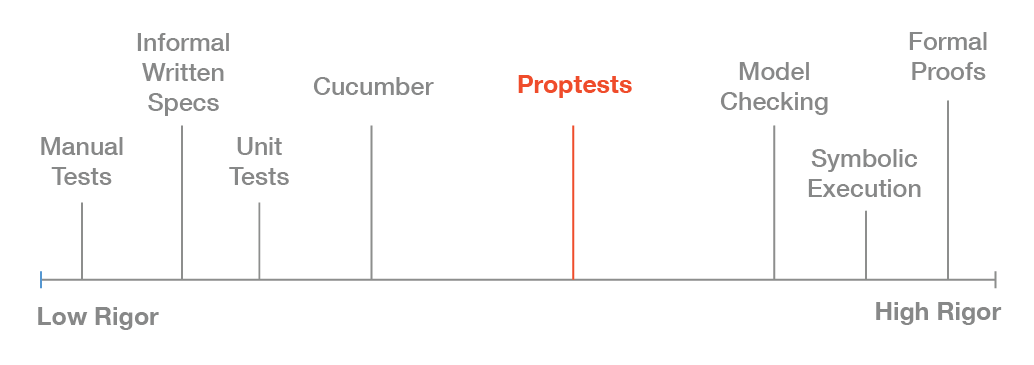
Does anyone have any thoughts on the graphic showing the spectrum of testing options listed in the article (or additional resources that cover at a high-level this topic of understanding range of testing options)?

link to the graphic for ease of reference:

https://blog.auxon.io/images/posts/effective-property-based-...

Re: Effective Property-Based Testing

#13

Property testing is awesome, but it does significantly slow down test suites. Are there any standard practices for striking a balance of getting the added confidence/safety of using property tests without introducing large delays into your CI pipeline?

Item 5 in TFA is one that I found related to performance most. Using filters to toss out bad input means you're potentially generating thousands of inputs for dozens of tests. Aggregate this across all your tests and it's an incredible waste of time. Constructing proper inputs directly can get you closer to the minimum time required to execute the tests and help achieve that desired performance threshold. (NB: Not used professionally, only got one office to even entertain them but they wouldn't take it and run with it even after I showed them a dozen errors I'd found in an hour of using them. Consequently my experience is still limited.)

Re: Effective Property-Based Testing

#14
Brilliant article.

If I were to add just one thing to the list: metatest. Write a test that asserts that your generated test cases are "sufficiently comprehensive", for whatever value of "sufficiently" you need. In an impure language, this is as easy as having the generator contain a mutable counter for "number of test cases meeting X condition" for whatever conditions you're interested in. For example, say your property is "A iff B". You might want to fail the test if fewer than 10% of the generated cases actually had A or B hold. (And then, of course, make sure your generators are such that - say - A and B hold 50% of the time; you want an astronomically small chance of random metatest failure.)

(I did a brief intro to this in the Metatesting section of a talk I did two years ago: https://github.com/Smaug123/talks/blob/master/DogeConf2019/D... . On rereading it now, I see there's a typo on the "bounded even integers" slide, where the final `someInts` should read `evenIntegers`.)

Re: Effective Property-Based Testing

#15
post #6

Property testing is awesome, but it does significantly slow down test suites. Are there any standard practices for striking a balance of getting the added confidence/safety of using property tests without introducing large delays into your CI pipeline?

We like to run the tests as part of CI with a relatively small number of iterations, and then turn the knob way up in a nightly or weekly scheduled test job.

Yup. We've got some stuff set up so that in the IDE your tests finish in ~100ms; in precommit testing pipelines you get several seconds; in nightly tests you get two hours.

Re: Effective Property-Based Testing

#16
I would like to make a shout out to quickcheck (Haskell, https://hackage.haskell.org/package/QuickCheck) as it was my first introduction to property based testing and has since let me to use property based testing everywhere in the last 10 years. Then there is scalacheck (https://www.scalacheck.org/). Both let you write your own generators and are quite good at shrinking down to minimal use cases.

The suggestion elsewhere in this thread to decrease the number of iterations during normal testing and crank it up during nightlies is also good.

The only thing I’m still missing from the libraries is a convenient mechanism of remembering previously failing generated inputs and use them as a static list of testcases next to the at runtime generated ones like a regression test of sorts.

Edit: typos

Re: Effective Property-Based Testing

#17
post #16

I would like to make a shout out to quickcheck (Haskell, https://hackage.haskell.org/package/QuickCheck ) as it was my first introduction to property based testing and has since let me to use property based testing everywhere in the last 10 years. Then there is scalacheck ( https://www.scalacheck.org/ ). Both let you write your own generators and are quite good at shrinking down to minimal use cases. The suggestion e…

Indeed. It's an unfortunate general omission in the ecosystem. It's one of the things that our product does (in its appropriation from different inspirations like MC, PBT, SBFL, etc., but we move things up to assessing systems rather than programs) where contradictions and counter-examples are curated specifically for making it easier to reuse them. They're provided back to the user as executable "properties" in our DSL to apply to past, present, future data.

disclaimer: Auxon co-founder

Also, big (h/t) to Quickcheck from me as well. Getting into it via Erlang many, many years ago was among the more impactful and transformative developments in my approach to thinking about improving software quality.
Re: Effective Property-Based Testing

#19
post #16

I would like to make a shout out to quickcheck (Haskell, https://hackage.haskell.org/package/QuickCheck ) as it was my first introduction to property based testing and has since let me to use property based testing everywhere in the last 10 years. Then there is scalacheck ( https://www.scalacheck.org/ ). Both let you write your own generators and are quite good at shrinking down to minimal use cases. The suggestion e…

Indeed. It's an unfortunate general omission in the ecosystem. It's one of the things that our product does (in its appropriation from different inspirations like MC, PBT, SBFL, etc., but we move things up to assessing systems rather than programs) where contradictions and counter-examples are curated specifically for making it easier to reuse them. They're provided back to the user as executable "properties" in our…

In the article you (auxon) wrote to avoid using type based generators and unbounded collections and instead write your own generators. Usually I find it more convenient to write filters on the generated types then create my own generators. As the post mentions, this can lead to many discarded inputs. Have you ever considered how we could use the predicates in the filters to create Specialized generators that only generate inputs that will be accepted by the filter? You probably need some meta programming or reification of the predicates for that to work.

Re: Effective Property-Based Testing

#20
This is a good overview of property based testing but the mentions of Cucumber threw me off.

In my job Cucumber seems to add little more than just commenting and sequencing functions, tasks that are better suited to your programming language of choice, while adding overhead and complexity.

What am I missing?

Post reply on HN