I like how the main objection would be instantly nullified if Amazon paid their workers more. Do you think a union would be able to negotiate for more than $500 of extra compensation?
Amazon's anti-union site for its Alabama warehouse
11–20 of 204 posts
Re: Amazon's anti-union site for its Alabama warehouse
#12[deleted]
Re: Amazon's anti-union site for its Alabama warehouse
#13Maybe if we WRITE IN ALL CAPS it will SOUND MORE PERSUASIVE.
Re: Amazon's anti-union site for its Alabama warehouse
#14I like how the main objection would be instantly nullified if Amazon paid their workers more. Do you think a union would be able to negotiate for more than $500 of extra compensation?
I honestly am skeptical. AMZN already pays more than other small businesses and even medium/large businesses. It doesn't make money by paying its workers less - it makes money with efficiency and volume.
Alabama is a right-to-work state. My understanding is that it would be completely legal for Amazon to hire new employees the second someone doesn't show up because of a strike, so I'm not sure their leverage.
These workers are probably making between 30k and 50k a year so $500 isn't nothing.
Re: Amazon's anti-union site for its Alabama warehouse
#15This is another reminder that we have some of the negative aspects of a cyberpunk future without the cool empowering hacking parts.
I wonder about the sort of person who would design such a website. Surely you'd have to be dead inside to create such an abomination, even if it's just a job? I am not trying to be hyperbolic here.
Re: Amazon's anti-union site for its Alabama warehouse
#16Re: Amazon's anti-union site for its Alabama warehouse
#17Wow. Just...wow.
Maybe the line with the worst rhetorical trick is this bullshit in the "joining a union" FAQ: "Q: Will a union provide better wages and benefits? A: A union cannot guarantee better wages and benefits. With union negotiations, you could end up with more, the same.... or less than what you make today."
I love that because it works exactly as well when you just negate the question:
"Q: Will NOT having a union provide better wages and benefits? A: Without a union, Amazon cannot guarantee better wages and benefits. Without union negotiations, you could end up with more, the same.... or less than what you make today."
Re: Amazon's anti-union site for its Alabama warehouse
#18Why is blatant union suppression like this even allowed?
Re: Amazon's anti-union site for its Alabama warehouse
#19The best argument against unions is thay they violate contract liberty, and thereby inhibit market freedom and increase economic rent seeking. With a couple notable exceptions, like Hollywood, any industry in the US that came to be dominated by unions became uncompetitive: the auto industry, US Steel, and the passenger rail service, which went bankrupt as a result of the demands of the "Brotherhoods". Numerous states…
You're asserting causality based on very few data points. The US auto industry is still very union-based, and beyond the occasional bailout, seems to be doing well. Moreover, plenty of industries that didn't become dominated by unions also became uncompetitive. You say that "those working for the media are all unionized" but I have no idea what you're talking about. Citation? Unionization does not cure bad management…
I cannot prove causality, but I think common sense dictates here. Everything we know about economics tells us that inhibiting contract liberty in the way that labor laws do in order to give unions monopolistic control over the negotiating power of a company's work force will be economically harmful and an objective review of US economic history validates that.
>>The US auto industry is still very union-based, and beyond the occasional bailout, seems to be doing well.
The US auto industry is now protected by trade barriers so the bleed has stopped, but it saw a massive drop in market share since the early 1960s:
https://detroitwillrise.weebly.com/uploads/1/8/2/1/18213209/...
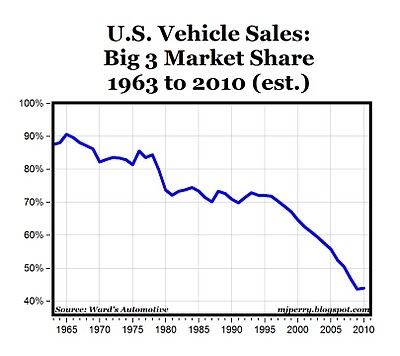
Tesla is doing great, and its workforce is not unionized.
>>You say that "those working for the media are all unionized" but I have no idea what you're talking about. Citation?
Look at the New York Times:
https://www.nyguild.org/about-the-new-york-times
Or the Washington Post:
Or any other major news organization.
>Unionization does not cure bad management, it merely makes sure that the employees are treated fairly, regardless of the quality of management.
It reduces managerial discretion. It makes it so that the labor market is not free. It makes unionized workers into a privileged set of insiders who do not compete on an level playing field with other workers. It also reduces the range of options available to investors/entrepreneurs, in inhibiting their contract liberty. Reducing optionality in voluntary interaction is going to be an economic net negative.
>>Remember: the reason people have jobs is to feed their families, not to support the company.
The reason people invest in companies, or buy from a company, is to personally profit, not to provide people with jobs. Once you force the private sector to act like a charity, you are introducing top-down control and limiting the free market that is so effective at coordinating large numbers of people to better meet their collective needs.
responding to below:
chmod775:
>>Worker's unions are compatible with free markets as much as corporate groups or large companies are.
Yes, that is true. I meant under the current laws, where a union can force their employer to negotiate exclusively with them. This is mandated collective bargaining, as opposed to mutually voluntary collective bargaining.
>>Except that a most of the competition that leapfrogged them has famously strong unions.
Besides the unionized German auto sector, I don't know what you're referring to. Some of my examples, like the US passenger rail service which went bankrupt soon after the unions took over, or the public sector, had/have no foreign competition.
With respect to Germany, it should be noted that Germany's wage/GDP growth has been quite stagnant since the 1970s as well. Its auto industry has been successful, but that can be attributed to numerous other factors, like its effective education system, its engineering culture, and government policy focused on promoting auto manufacturing, all of which can counter-act the negative effects of its unions.
Also it should be noted that the relationship between unions and employers in Germany is more cooperative that in the US.
jakelazaroff:
>>Unions increase the negotiating power of those selling their labor. That’s not forcing the private sector to act like a charity, it’s just giving workers more leverage.
They increase that negotiating power by preventing the employer from negotiating with the larger labor pool. It is a zero sum gain that enables unionized workers to extract economic rent.
danShumway:
>>Alabama is a right-to-work state, so how is a union inhibiting contract liberty? You legally cannot be forced in Alabama to pay union dues if you don't want to be part of a union.
Federal labor laws, that force employers to collectively bargain if a union demands it, still apply in Alabama. But yes, right to work has gone some way in restoring contract liberty, and has been a lifeline for the US auto industry, and US manufacturing in general.
The Biden administration is planning to get rid of right to work:
https://www.forbes.com/sites/patrickgleason/2020/10/21/biden...
> Tesla is doing great, and its workforce is not unionized.
>>By what definition? There have been multiple articles and accounts describing Tesla's factories as awful places to work, and its management tried to pressure its workers to ignore COVID restrictions.
We're talking about the strength of industry here. By that standard, Tesla is doing great.
As for labor conditions, the massive export revenue that Tesla is bringing into the US will help US workers overall. I recommend looking at the big picture. There's no sense mandating that all jobs provide great working conditions if it leads to stagnation of US industry, and a lack of profitable employers that pay high wages.
monsiousbanana:
>>I can't believe you're saying that with a straight face, talking about Jeff Bezzos' company, after covid and 2020.
I don't know if you realize how much Amazon helped people during the lockdowns.. Cost-effective and timely home delivery of consumer goods was an absolute lifesaver, literally.
Amazon is also a massive employer. Without all those jobs that Amazon's export revenue creates in the US, the US worker would be much worse off.
olliej:
>>Such rent as sick leave, holidays, weekends, basic health insurance (US), ...? That rent?
The benefits that employers provide should be based on market demand, not mandated by cookie cutter rules. What if an employee prefers higher wages over health insurance? Cookie cutter mandatory benefits prevent that arrangement. They prevent optimal trade-offs, that would be found if benefits were the product of mutually voluntary interaction, from being found.
It's not economically sound policy. An economy is far far too complex and fast-evolving to regiment in this top-down way.
Re: Amazon's anti-union site for its Alabama warehouse
#20Amazon warehouses are one of the few reasons, I think we can all agree, that a union has a place. There is the argument to be made that if someone doesn't like the job, go elsewhere, it's the free market. True, but I see a lot of these fulfillment centers in small towns. They become a major employer, sometimes eclipsing even the local Walmart. It's a place where jobs are hard to come by, so maybe Amazon offers something the desperate, the poor, and the struggling something they can't get elsewhere. I don't have an answer for it, but shifting a little power away from the corporate monolith and to the citizens of the community it inhabits, sounds like a good idea.