Live data from Hacker News

Education and Men without Work

nationalaffairs.com

11–20 of 342 posts

Re: Education and Men without Work

#11

> but they nevertheless suggest that changes in family structure had a powerful and adverse impact on male work rates and labor-force participation rates... This article seems to assume that changes in family structures are a cause of men not working. I see no mention that it could actually be an effect of that. Who's gonna want to marry (let alone have kids with) a man who is unemployed and isn't even looking for wo…

>Needless to say, the relationship between family structure and prime-age male labor-force participation is complex, with causation arrows pointing both ways. Yet on balance, the net effect of such changes appears to have been a withdrawal of male labor from the workforce — a "supply-side effect," and a major one.

[deleted]

Re: Education and Men without Work

#12

> but they nevertheless suggest that changes in family structure had a powerful and adverse impact on male work rates and labor-force participation rates... This article seems to assume that changes in family structures are a cause of men not working. I see no mention that it could actually be an effect of that. Who's gonna want to marry (let alone have kids with) a man who is unemployed and isn't even looking for wo…

Who's gonna want to marry (let alone have kids with) a man who is unemployed and isn't even looking for work?

This betrays your unfamiliarity with the segment of population under question. As it turns out, lots of women will readily have kids with those men. Along with the growth of single-man household, we observe growth of single never married women with children.

See for example "Promises I Can Keep" (https://www.amazon.com/Promises-Can-Keep-Motherhood-Marriage...) and "Doing the Best I Can" (https://www.amazon.com/Doing-Best-Can-Fatherhood-Inner/dp/05...) for some sociological view of realities about the lives of people this discussion revolves around.

Re: Education and Men without Work

#13
> Among economists and policy analysts who have examined these unsettling trends, the general consensus is that declining male workforce participation in modern America is mainly a structural, demand-driven problem — a matter of evaporating local jobs, and especially jobs requiring limited skills, in an increasingly dynamic and globalized marketplace.

Basically these are the men would have traditionally "built stuff"; factory workers, etc.

We don't have any factories anymore.

>If this assessment is more or less correct, it would be hard to overstate the importance of education and training as instruments for addressing our "men without work" crisis.

How would that help? We don't have jobs for them. And the few that maybe could find work, well, those jobs will soon enough be automated away.

> Third, there is America's curiously poor prime-age male labor-force participation-rate performance in comparison with other affluent never-communist democracies. Between 1965 and 2015, U.S. levels fell faster and sank lower than in any comparable country, with the exception of Italy (where official employment figures notoriously neglect "unofficial" work income). Yet America's race to the bottom in prime-age male labor-force participation is not readily explained by lackluster economic growth (which could also be called sluggish demand).

In America (USA) you ARE your job; it defines you. The American Way is to be hard working and self sufficient. If you can't do that, there are tremendous psychological effects. You can't blame these men for giving up.

We need to accept that this is the way forward and stop treating people who don't work like leaches. We need to retrain society that there will be plenty of able bodied people without work and society will need to take care of them.
Re: Education and Men without Work

#15
post #3

>”The fall in participation for prime-age men has largely been concentrated among those with a high school degree or less... …” What would a high school diploma or 2 year college give them that would enable them to get higher skilled jobs? I’d be inclined to think that rather than needing “GE” (general Ed) they need vocational type trading that focuses on making them skilled in a particular area (no, not coding). Tha…

“What would a high school diploma or 2 year college give them that would enable them to get higher skilled jobs?” When I look at programming jobs you pretty much need a college degree to even get a company to talk to you. I wouldn’t be too surprised if there were other jobs where having 2 years of college or a high school degree is required to be even considered. There may be exceptions but in general there is a tren…

There’s the employer expectations, but I would also bring up access to capital for launching entrepreneurial endeavors - for this category of guys and people in general. We need to target how we can encourage more small business.

Re: Education and Men without Work

#16
post #6
post #3

>”The fall in participation for prime-age men has largely been concentrated among those with a high school degree or less... …” What would a high school diploma or 2 year college give them that would enable them to get higher skilled jobs? I’d be inclined to think that rather than needing “GE” (general Ed) they need vocational type trading that focuses on making them skilled in a particular area (no, not coding). Tha…

It's not that it provides any particular skills, but rather that it acts as an indicator that someone can take direction and instruction. If an employer has 100 applicants, half of which have a high school degree or less, then they're just going to toss those applications and interview the other half simply as a matter of cost/time savings and risk reduction.

> If an employer has 100 applicants, half of which have a high school degree or less, then they're just going to toss those applications and interview the other half simply as a matter of cost/time savings and risk reduction.

If this was as simple, the high school dropouts would just lie about not graduating from high school. It's not like the employer would ever find out about that.

Re: Education and Men without Work

#17

As unpopular it may be to say such a politically incorrect thing (admitting this is a generalization, and all the caveats that come with it) -- Men generally have the biological need to go do and wander and discover things. I don't know whether it's hormones or what. Debate all you like elsewhere (I'm not trying to debate that point here). My point is that when they don't get an outlet to do this, they cause trouble.…

It's not obvious to me that your assessment is even close to accurate, so it would help to know more about which countries you've observed and also where can we find data on this topic.

My observation would be more like: there are less regulated and less bountiful countries, and there are more regulated and more bountiful countries, but I don't know of less regulated more bountiful countries.

Re: Education and Men without Work

#18

As unpopular it may be to say such a politically incorrect thing (admitting this is a generalization, and all the caveats that come with it) -- Men generally have the biological need to go do and wander and discover things. I don't know whether it's hormones or what. Debate all you like elsewhere (I'm not trying to debate that point here). My point is that when they don't get an outlet to do this, they cause trouble.…

> Men generally have the biological need to go do and wander and discover things. I don't know whether it's hormones or what. Debate all you like elsewhere (I'm not trying to debate that point here).

What an obnoxious thing to do. You know you're stating a controversial opinion, or you wouldn't have said that. You don't get to set the rules of conversation like that.

Re: Education and Men without Work

#19
post #14

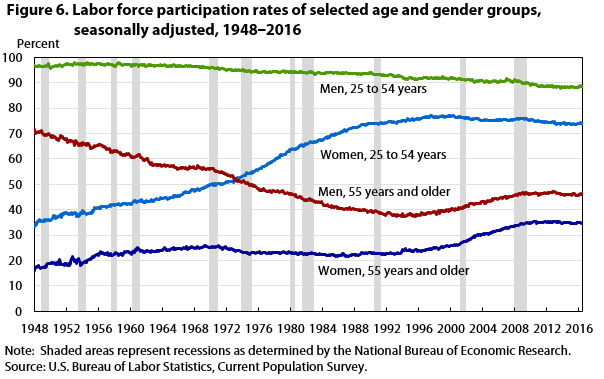
This story really needs another graph showing "NOT-IN-LABOR FORCE RATES FOR WOMEN AGES 25-54; 1965 TO 2019". See https://www.bls.gov/opub/mlr/2016/images/hipple-fig6.png It appears that the non-participation rate for women is about twice as high as for men.

What does this have to do with men?

Re: Education and Men without Work

#20

The article is long on detail and short on suggestions (which is understandable). However, the suggestions it does make are not obviously going to work. The men illustrated in the article do not seem incapable of work, but rather disinterested. Vocational training isn't going to fix the fact that the government benefits the article cited allows the men to stay at home playing video games all day. Most people (but esp…

> the fact that the government benefits the article cited allows the men to stay at home playing video games all day

Is that actually the case?

The article takes issue with the narrative that supply and demand are involved ... but I don't think this article proves this idea that folks are enjoying government benefits and that results in them not working. The article certainly mentions it, but is pretty short on evidence.

Plenty of US states have been cutting benefits, and they're not seeing people go back to work.

Post reply on HN