Another article from the same author on how to be a Dangerous Professional: https://www.kalzumeus.com/2017/09/09/identity-theft-credit-r... (HN discussion: https://news.ycombinator.com/item?id=15206926 )
> “But I’m not a shareholder!” A surprising amount of Americans are shareholders in large financial institutions. Do you have an IRA? Does it invest in e.g. mutual funds? If you own a mutual fund or index fund, you are highly likely to beneficially own fractional shares of US financial institutions. Someone who owns 0.01 shares is a shareholder; welcome to the magic of capitalism. I like this guy. He has great insigh…
Shibboleths that get you past the initial script stage
11–20 of 246 posts
Re: Shibboleths that get you past the initial script stage
#12This is (hopefully not) obnoxiously off-topic... As a Hebrew speaker, I wish the "shibboleth" idiom (which is a good one) was translated, rather than transliterated. laoned idioms are inherently exotic, and this one is worth demystifying It means any choice of word (or pronunciation, in the literal example) that clearly identifies the speaker's group affiliations. A good modern example is "LondonDerry/Derry. This'd b…
- Streichholzschächtelchen (match box – diminutive): https://commons.wikimedia.org/wiki/File:De-Streichholzsch%C3...
- Austrians use a lot of different words, my favorite being Jänner and not Januar for the month January
- Swiss German: Chuchichäschtli (small kitchen cup board) which is hard to pronounce, apparently Arab, Dutch and Hebrew speakers are at an advantage here.: https://commons.wikimedia.org/wiki/File:Chuchichaeschtli.ogg
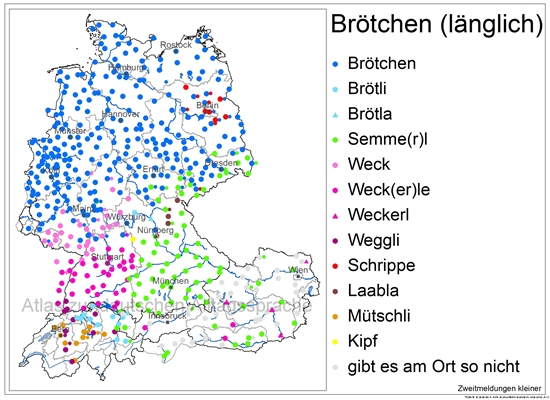
- Another fun thing, different words for bread rolls depending where you are from: http://www.atlas-alltagssprache.de/wp-content/uploads/2012/1...
Re: Shibboleths that get you past the initial script stage
#13Earlier quoted context omitted.
> “But I’m not a shareholder!” A surprising amount of Americans are shareholders in large financial institutions. Do you have an IRA? Does it invest in e.g. mutual funds? If you own a mutual fund or index fund, you are highly likely to beneficially own fractional shares of US financial institutions. Someone who owns 0.01 shares is a shareholder; welcome to the magic of capitalism. I like this guy. He has great insigh…
It seems wrong though - I am not an American, but if you e.g. own shares in an ETF (or mutual fund), you just own shares in the ETF while they own the shares in the underlying assets. I am not even sure if there's a legal definition of shareholder, but assuming that there is, I suspect this doesn't cut it and you are simply a stakeholder instead. Feel free to link to relevant materials, if that's not the case.
In fact every public US stock is owned first by Cede and Company. Any public stock you own is a contract with them (via intermediaries). https://en.wikipedia.org/wiki/Cede_and_Company
Re: Shibboleths that get you past the initial script stage
#14Earlier quoted context omitted.
> “But I’m not a shareholder!” A surprising amount of Americans are shareholders in large financial institutions. Do you have an IRA? Does it invest in e.g. mutual funds? If you own a mutual fund or index fund, you are highly likely to beneficially own fractional shares of US financial institutions. Someone who owns 0.01 shares is a shareholder; welcome to the magic of capitalism. I like this guy. He has great insigh…
It seems wrong though - I am not an American, but if you e.g. own shares in an ETF (or mutual fund), you just own shares in the ETF while they own the shares in the underlying assets. I am not even sure if there's a legal definition of shareholder, but assuming that there is, I suspect this doesn't cut it and you are simply a stakeholder instead. Feel free to link to relevant materials, if that's not the case.
Re: Shibboleths that get you past the initial script stage
#15This is (hopefully not) obnoxiously off-topic... As a Hebrew speaker, I wish the "shibboleth" idiom (which is a good one) was translated, rather than transliterated. laoned idioms are inherently exotic, and this one is worth demystifying It means any choice of word (or pronunciation, in the literal example) that clearly identifies the speaker's group affiliations. A good modern example is "LondonDerry/Derry. This'd b…
Yes. I am a native German speaker, and apart from grammar (people usually have a bit of trouble with cases, articles and particles) there are a few nice words to trip people up: - Streichholzschächtelchen (match box – diminutive): https://commons.wikimedia.org/wiki/File:De-Streichholzsch%C3... - Austrians use a lot of different words, my favorite being Jänner and not Januar for the month January - Swiss German: Chuch…
Hebrew is well adapted to dealing with words made mostly made from subtle variations of s, sh & t sounds... Which brings us full circle to shibboleth/שיבולת
Re: Shibboleths that get you past the initial script stage
#16Find the accounting department at work and make as many friends as possible. These people see the "numbers" (and that is the heart of any business). They can get your checks expedited (reimbursement or for vendors). They can tell you when a lay off is coming, or when the company blew out the numbers. Most of them keep booze at their desks. All of this will come at the price of coffee and doughnuts/pastries/baglels at…
Re: Shibboleths that get you past the initial script stage
#17Re: Shibboleths that get you past the initial script stage
#18Earlier quoted context omitted.
It seems wrong though - I am not an American, but if you e.g. own shares in an ETF (or mutual fund), you just own shares in the ETF while they own the shares in the underlying assets. I am not even sure if there's a legal definition of shareholder, but assuming that there is, I suspect this doesn't cut it and you are simply a stakeholder instead. Feel free to link to relevant materials, if that's not the case.
Legally, people make distinctions between different kinds of ownership. So you can be the "beneficial owner" without being the "registed owner". In fact every public US stock is owned first by Cede and Company. Any public stock you own is a contract with them (via intermediaries). https://en.wikipedia.org/wiki/Cede_and_Company
>So you can be the "beneficial owner" without being the "registed owner".
Are you the 'beneficial owner' of an ETF's invested assets or just of the ETF instead?
Re: Shibboleths that get you past the initial script stage
#19Re: Shibboleths that get you past the initial script stage
#20This is (hopefully not) obnoxiously off-topic... As a Hebrew speaker, I wish the "shibboleth" idiom (which is a good one) was translated, rather than transliterated. laoned idioms are inherently exotic, and this one is worth demystifying It means any choice of word (or pronunciation, in the literal example) that clearly identifies the speaker's group affiliations. A good modern example is "LondonDerry/Derry. This'd b…