Live data from Hacker News

Deficit Reduction

avc.com

11–20 of 44 posts

Re: Deficit Reduction

#11
post #8
post #3

He is wrong on the second count, nyt had an info thing some time ago where you could come up with a plan to balance the federal budget. It was easy to do without raising taxes.

It might be easy to do in a spreadsheet, but that doesn't mean it's easy to do in a politically realistic way.

[deleted]

Re: Deficit Reduction

#12
Yes, the issues deficit hawks are raising are worth addressing in and out of themselves. But not because of deficits they generate!

What majority fails to understand and minority who understands it is too afraid to acknowledge is that for countries like US or Japan with independent monetary policy deficits truly don't matter. It's just another variable central bank deals with when executing monetary policy algorithm.

US public debt seems unsustainable to you? Go check Japan's debt (in reality it is japanese people savings)!

Japan's real problem is aging population, not its' World record public debt.

P.S. some good reading on WHY deficits don't matter:

http://voices.washingtonpost.com/ezra-klein/2010/05/galbrait...

Re: Deficit Reduction

#13
This is a terrible article. The heart of the projected deficit is increased medical spending -- if you don't deal with that, nothing else matters much, and vice-versa. Social Security is projected to be in balance for decades, then modestly out of balance for some time -- there is no rush to adjust it, and when we do the adjustment will not have to be dramatic, because although the expenditures are huge, so is the dedicated revenue stream. Finally, the "bipartisan" commission was bipartisan between rich centrist Democrats and conservative Republicans, and it foisted a deficit-increasing preference for reducing taxes on rich people into its report.

Fred Wilson, Paul Graham, Bill Gates, Larry Page, etc. ... these people are extraordinarily rich, in important ways the richest people the world has ever seen. Their perspective and interests do not and should not stand for the tech community, let alone the country or the world. The HN community could stand to be a little more skeptical of their pronouncements, and a little less slavish about enforcing the existing status hierarchy which upvotes every blog post they see fit to publish.
Re: Deficit Reduction

#14
post #5

Military and "defense" costs far more than "just" $1 trillion every year. There are many many hidden costs and the massive expenses for the thousands of severely wounded soldiers from Iraq and Afghanistan that survived instead of dying because of modern medical technology. http://en.wikipedia.org/wiki/Military_budget_of_the_United_S... This does not include many military-related items that are outside of the Defense…

I think this site includes many of the hidden costs. Clicking the "Defense" dropdown, you can see many of the categories of spending you mentioned (e.g. 90B on veterans, 18B on "Atomic energy defense activities").

http://usgovernmentspending.com/year2009_US.html

It's a nice site for budget issues, among other things it doesn't go the lazy route and look at federal spending only.

(Interesting fact the site reveals: including state/local budgets, education is the #2 expense in the US. The military is #4.)

Re: Deficit Reduction

#15
post #7

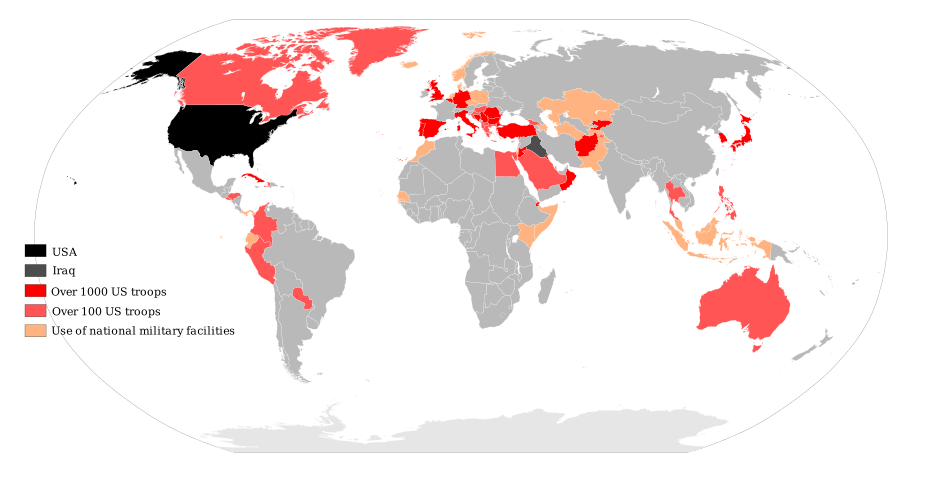
I can't read the comments for this article. It makes my brain hurt. Everything from 9/11 being an inside job to increase the national security net to the concept that the USA exists as a totalitarian empire.

I live in China, which I wouldn't even call totalitarian but rather authoritarian (http://en.wikipedia.org/wiki/Totalitarianism#Difference_betw...), so I can't find much sympathy for the 'totalitarian' part.

But I think a decent knowledge of history would reveal that the US functions in many ways that are similar to how historical empires functioned.

http://upload.wikimedia.org/wikipedia/commons/f/ff/US_milita...

I wouldn't go so far as to say that we still have many colonies, but a huge amount of spheres of influence across the planet? Yes.

When we are studied 500 years in the future, I suspect the US' historical role during this past century or so will be likened to the role of Britain at the peak of the British empire.

Re: Deficit Reduction

#16

Fixing Social Security - it's always up for discussion and nothing ever gets done about it. The frustrating part is that the solution is somewhat simple, but politically it's untouchable. Here's my quick & simple solution for the problem: 1) Phase out Social Security benefits if your income level hits $50k that year. - This aspect of Social Security is perhaps most baffling - why does someone who is making $250k a ye…

1.) FYI - Your car insurance analogy falls apart in aggregate because some people do use it, but the element of luck is what you can't account for, so we use risk tables. There's no refund for you because other people got unlucky - you're paying for them to absorb your risk. Social Security isn't insurance - it's a progressive tax for the purpose of generating a small pention for everyone.

Re: Deficit Reduction

#17

This is a terrible article. The heart of the projected deficit is increased medical spending -- if you don't deal with that, nothing else matters much, and vice-versa. Social Security is projected to be in balance for decades, then modestly out of balance for some time -- there is no rush to adjust it, and when we do the adjustment will not have to be dramatic, because although the expenditures are huge, so is the de…

Very true, but he includes Medicare / Caid under SS.

Re: Deficit Reduction

#18

Fixing Social Security - it's always up for discussion and nothing ever gets done about it. The frustrating part is that the solution is somewhat simple, but politically it's untouchable. Here's my quick & simple solution for the problem: 1) Phase out Social Security benefits if your income level hits $50k that year. - This aspect of Social Security is perhaps most baffling - why does someone who is making $250k a ye…

[deleted]

Re: Deficit Reduction

#19
To a large extent, the focus on Social Security budget shortfalls in these pieces is like the punchline in the joke about why the drunk guy is looking under the lamp post for his keys when he lost them in the alley: "Because the light is better here." Rising Medicare/Medicaid costs are a much bigger long-term budget issue than Social Security, but coming up with realistic-sounding proposals to improve Social Security's fiscal status is relatively easy (and less politically radioactive) compared to controlling medical costs.

Still, I think that blog post really drops the ball by not even mentioning Medicare/Medicaid as budget problems.

Re: Deficit Reduction

#20

Fixing Social Security - it's always up for discussion and nothing ever gets done about it. The frustrating part is that the solution is somewhat simple, but politically it's untouchable. Here's my quick & simple solution for the problem: 1) Phase out Social Security benefits if your income level hits $50k that year. - This aspect of Social Security is perhaps most baffling - why does someone who is making $250k a ye…

I absolutely hate #2, however I would go along with it happily if #1 and #3 were implemented.

These are 3 really solid suggestions, that would in fact save social security. However, I think #2 is the only one thats going to happen, and its the worst one.

Post reply on HN